


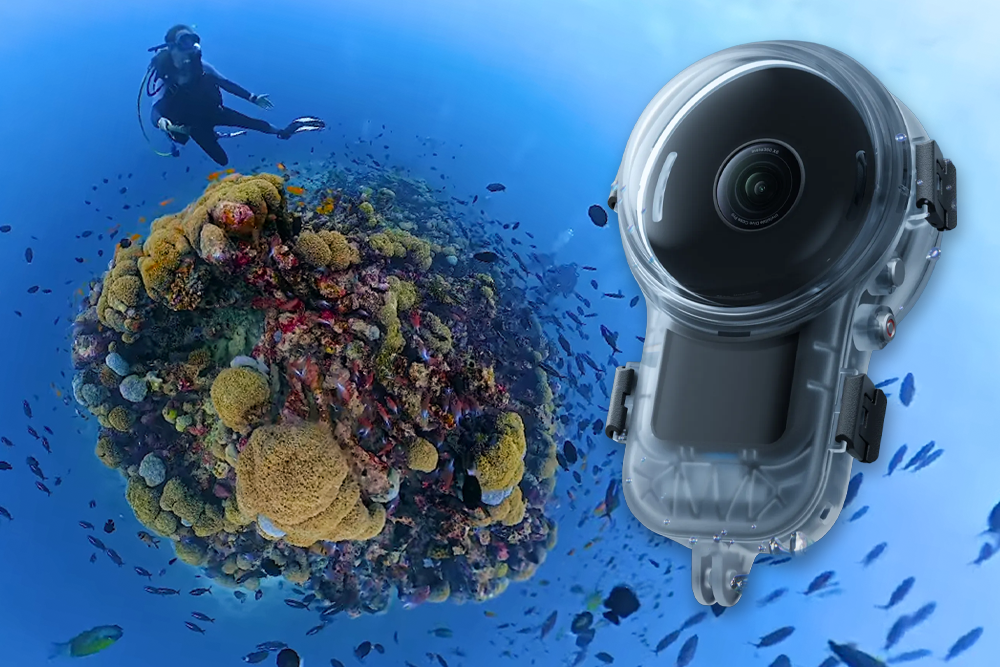
Award-winning underwater photographer Jenny Stock reviews Insta360’s new flagship 360 action camera – the Insta360 X6
Review by Jenny Stock; additional reporting by Mark ‘Crowley’ Russell
Insta360’s 360-degree action cameras have been a game-changer for content creators, and the new Insta360 X6, launched earlier this year, has built on the success of its X5 and X4 predecessors with bigger sensors, faster 8K recording, longer battery life, a much smaller overall profile and a redesigned dive housing.
As an underwater photographer, I’m always interested in technology that opens up new creative possibilities. But changing light levels, fading colours and the practicalities of operating a camera underwater can make filming feel like a distraction from enjoying the experience.
The Insta360 X6 records the scene in every direction, allowing you to choose your preferred viewpoint during editing. You can concentrate on the reef ahead, without looking at a screen, knowing that the camera will be recording any animal that approaches from behind.
Including yourself in the frame creates a third-person feel, giving viewers the perspective of an observer following you through the water. For social-media creators this is gold dust, and I was keen to discover what the latest model would bring to my kit on a trip to the Maldives.
Out of the box
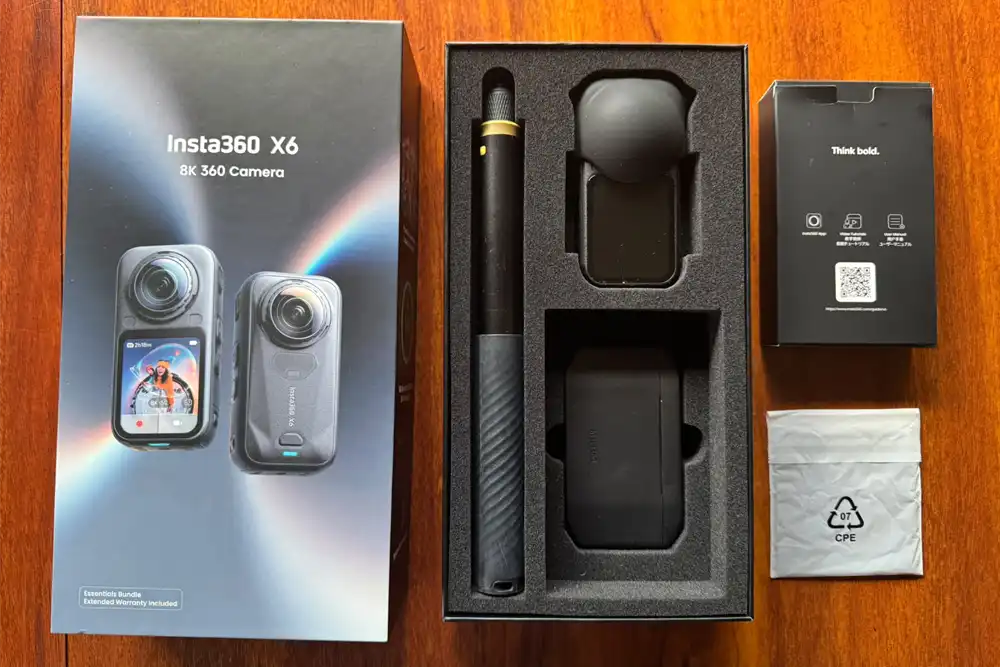
Straight out of the box the Insta360 X6 feels different, and there are some excellent physical improvements over earlier models.
DIVE was sent the Essentials Bundle (£709), which adds a 114cm Invisible Selfie Stick, Lens Cap, a smaller, lighter dual-battery Fast Charge Case and a second Xtreme Battery to the Standard Bundle (£619), together with the optional Invisible Dive Case Pro (£158.99).
The Invisible Dive Bundle (£828) includes the housing and underwater lenses, but comes with only one battery and does not include the charging case.
The X6 is noticeably shorter in length and a little wider than the X5, and its 2.32-inch OLED screen is a step up from the 2.5-inch LCD of its predecessors.
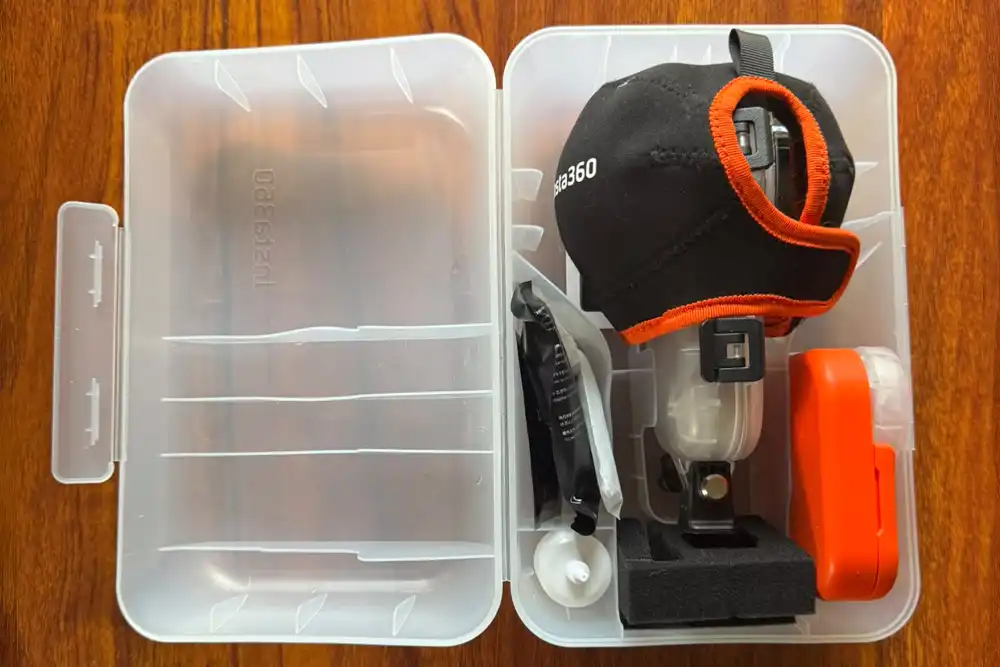
The new Invisible Dive Case Pro is of a comparable size to the standard dive case available for previous models but it’s essentially a more compact version of the oversized (and quite heavy) Dive Case Pro launched for the X5, and a much better product than both.
The combined weight of the camera, underwater housing and Invisible Selfie Stick is just 624g, making it as eminently portable as other models, and the Invisible Dive Case Pro comes with a new box to keep all the necessary components safe in a diving environment.
Kitting up with the Insta360 X6
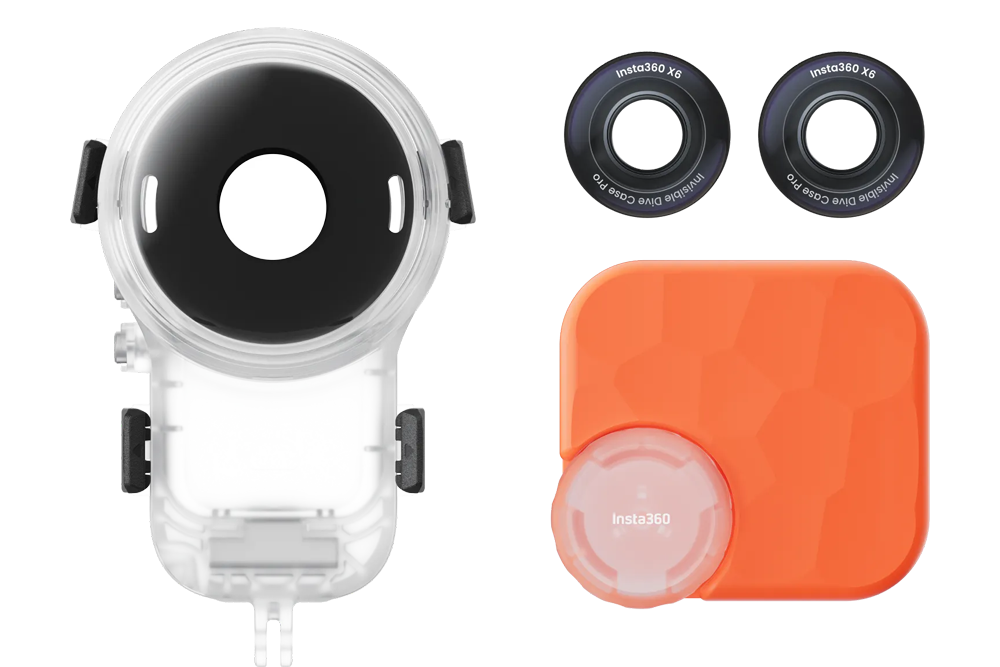
With my dive kit prepped, I began assembling the X6 for its first underwater outing. The housing and camera must be dry before assembly to minimise fogging, and unlike its predecessors, the X6 requires you swap its standard lenses for a pair of dedicated underwater lenses before fitting the housing, which helps to minimise distortion and stitching artefacts.
The removable lenses come neatly packaged in a bright orange case, complete with a suction-cup tool that allows you to handle them without touching the glass, helping to minimise fingerprints and dust.
Care must be taken, however, as my first lens change didn’t go entirely to plan. Despite working over a soft surface, I managed to drop one of the lenses and chip it, although thankfully, the damage was purely cosmetic and had no impact on the resulting images.
The camera itself is rated to 20m, up from 15m for the X5 and 10m for the X4, while the X6’s acrylic housing is rated to 60m. I’d recommend using the housing whenever you take the camera underwater, even at shallow depths.
Accidents happen and it provides extra protection for your expensive piece of kit. After use, rinse thoroughly in fresh water.
Underwater with the Insta360 X6
The X6 automatically activates Dive Mode when installed in the housing, so after checking the system in the rinse tank, I descended at Lankan Manta Point in the Maldives, hoping to see some of the majestic rays.
The giants appeared within seconds, leaving me little time to familiarise myself with the controls. Fortunately, there aren’t many buttons to contend with, so I had the camera recording in plenty of time to capture the big beasts.
My closest manta pass came at a depth of around 21m, which in the sometimes overcast tropical skies of the Maldives makes natural light less than ideal for underwater imaging.
Back on the boat, however, I was blown away by the results – the picture quality at depth was incredible.
This is in large part thanks to the updated sensor of the X6, which combines two custom Sony 1/1.1-inch square sensors with an upgraded triple-AI-chip processing system designed to enhance low-light performance, but it is superbly aided by Insta360’s PureVideo mode, first introduced with the X5 and refined for the X6.
The X6 also introduces 10-bit colour and 360-degree light metering across most of its shooting modes. Together, these features are designed to produce smoother exposure transitions and more consistent colour reproduction to overcome the familiar blue-green cast associated with underwater footage.
Insta360’s approach aims to improve colour consistency straight out of the camera, reducing the amount of correction needed in post-production.
I put the theory to the test on a particularly fishy dive at Bathala Reef, and the footage I recorded showed orange anthias, red longspine squirrelfish and colourful coral veritably popping against the beautiful blue of the ocean.
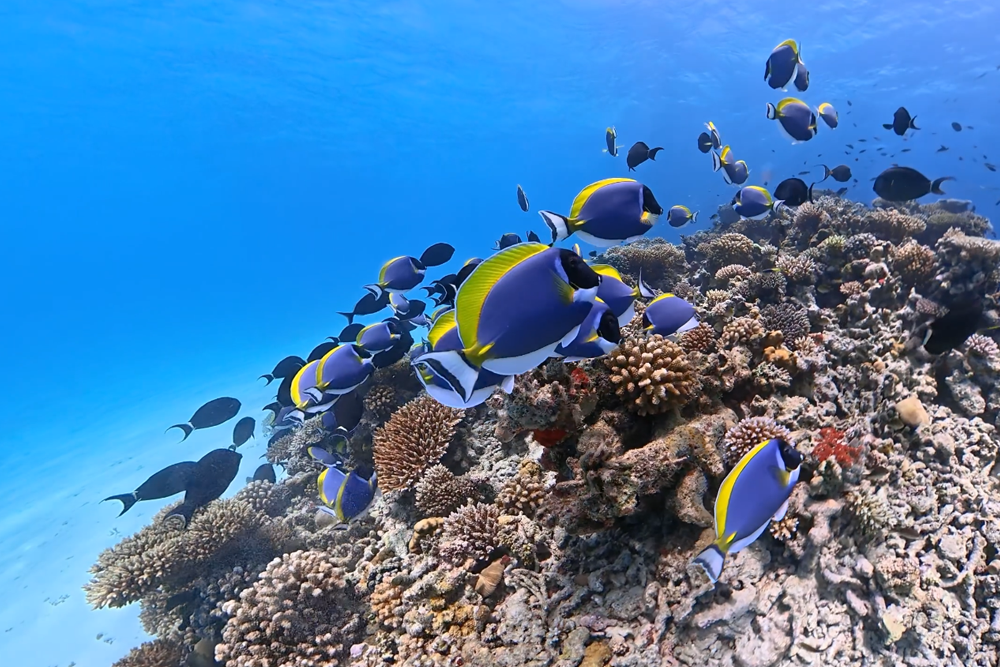
But if any correction is needed in post-production, I found myself leaning towards the second built-in AquaVision filter at 30 per cent when using the dedicated free editing Insta360 Studio software.
I do want to note that it’s worth keeping expectations realistic. The stitching of two lenses isn’t always perfect, and no camera can completely overcome the loss of natural light and colour underwater – results will always depend on depth, visibility, available light and the surrounding environment.
Modes and features
In 360-degree mode, the X6 supports recording at up to 8K at 50 frames per second, and also captures 120-megapixel 360-degree still photographs.
For conventional wide-angle recording, it supports video at up to 5K and 60 frames per second, while additional high-frame-rate modes offer plenty of opportunities for stylistic slow-motion and ‘Bullet Time’ footage.
Underwater, the aforementioned PureVideo and AquaVision are the most essential for underwater footage – frame rate and resolution are not quite as important for scuba diving as they are in the fast-paced world of more extreme sports, but making the best use of available light is what’s going to make those underwater shots pop.
Insta360’s major selling point for the X series cameras is the ability to ‘shoot first, point later’, by capturing everything and allowing the videographer to select their angles afterwards.
There is an InstaFrame feature, designed to simplify filming of yourself or your dive buddy by producing conventionally framed footage without the need to manually select the angle afterwards – essentially functioning as a gimbal camera but without the extra moving parts.
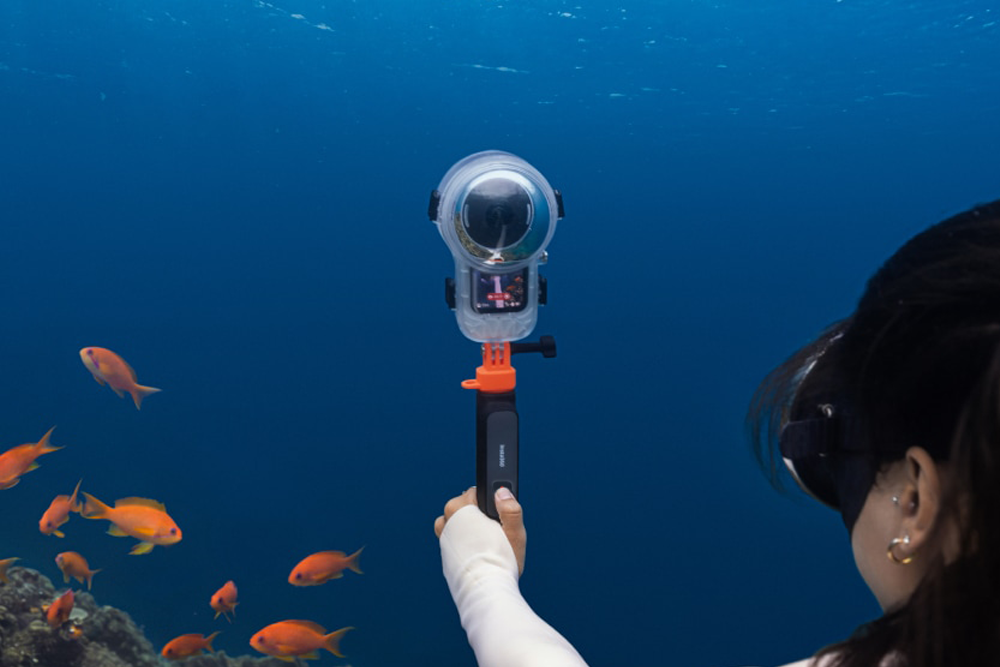
Personally, however, and so as not to miss any action, I prefer to always shoot in 360 and use the editing software’s ‘smart tracking’ to keep a moving subject within the frame.
Of course, recording the entirety of your surroundings doesn’t guarantee a great shot. Positioning still matters and the 114cm-long Invisible Selfie Stick is essential for creating more intimate close-ups.
While this particular disappearing accessory has been well documented, Insta360 has also launched a version with a remote control built into the handle, rated to 60m and a useful optional extra that removes the need to keep extending and shortening the pole to stop and start recordings.
In terms of battery life – the longer usage was very useful – Insta360 rates the 2,600mAh battery up to 140 minutes of continuous 8K/30fps recording (compared to 93 minutes for the X5).
I only took one of the two I received with me to the Maldives and I didn’t run out of juice on a single occasion.
The X6 also adds 47GB of usable built-in storage, a great backup if you forget your memory card, although high-resolution footage can quickly consume the available space.
Editing and post-processing
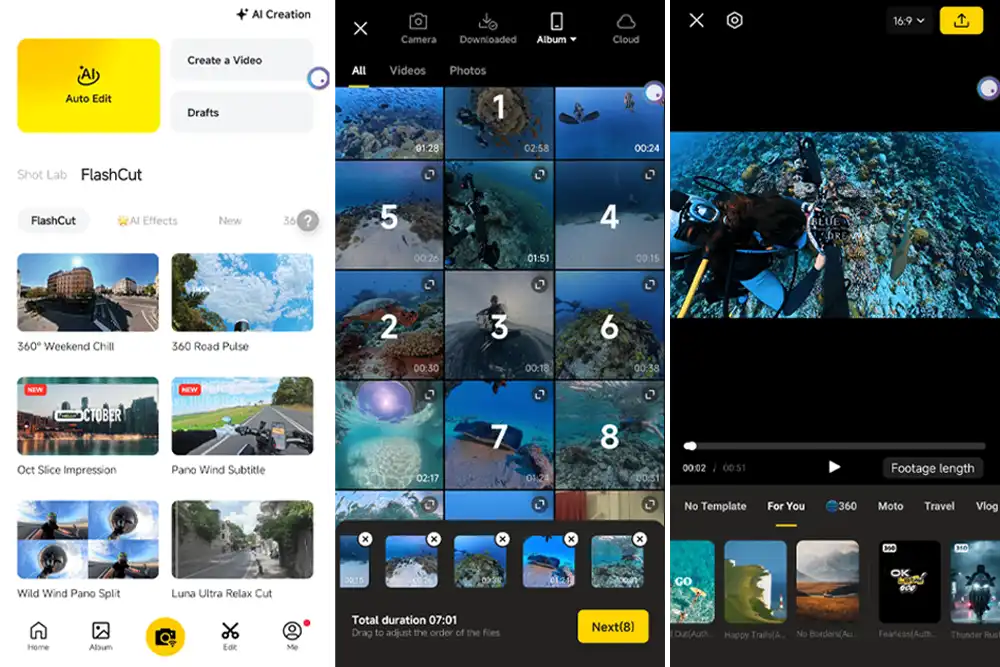
For many divers, filming is the fun part; editing is where the hard work begins. Every 360-degree recording contains multiple possible compositions, and choosing between them can produce decision paralysis.
Insta360 cameras come with two editing tools, the Insta360 Studio for desktops and the Insta360 App for smart devices. The app has a built-in AI-assisted auto-editing feature which removes much of that decision-making process – you select which recordings you want to use and it will produce a complete video with smooth transitions and additional effects.
All you need to do is select a template and some music from the inbuilt library and even underwater enthusiasts with little to no knowledge of underwater imaging can create an almost perfect, Instagram-ready video.
The newer AI Director analyses footage and produces a daily vlog while the camera charges, with the finished video available through the mobile app with even less direct user involvement.
For the average social media post, much of the AI-generated content is nigh on perfect, but I found there are limitations. I often found the AI editor focused more on framing me, rather than what I was objectively trying to record.
Selfie-shots are understandable if you’re trying to capture yourself on a fast-moving motorcycle, snowboarding or surfing but scuba divers are much more focused on the environment rather than themselves. Well, most of us are, anyway!
Personally, I prefer to retain creative control. I found the AI editing interesting to experiment with, but the shots it selected weren’t always my favourites from the dive.
Automated editing won’t necessarily recognise the significance of a rare marine life encounter or the precise moment when an animal’s behaviour makes a sequence compelling, but the manual editing tools (the desktop editing suite does not have automated editing capacity) are powerful and – once you’ve mastered the art of keyframes – fairly simple to use.
After a shallow-water snorkel with a particularly friendly turtle, I found manipulating shots and exporting data a cinch. It was up online before my hair had dried.
Insta360 X6 overall thoughts
The Insta360 X6 honestly feels a bit like the X4 and X5, brilliant though they are in their own right, were developmental stepping stones to this extremely well-rounded action camera. Even the box it comes packaged in looks better than previous versions.
It goes without saying that for a professional photographer, the X6 won’t replace my dedicated DSLR-based underwater photography system for detailed macro shots, carefully lit wildlife portraits or magazine-quality images.
For divers who want to relive their adventures and bring viewers along for the ride without having to worry about precise composition and endless editing, the Insta360 X6 is perfect – and let’s not forget that scuba diving is only one of its many applications.
Away from the water, its 360-degree recording, wide-angle modes and stabilisation features make it well suited to activities such as motorcycling and biking, skiing and surfing.
Together these features make the X6 an appealing option for anyone who wants a single compact camera for documenting an entire adventure, from the journey to the dive and everything in between.
For content creators looking to stand out from the crowd, the X series of cameras has been offering that for some time. The X6 will make them stand out a bit further – and may well have usurped its main competitor for the title of ‘Vlog King’.
MSRP Insta 360 X6
Standard Bundle: £619
Essentials Bundle: £709
Invisible Dive Case Pro: £158.99
Invisible Dive Bundle: £828
www.insta360.com
More from Jenny
- Bermuda Retriangulation – diving the shipwreck capital of the Atlantic
- Jenny Stock’s guide to getting creative with your underwater photography
- Making a splash – a judge’s eye view from Dive Dauin
- Review – Suunto Tank POD wireless transmitter
- Artificial Intelligence in underwater photography – a force for good, or evil?

