


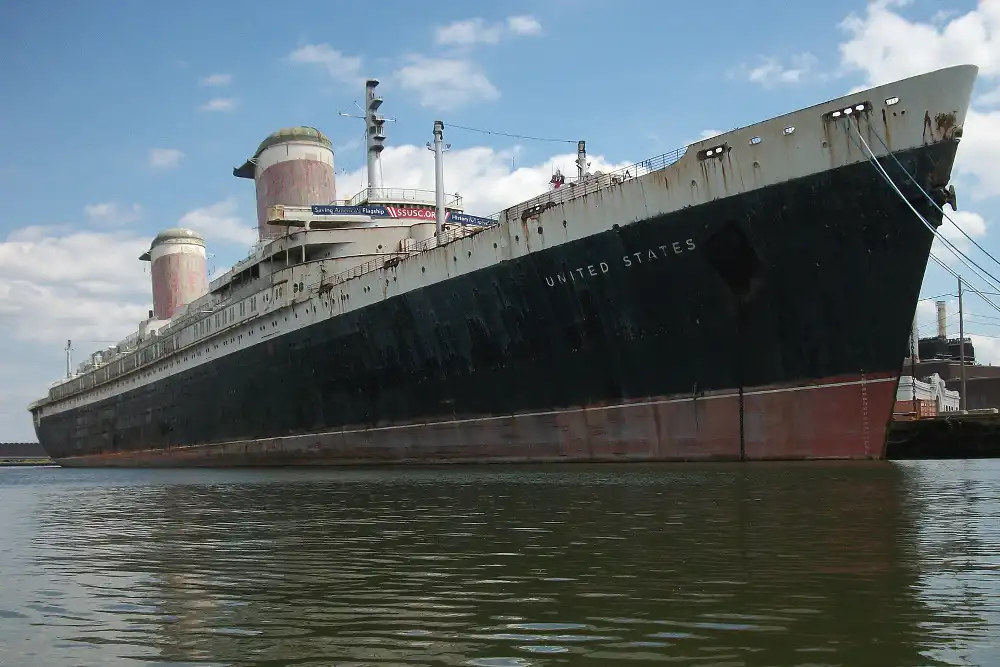
The SS United States, once the fastest passenger liner in the world, is scheduled to be sunk in the Gulf of Mexico in November, creating what will be the world’s largest artificial reef.
Officials from Okaloosa County, Florida, have confirmed that the 302m (990ft) ship will be scuttled approximately 22 nautical miles (25 miles; 41 km) southwest of Destin-Fort Walton Beach.
The sinking has been scheduled for the second week of November, although the exact date is dependent on weather conditions.
Built in 1951, the SS United States was designed to serve as both a luxury passenger vessel and military transport if so required.
She was awarded the Blue Riband for the fastest transatlantic crossing of 3 days, 10 hours, 40 minutes on her maiden voyage in July 1952, beating the record set by Britain’s RMS Queen Mary 14 years earlier by 10 hours and two minutes.
The rise of commercial air travel eventually brought her ocean-going career to an end in 1969, after the ship’s operating costs began to overrun her income.
Despite several offers to buy her and a plan by the US Navy to turn her into a hospital ship, she remained laid up in Norfolk, Virginia until 1992.

She was subsequently towed to Sevastopol Shipyard in Ukraine to have her asbestos linings removed, but despite changing hands several times since then, she was eventually returned to the US and spent almost three decades slowly deteriorating at a mooring in Philadelphia.
In 2011, she was bought by the SS United States Conservancy, a consortium of business owners who planned to redevelop the ship as a luxury waterfront development.
Disagreements over rent with the owners of the pier where she was docked led to a legal battle, which ended with the ship being ordered to vacate her mooring in September 2024.
Shortly before the eviction, officials from Florida’s Okaloosa County announced that they were involved in negotiations to acquire the ship and sink her as an artificial reef, at an estimated cost to the County of $1 million.
The ship finally departed Philadelphia in February 2025, arriving in Mobile, Alabama, the following month, where contractors began the extensive process of stripping and cleaning the vessel in preparation for her sinking.

According to a recent progress report by Okaloosa County, work to remove hazardous materials from the ship is now complete, and a renewal of the county’s existing permit to create artificial reefs has been authorised by the US Army Corps of Engineers, removing a major regulatory hurdle to the sinking.
All 128 fuel and lubricant tanks have been emptied, cleaned and certified safe by a marine chemist, and more than 200 samples have been collected to assess potentially hazardous materials, including polychlorinated biphenyls (PCBs).
Remediation and inspections across all 12 of the ship’s decks have been completed; exterior paint and deck coverings found to contain high concentrations of PCBs have been removed.
The ship’s distinctive red, white and blue funnels have also been removed, together with her radar mast and propellers, hundreds of fittings and more than 400 portholes.
Many of these artefacts will be preserved and displayed in a land-based museum being planned to celebrate the ship’s history.
The county has also completed seabed surveys of the proposed deployment site, using multibeam and side-scan sonar to identify obstacles and ensure that existing natural and historical features will not be damaged.
A digital model of the entire ship has been produced to preserve a record of her condition before sinking.
According to the latest update, United States will be sunk by controlled flooding rather than explosives, with the intention that she settles upright on the seabed.
Openings have been prepared to enable access for marine life and divers, while compartments considered to be unsafe have been sealed.
The ship is expected to rest in approximately 55m (180ft) of water, with her upper decks reaching depths of around 17–18m (55–60ft), making the wreck suitable for recreational and technical divers alike.
At 302m long, she will surpass the aircraft carrier USS Oriskany, sunk off Pensacola in 2006, as the largest vessel deliberately sunk to create an artificial reef.
Okaloosa County says the project will provide new habitat for marine life while creating a major attraction for the region’s diving and fishing industries. Researchers from several US marine science institutions are also expected to monitor the wreck’s environmental impact after deployment.
The SS United States Conservancy says further details of the sinking operation, including arrangements for a public livestream, will be announced once the final deployment date has been confirmed.
Related articles

