


Post-mortem examinations of the five Italian divers who died in a cave in Vaavu Atoll in the Maldives earlier this year have confirmed that they ran out of air.

Monica Montefalcone, a professor of ecology at the University of Genoa, her daughter Giorgia Sommacal, researcher Muriel Oddenino and recent graduate Federico Gualtieri failed to surface from a dive on 14 May.
The body of their guide, fellow Italian dive instructor and boat operations manager Gianluca Benedetti, was discovered at a depth of around 55m in the first chamber of the cave system on the same day.
The four remaining divers were found in a dead-end tunnel leading from a 60m-deep second chamber of the cave, accessible through a narrow tunnel, by a team of Finnish technical divers on 18 May.
A Maldivian rescue diver, Staff Sergeant Mohamed Mahudhee from the MNDF Coast Guard dive team, died during the search for the missing divers.
The cause of death has been officially given as anoxia – when the body is deprived of oxygen – although no reason has so far been given as to why they entered the deep cave in which they were found.
The report, which was reportedly filed by consultants from the Busto Arsizio Public Prosecutor’s Office on Friday, 2 October, ruled out other possible causes of death that were circulating in the speculative media at the time.
Toxicological examinations determined that no abnormal substances were present in the divers’ tissues, indicating that their breathing air was not contaminated with anything that might have caused the divers to lose consciousness underwater, nor were they under the influence of drugs or alcohol.
The autopsies also found no signs of serious injury to the divers, ruling out the idea that they fled inside the cave after being attacked by sharks.
The lawyer for the family of Federico Gualtieri, Antonello Riccio, told Italian journal La Stampa that he hadn’t yet seen the report, but the initial findings suggested they ran out of air.
‘Once our consultant has analysed the experts’ findings, we’ll draw our conclusions,’ he said. ‘Initial information suggests the cause of death is related to oxygen deprivation.
‘This certainly rules out some hypotheses, but we’re still far from understanding what happened.’
We still don’t know why

Many theories have been floated as to why the divers were found in the second chamber of a deep cave, without proper cave training and an inadequate supply of air.
Shark attacks, powerful Venturi currents, injury and disorientation were all floated at the time, although a more prosaic reason was offered by the Finnish dive team once the Italians’ bodies had been recovered.
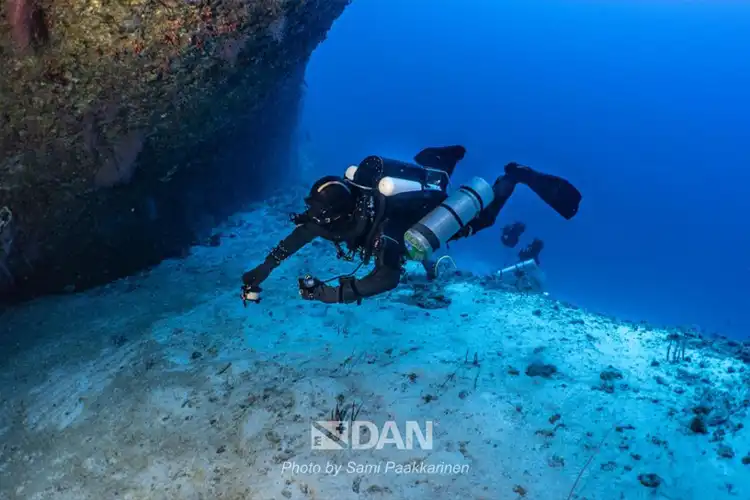
The cave system the group entered, known as Devana Kandu, consists of a large open chamber with an entrance at a depth of around 50-55m and a second, deeper chamber descending to 60-70m accessible through a narrow tunnel.
After documenting the cave system the Finnish team noted that the exit from the deeper chamber is partially concealed behind a sand bank, leading to the theory that the team entered the dead-end tunnel believing it was the exit, where they subsequently ran out of air.
Much commentary was made as to why recreational divers were exploring a cave almost twice the legal depth limit for recreational diving in the Maldives, and why they didn’t have a Maldivian guide with them.
Unconfirmed reports, however, have suggested that visits to the cave were a regular occurrence, a known hotspot where sharks would shelter during the monsoon, which divers would visit for a brief look inside the cave before ascending.
The dive team was carrying GoPro cameras with them when they made their final dive, footage from which, along with the divers’ laptops and phones, remain in the possession of the authorities.
‘Perhaps to get more answers, we need to cross-reference the autopsy data with the analysis of the divers’ GoPros, PCs, and phones,’ said Riccio.
‘We don’t know when these results will be available. We’ve already asked to have Federico’s technological equipment returned, but that’s not possible because the analysis hasn’t been completed.’
Related articles

- Autopsies confirm Maldives tragedy divers ran out of air - 8 October 2026
- Peter Benchley’s Jaws memorabilia and dive gear to be auctioned for charity - 8 October 2026
- Shifting focus – an interview with Fabi Fregonesi - 7 October 2026
