


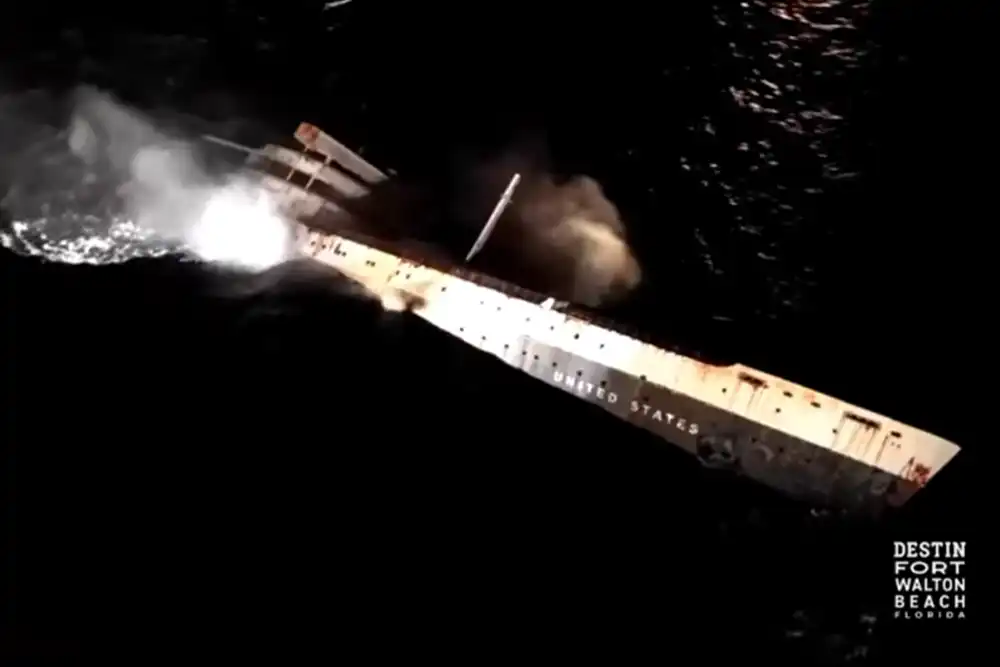
The SS United States has finally been sunk, earning the ship that was once the fastest passenger liner in the world a new record as the world’s largest artificial reef.
The 990ft (302m) ship was towed from Mobile, Alabama, to her final resting place 22 nautical miles (25 miles/41km) off the coast of Destin, Florida, on Monday, 9 November, with a planned date for the sinking of Thursday, 12 November.
The sinking was brought forward a day ahead of schedule due to the approach of inclement weather, after surviving a last-minute legal challenge from the SS United States Preservation Foundation, which sought to preserve her status as an historic American ship, citing environmental concerns over contaminants that may remain within her.
Explosives were prohibited from use in the sinking, so United States was flooded through a series of valves in her piping and holes drilled into her hull.
The process took several hours – and longer than expected – but she eventually slipped beneath the waves under the cover of darkness at around 9.00 pm CST.
‘She was designed to be unsinkable,’ said Nick Tomecek, a spokesperson for Okaloosa County, which organised the sinking, ‘and that fact has definitely given our crews some challenges today.’
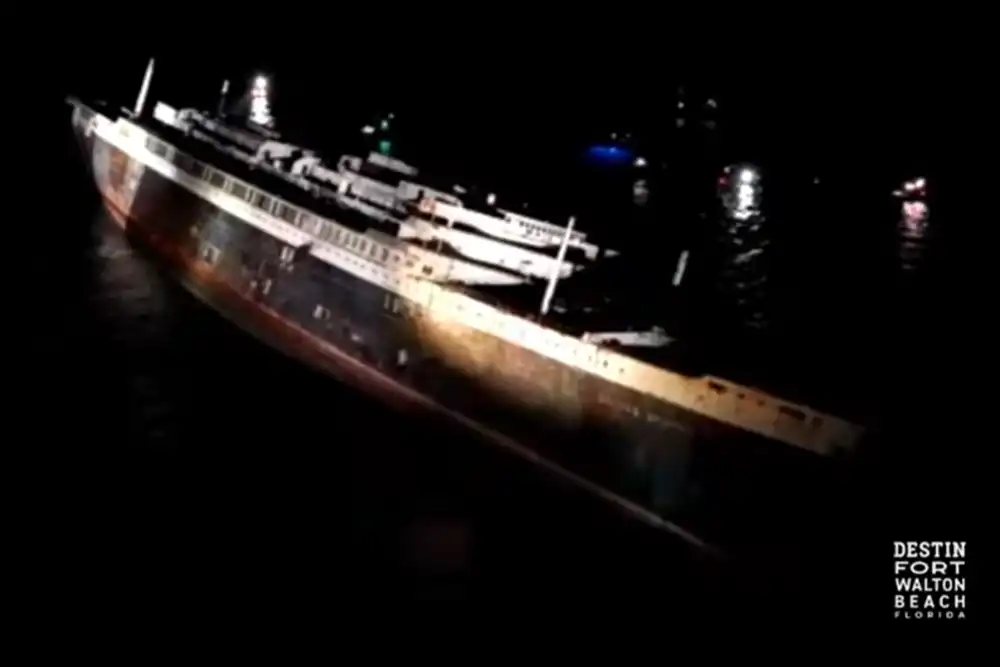
Video of the final moments (see below) shows her listing heavily to port before submerging, although it’s not yet known if she hit the bottom upright or on her side.
Officials said it could take up to an hour before the wreck would reach the sea floor once it had been completely flooded.
An historic moment
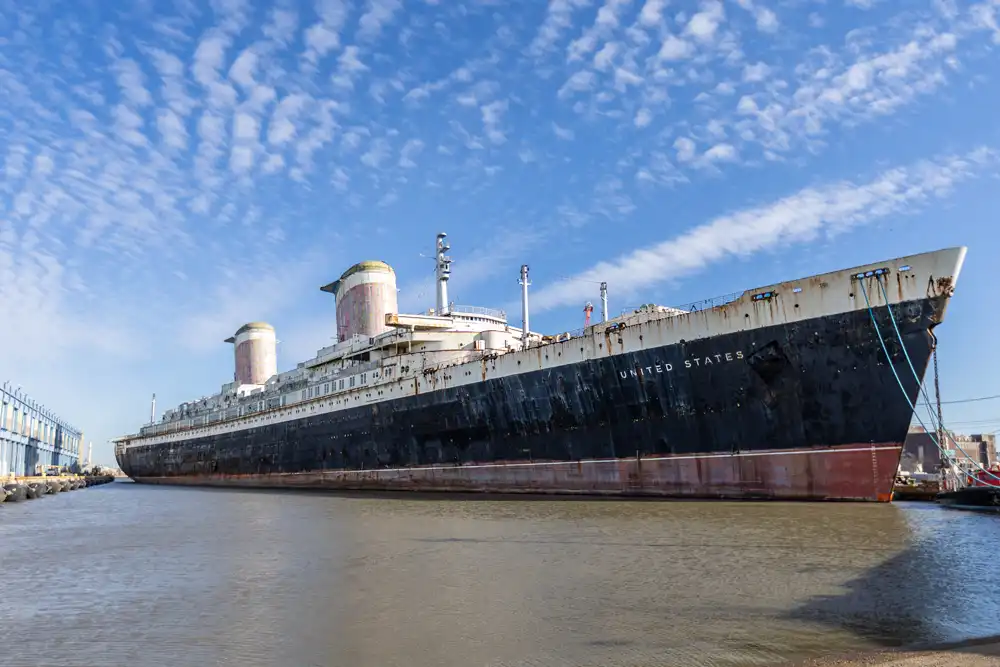
Launched in 1951, the SS United States was awarded the Blue Riband for the fastest transatlantic crossing on her maiden voyage in July 1952, setting a time of 3 days, 10 hours and 40 minutes – beating the 1938 record set by Britain’s RMS Queen Mary by 10 hours and two minutes.
As a passenger liner she became the darling of 1950s celebrities, including the likes of Marilyn Monroe, Judy Garland and Cary Grant, but the rise of transatlantic air travel during the 1960s brought the age of ocean-going liners to an ignominious end.
Despite offers to buy her and plans to turn her into a US Navy hospital ship, she spent 23 years laid up in Norfolk, Virginia before being towed to Sevastopol Shipyard in Ukraine in 1992 to have her asbestos linings removed.
She changed hands several times in the following years, but eventually returned to a permanent mooring in Philadelphia, where she would remain for nearly 30 years before being ordered to vacate her mooring in 2024.
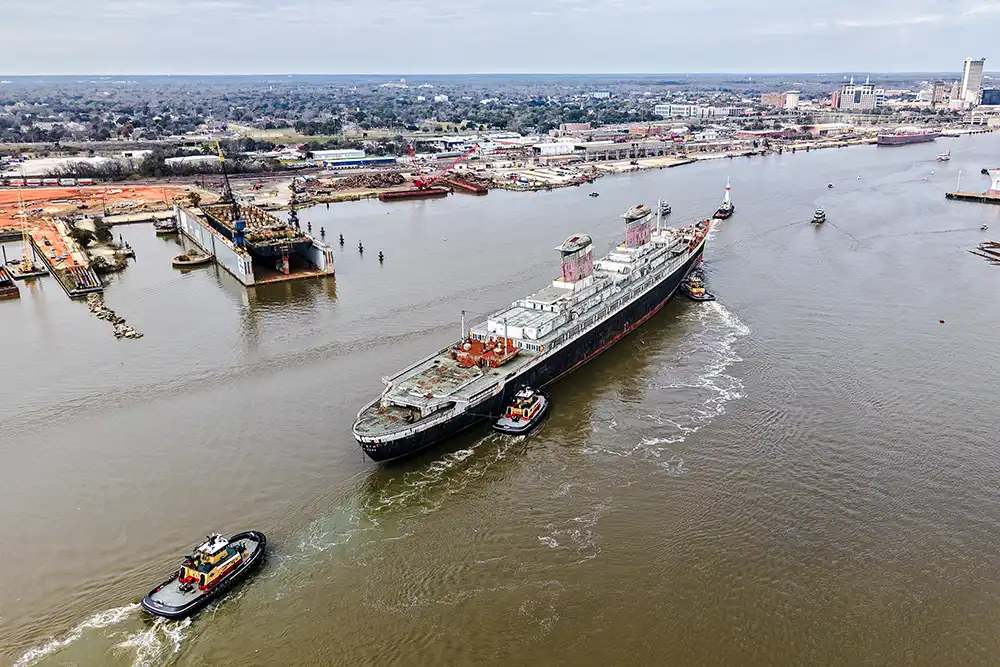
United States was eventually bought by Florida’s Okaloosa County for $1 million, with the intention to sink her as an artificial reef. She arrived in Mobile, Alabama in March 2025 to be stripped and cleaned before yesterday’s sinking.
An artificial reef for divers and science
At 990ft (302m) in length, United States now holds the world record for largest artificial reef, around 102ft (31m) longer than the 888ft (271m)-long USS Oriskany, an aircraft carrier sunk around 26 miles off of Pensacola Pass in 2006, approximately 14 miles (22km) from the new record-holder.
The planned depth for the wreck was 55m (180ft) to the sea bed, with the upper decks at approximately 17–18m (55–60ft), assuming she settled upright, making the SS United States a great choice for recreational and technical divers alike.
In addition to her status as a scuba diving attraction, the new reef will be studied by scientists as it develops.
‘This is an exciting opportunity to study and monitor the development of a new ecosystem,’ said Kirstin Meyer-Kaiser, a marine biologist at the Woods Hole Oceanographic Institution (WHOI). ‘This multi-year effort will show how a community takes shape over time, and how the physical and chemical transformations to a habitat influence the biological community.’
‘Shipwrecks are more than artifacts, [but] most of the time, we find them long after the ship sank, so the ecosystem is already mature,’ added Meyer-Kaiser.
‘Understanding the controls on colonisation of shipwrecks will also inform strategies for improving the effectiveness of artificial reef structures, including the design and engineering of materials that produce better artificial reefs and increase biodiversity.’
Looking to be among the first to dive the new reef? Check out www.divedestin.net
Related articles

- SS United States becomes world’s largest artificial reef - 12 November 2026
- Red Sea liveaboard Unity seriously damaged by fire in Hurghada - 9 November 2026
- Investigation sought after underwater confrontation in the Maldives - 4 November 2026
