


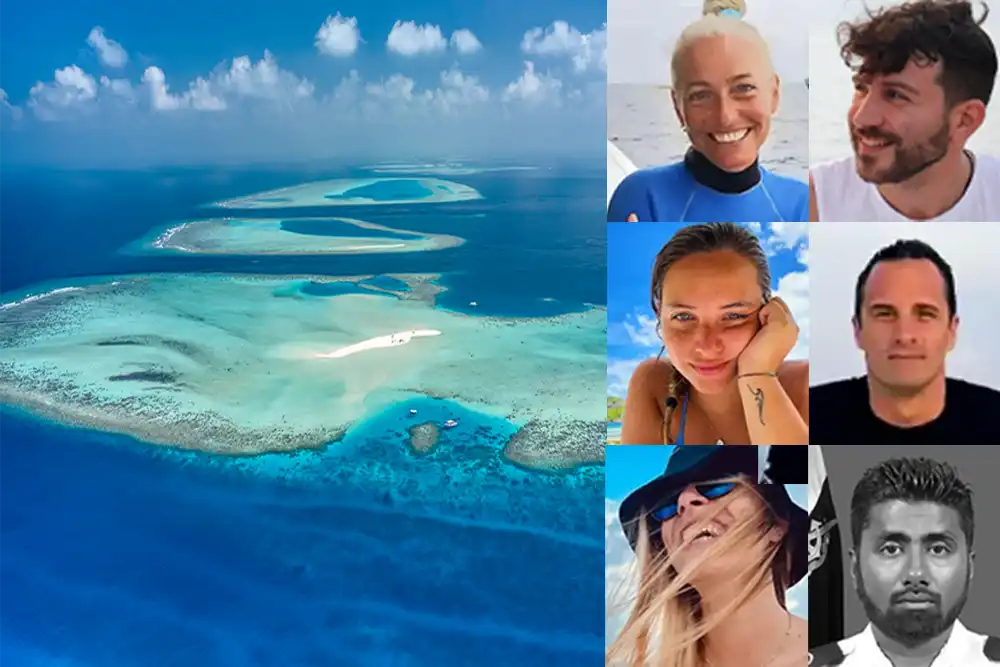
Italian investigators have seized electronic devices and personal equipment belonging to the five divers who died inside the Vaavu Atoll cave, referred to in local reports as Devana Kandu, or Dhekunu Kandu, on 14 May.
Meanwhile, interviews with the Finnish cave rescue team that recovered the bodies, coupled with testimony from local experts, are starting to shed light on the most likely cause of the tragedy.
Mobile phones, computers, tablets, USB drives and a hard drive belonging to the victims have been taken by the Genoa Flying Squad as part of a widening culpable homicide (manslaughter) investigation begun by prosecutors in Rome.
The Italian journal Corriere Della Sera reports that the equipment was returned to Italy by Stefano Vanin, associate professor of zoology at the University of Genoa, who was on the same trip onboard the liveaboard Duke of York as Monica Montefalcone, a professor of ecology at the University of Genoa and one of the five divers who died inside the cave.
Montefalcone’s daughter Giorgia Sommacal, researcher Muriel Oddenino, research assistant Federico Gualtieri and instructor Gianluca Benedetti were reported missing after failing to surface from a dive on 14 May.
Rescue diver Staff Sergeant Mohamed Mahudhee of the Maldives National Defence Force died during an initial search for the missing divers.
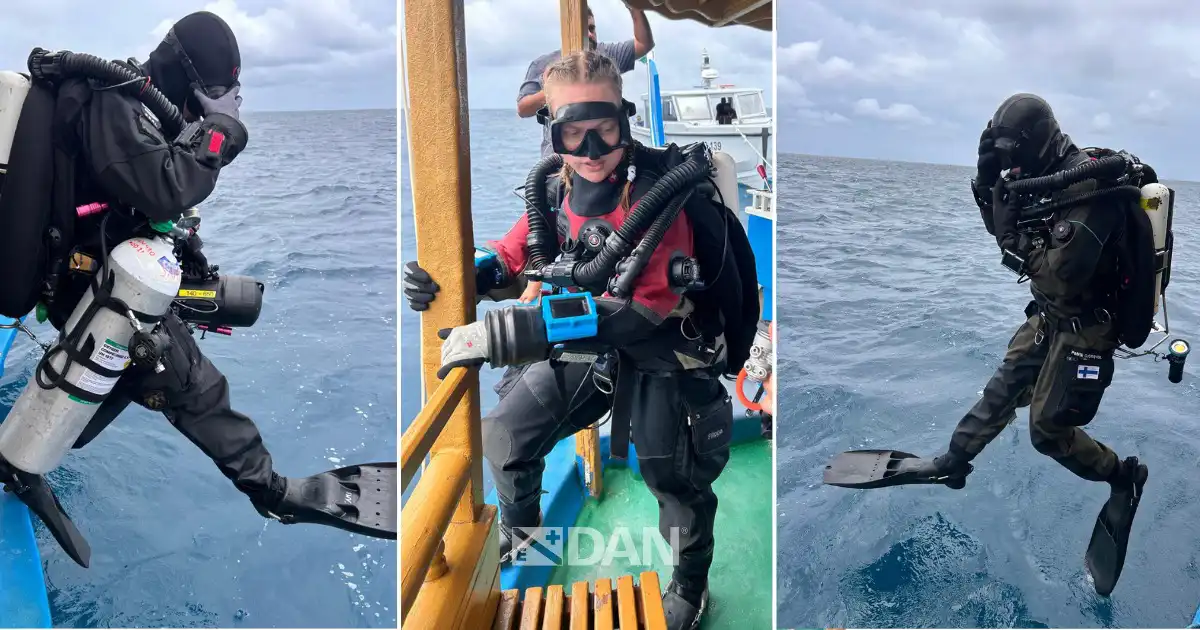
Benedetti’s body was recovered on the same day the incident occurred while the others were located on 18 May by Finnish cave specialists Sami Paakkarinen, Patrik Grönqvist, and Jenni Westerlund, who had been deployed by DAN Europe, and who recovered the rest of the missing dive team over the next two days.
Italian authorities have also requested access to the GoPro cameras, dive computers, and other equipment recovered from the bodies by the Finnish recovery team, which is currently being held by investigators in Malé.
The devices could provide crucial information about the dive, including depths, timings, gas usage and, potentially, video footage of the tragedy as it unfolded, and help lay to rest theories about whether or not the team entered the cave voluntarily, or were pushed towards it or inside it by a strong current.
The most likely explanation, based on interviews with the Finnish rescue team and reporting in the Italian media, however, is that the divers deliberately entered the cave and became trapped when they mistook a dead-end tunnel for the exit.
‘Fatal navigational error’

In an interview with Corriere della Sera, Sami Paakkarinen said that he thought it unlikely that the divers entered the cave accidentally.
‘It’s a huge cave,’ said Paakkarinen, ‘and besides, in the Maldives, the sun shines up to, I think, 100 metres deep.
‘So at 60 metres it’s still daylight, and when you enter a cave, you know it because it gets dark. You don’t risk accidentally entering a cave.’
One of the most prevalent theories as to why the divers died was the idea that they were pulled into the cave by currents near the cave’s entrance, creating a Venturi effect which they were unable to swim against.
The Venturi effect occurs when a fluid or gas flows through a narrow passage, reducing the surrounding pressure and potentially creating a suction effect as its speed increases.
The theory was proposed by Alfonso Bolognini, president of the Italian Society of Underwater and Hyperbaric Medicine, based on sketches of the cave’s entrance; however, Paakkarinen has challenged this theory.
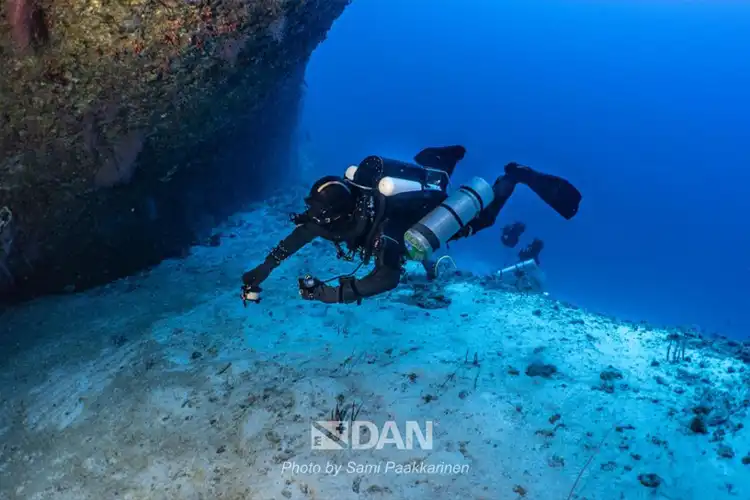
‘I can only comment based on my experience,’ he told Corriere. ‘We experienced these so-called tidal currents. The water moves in this direction for 12 hours and then in the opposite direction for another 12. Continuous currents.
‘In the coral reef, it’s very predictable. When we entered the cave, we felt a very slight current inside it.
‘So it’s true that there is a current going in and out of the cave. The cave, so to speak, is breathing. But it’s really not very strong. It’s not possible that it sucked anyone in.’
While this doesn’t completely eliminate the possibility of the divers being pushed into the cave by a current, the cave’s configuration and the location of the bodies suggest that the divers entered the deeper second chamber of the cave voluntarily.
The cave, as described by the Finnish rescue team and others who have visited, including Shafraz Naeem, a Maldivian technical diver who has dived the caves more than 30 times, has a large visible entrance at a depth of 47 metres (154ft), and a ‘spacious’ first chamber – described by Paakkarinen in the quote above as ‘huge’.
The first chamber is connected to a deeper second chamber by a 30m-long S-shaped tunnel, but DAN Europe CEO Laura Marroni said that a sandbank near its exit into the second chamber creates an ‘optical illusion’ which hides its position in the cave.

A second tunnel to the left of the exit corridor leads to a smaller third chamber and a dead end, which is where the bodies of Monica Montefalcone, Giorgia Sommacal, Muriel Oddenino, and Federico Gualtieri would later be found.
It is thought that the optical illusion generated by the sandbank, perhaps further blocked by stirred-up sand, led the divers to mistake the second corridor for the way out.
‘The divers, unable to find the exit corridor, found themselves in a corridor to the left of what would have been the exit, which, however, was a dead end,’ said Marroni.
‘The bodies of the divers were found all together inside there, as if they had mistaken it for the right one, but there was no way out.’
The body of Gianluca Benedetti, which was recovered on the same day the incident occurred, was found in the first chamber of the cave at the start of the tunnel into the second chamber.
It is not known at this time if he was waiting for the others to return, or had been the only diver to find the correct exit before he, too, ran out of air.
Questions over gas and equipment
It must be stressed that these reports represent only the most plausible scenario given the evidence gathered so far, but there has also been a great deal of scrutiny over the gas mixtures and equipment used by the team.
It is known that three of the five divers were covered by a permit issued by Maldivian authorities to dive to 50m for the purposes of research, but according to a report in La Repubblica, the divers were only using standard 12 litre tanks.
While it is possible to dive to 50-60m on air, the effects of nitrogen narcosis – more accurately ‘gas narcosis’, as oxygen is almost as narcotic as nitrogen – are likely to be much more exaggerated.
Many divers will already know that diving for any length of time beyond the accepted recreational limit of 40 metres – and certainly anything deeper than 50m – requires trimix, a blend of oxygen, nitrogen and helium, to minimise narcosis.
Even with an appropriate gas mixture, however, using a single 12- litre tank for a 50-60m dive would have meant their bottom time would be measured in minutes.
‘We’re talking about ten minutes, perhaps even less,’ said Marroni, adding that if they had begun to panic, their time would have grown even shorter.
‘Realising that the way is not right, and having little [remaining] air, maybe after going back and forth, terrifies you – then you breathe more quickly and your [air supply] drops.’
Many commentators have also noted that they did not use a guideline of any kind, an absolute must-have when navigating caves and something which, if present, may well have saved their lives.
Autopsies on the divers are expected to take place in Italy as soon as their bodies have been repatriated, while evidence from the team’s dive computers and GoPro will – if available – hopefully piece together how this tragedy unfolded.
More from this story
- Culpable homicide investigation launched as final two Maldives divers recovered
- Bodies of two Italian divers recovered in Maldives tragedy
- Bodies of missing Italian divers located in Maldives cave
- Maldives rescue diver dies during recovery operation for missing Italian divers
- Five Italian divers die in Maldives cave

- Polish cave diver breaks world scuba depth record with 338m descent - 23 October 2026
- Aggressor Adventures last-minute $1,000 savings on Belize Aggressor III - 23 October 2026
- SS United States to be sunk as world’s largest artificial reef in November - 22 October 2026
