


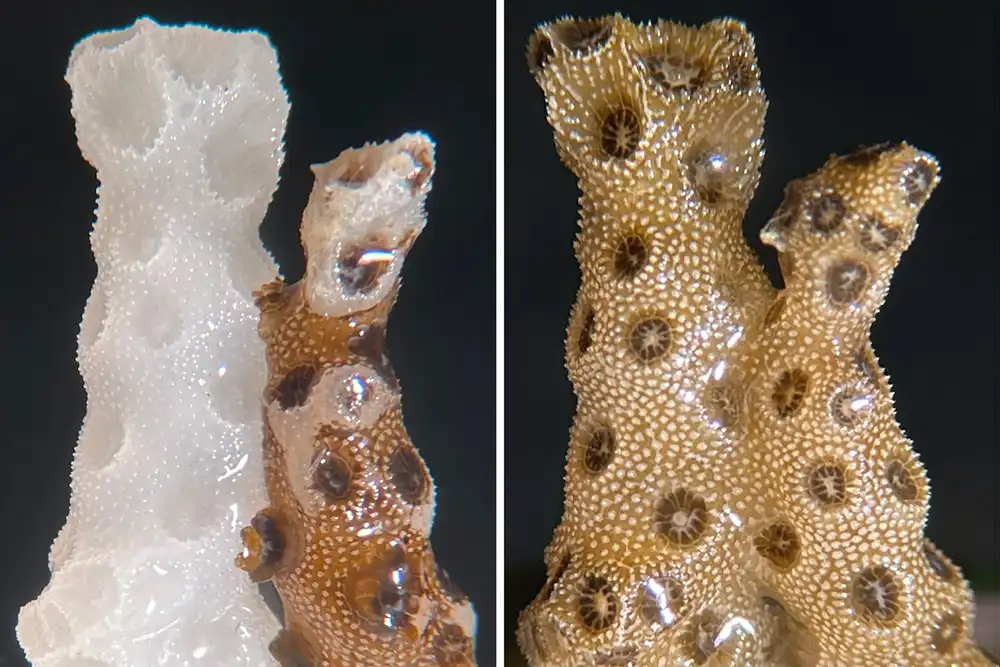
Scientists at Stanford University in California, USA, have found that severely bleached corals can make a full recovery if they come into contact with healthy neighbours.
In a new paper published in Science Advances, the researchers found that the symbiotic dinoflagellates that produce much of the coral’s nutrients could be transferred through contact, and would remain and enable the coral to recover even if the fragments were later separated.
The new study, led by PhD student Daniel Collins at Stanford’s Hopkins Marine Station in California, resulted from an accidental observation in 2025, when marine biologist Professor Stephen Palumbi noticed that a healthy coral fragment had fallen against a bleached fragment in a laboratory tank, and the bleached coral was starting to recover its colouration where the two fragments touched.
The observation prompted PhD researcher Danny Collins to investigate whether physical contact could be used to restore the symbiotic algae that corals lose during bleaching.
‘While bleached corals may be dying, they are not dead yet,’ said Collins. ‘The question we wanted to answer is, once a coral has bleached, what can we do?’
Coral bleaching occurs when environmental stress, often due to a rise in surrounding water temperatures, disrupts the relationship between the coral polyps and the dinoflagellates – a form of algae known as zooxanthellae – which live within them.
The zooxanthellae produce much of the energy the corals need through photosynthesis, and also provide the coral polyps with their colour.
Changes in water temperature cause the zooxanthellae to be ejected from the polyps, slowly starving the animal and giving the colony a white, ‘bleached’ appearance due to the colouration of its underlying calcium carbonate skeleton.
Although bleaching does not necessarily result in mortality, recovery can take months or even years, leaving the coral vulnerable to further environmental stress and disease.
Friendly coral relatives
To confirm the initial observation, Collins and his team conducted an experiment using ten genetically identical pairs of fragments from a single colony of the branching coral Pocillopora damicornis, commonly known as cauliflower (or lace) coral.
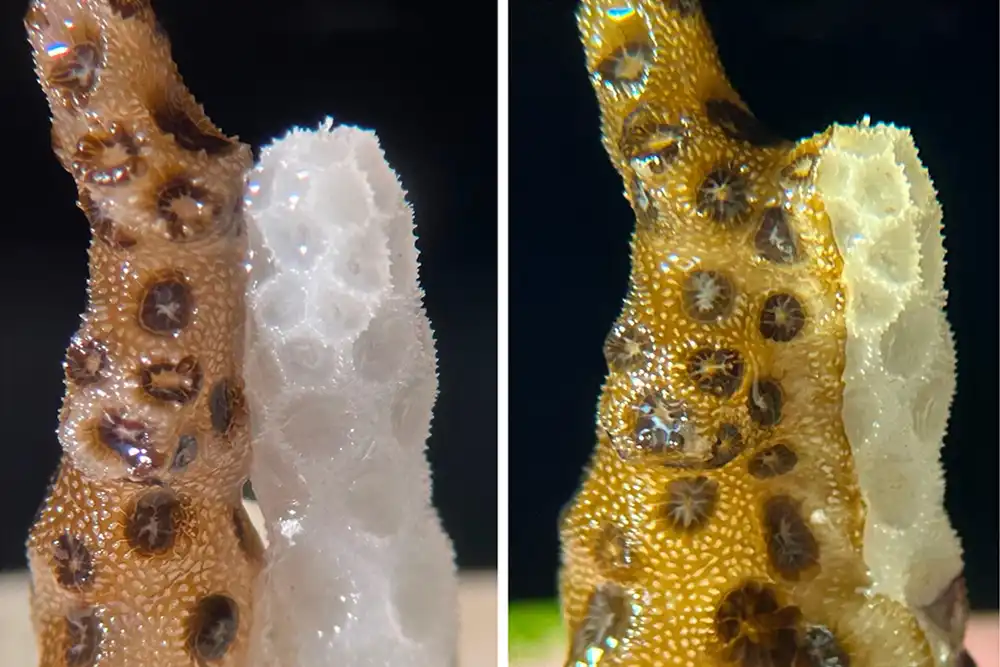
Each pair consisted of one healthy and one bleached fragment taken from the same original colony, with five pairs being placed in direct contact, and the remaining fragments separated by a few millimetres.
All five of the bleached fragments that touched their healthy coral neighbours recovered within seven to eight weeks, but those kept apart did not recover and eventually died.
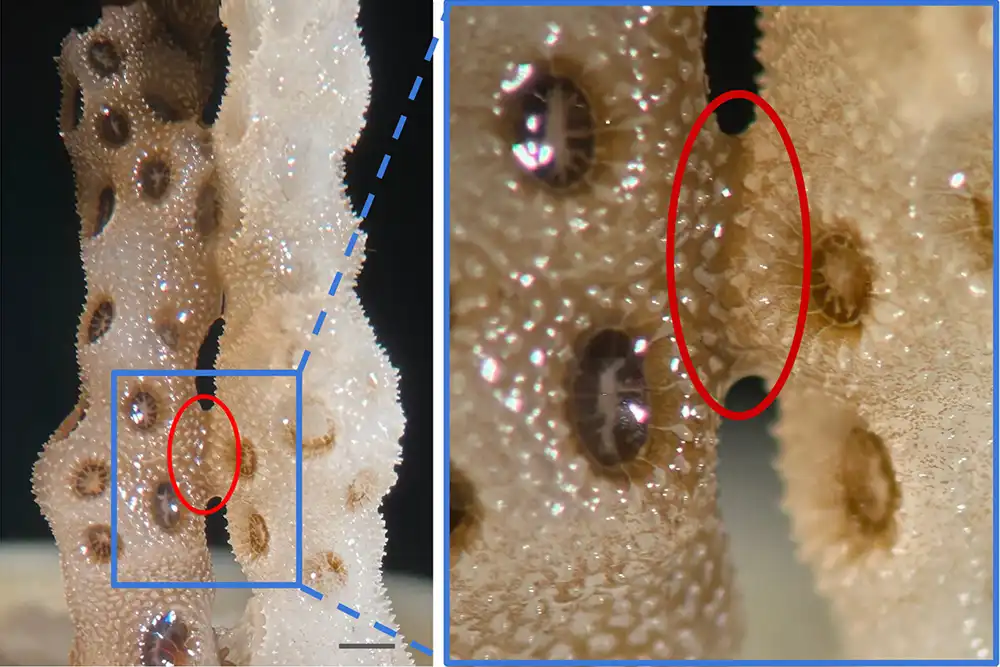
The scientists discovered that the coral fragments placed in contact with each other were able to fuse their tissues, creating microscopic channels through which both the algae and nutrients could pass.
Once inside the bleached coral, the zooxanthellae multiplied rapidly, doubling their numbers every four days by the second week, approximately ten times faster than rates typically observed during natural recovery.
Collins and his team also found that the connection did not have to be permanent – enough algae were transferred for the bleached coral to continue recovering independently with just a few days of contact.
The findings suggest a possible new approach to coral restoration, although the technique has an important limitation as the tissue connection only formed successfully between genetically identical fragments originating from the same coral.
Imperfect reef restoration
When fragments from different colonies were brought together, even those belonging to the same species, they were observed mounting a defensive response by producing stinging filaments to reject the foreign coral. In some cases, the healthy coral actually grew over the bleached and dying fragment.
The rejection makes the process impractical for restoring large areas of damaged reef, where individual corals have different genetic backgrounds, but understanding how healthy corals transfer their zooxanthellae could enable scientists to develop treatments that do not require physical contact between living fragments.
The Stanford team is now investigating whether beneficial algae could be collected from healthy corals, cultivated and subsequently introduced into bleached colonies to accelerate their recovery.
Professor Fiorenza Micheli, a co-author of the study and co-director of Stanford’s Center for Ocean Solutions, said the research could help scientists develop ways to keep damaged corals alive long enough to recover.
‘Bleached corals are often considered a lost cause because recovery after a heatwave is very slow, if it happens at all,’ said Micheli. ‘We hope this new research will inspire solutions that keep corals healthy long enough to enable full recovery after heat waves through slower processes such as growth, reproduction, and recruitment of new colonies.’
The study ‘Rapid coral bleaching recovery via symbiont transfer from healthy corals’ by Daniel S Collins, et al, is published in Science Advances.
Related stories
