


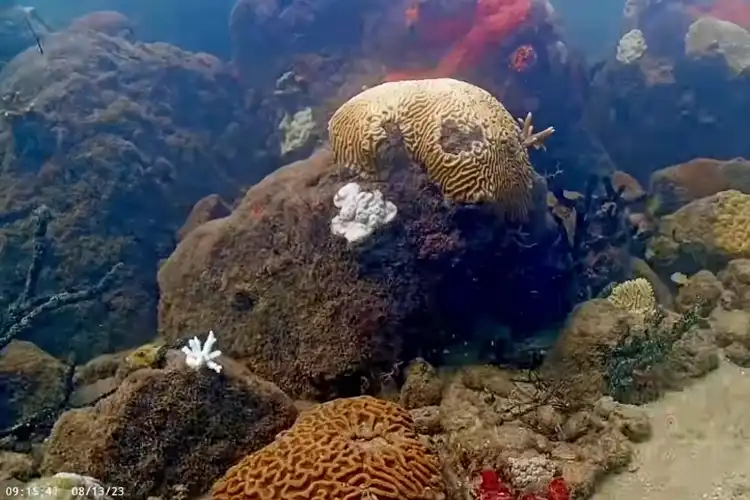
A 1,000-day underwater timelapse recorded at PortMiami, Florida, has documented both coral bleaching and subsequent recovery, in what organisers describe as the longest continuous underwater timelapse of its kind.
The sequence runs from 1 May 2023 to 28 January 2026 and captures the impacts of the 2023 coral bleaching event in Florida, along with changes in coral condition throughout 2024 and 2025.
‘We are proud to unveil the world’s longest underwater timelapse, starting May 1st 2023 and running 1,000 days through January 28, 2026,’ said the project team on its website.
‘This period covers summer 2023’s unprecedented coral bleaching mortality event, and indeed multiple corals can be seen bleaching, but then recovering and growing through 2024 and 2025 into 2026.’
The footage was recorded by the Coral City Camera, part of a public art and scientific research project called Coral Morphalogic, founded in 2007 by marine biologist Colin Foord and musician Jared McKay to ‘chronicle the fate of the Earth’s imperilled coral reefs’.
Writing in a blog post on their website, the project’s founders highlight the performance of a locally adapted strain of staghorn coral, Acropora cervicornis, which they have nicknamed ‘ACER Ventura’.
‘Not only did [ACER ‘Ventura’] not bleach,’ they write, ‘but it has grown swiftly. In just four years, a single branch of ACER ‘Ventura’ has increased thousands of times in biomass, to the point that we now have one of the densest thickets of this endangered coral in the State of Florida.’
Temperature data recorded at the site over the duration of the timelapse has been reported as varying from winter lows of 15.5°C (60°F) to late summer temperatures of 32.6°C (90°F) during the 2023 marine heatwave and bleaching event.
‘This represents a huge range of thermal tolerance for this strain of critically important reef-building coral,’ writes the team, ‘and a reminder that corals grown for nearshore reef restoration in Florida need cold-stress adaptation as well as heat-stress.’
The project is being conducted in collaboration with NOAA’s Atlantic Oceanographic and Meteorological Laboratory and the University of Miami’s Rescue a Reef programme.
As well as the resistance to temperature and the surrounding reef’s recovery, the timelapse also highlights how the coral has fared in the strong currents and disturbances from heavy shipping traffic.
‘Of particular interest is observing how dynamic the sediment is at the site,’ writes the team. ‘PortMiami is subject to intense currents, magnified by passing ships displacing huge volumes of water.
‘Despite these unnatural conditions, the corals and fish have adapted well to this anthropogenic environment.’
The Coral City Camera has been recording for more than six years, documenting both coral growth and associated marine life, with nearly 220 species of fish also catalogued over the timeframe.
The camera is still active and can be viewed live at coralcitycamera.com. Donations to keep the camera running can be made on the local Key Biscayne Community Foundation website.
For more about Coral Morphologic, visit the team’s website at coralmorphologic.com, or follow along on Facebook @coralmorphologic, Instagram @coralmorphologic, X @CoralMorph and YouTube @CoralMorphologic
Related articles
