


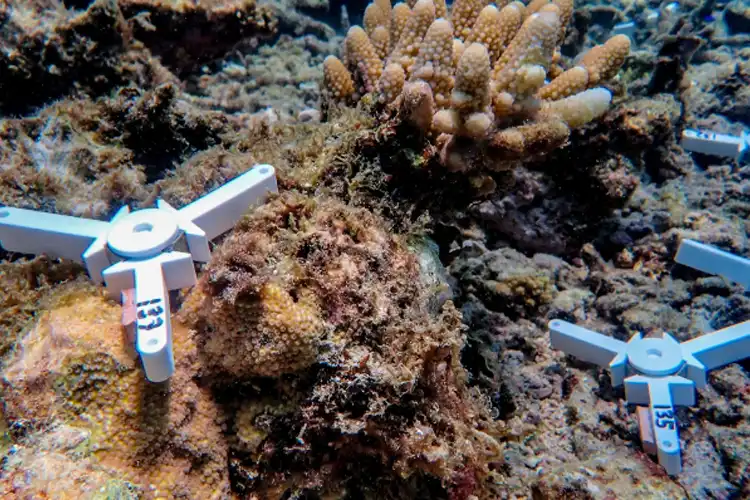
Scientists from the Australian Institute of Marine Science (AIMS) have led one of the world’s largest experimental coral restoration trials, deploying millions of young corals onto degraded reefs following the recent mass spawning event on the Great Barrier Reef.
The work was carried out under AIMS’ Pilot Deployments Program (PDP), with coral spawn collected in partnership with locally based tourism, fishing and marine operators in far north Queensland.
The spawn was reared into juvenile corals and deployed onto test reefs near Cairns, Port Douglas and the Keppel Islands, using two different restoration techniques.
The trials form part of efforts to develop practical methods that could accelerate coral recovery on damaged reefs, particularly in areas affected by bleaching, storms or other disturbances.
According to AIMS, the restoration methods being tested combine scientific innovation with local expertise, relying on the skills, vessels and knowledge of people who work on the reef daily. The approach is designed to explore how reef restoration could be delivered at scale, rather than as small, isolated projects.
The techniques were developed through AIMS’ Reef Restoration and Adaptation Program (RRAP), a national collaboration of researchers working on new ways to help coral reefs cope with the impacts of marine heatwaves.

AIMS PDP director Dr Mark Gibbs said the program would help identify what is required to make reef restoration viable on a larger operational footing.
‘We’ll gain first-time insights into best-practice approaches, supply chains, technology and the people power needed to build a large-scale operational reef restoration program and a supporting aquaculture industry,’ he said.
‘Over the next three years, we’ll be improving the efficacy of deploying RRAP interventions at scale on the Great Barrier Reef.’
Local operators involved in the program say participation has reinforced their connection to the Reef and its long-term health. Corey Brown, general manager of Cairns Reef Fishing, said the project highlighted the direct link between healthy reefs and sustainable marine industries.
‘As operators who spend our lives on the water, we see firsthand that the Reef is under pressure,’ he said.
‘Being part of this program reminds us how vital a healthy reef is — not just for tourism and fishing, but for the entire ecosystem that depends on it.
‘We want the Reef to be thriving for future generations of anglers, families and visitors. Supporting this work is one way we can give back and help protect the place that supports our livelihoods.’
AIMS scientists will monitor the deployed corals over the next 12 months, assessing survival rates, growth and responses to stressors such as bleaching and competition from algae. Northern test sites include Elford, Arlington and Agincourt reefs.
The Pilot Deployments Program is funded by the Australian Government’s Reef Trust and led by AIMS, while RRAP is funded through a partnership between Reef Trust and the Great Barrier Reef Foundation.
Related articles
