


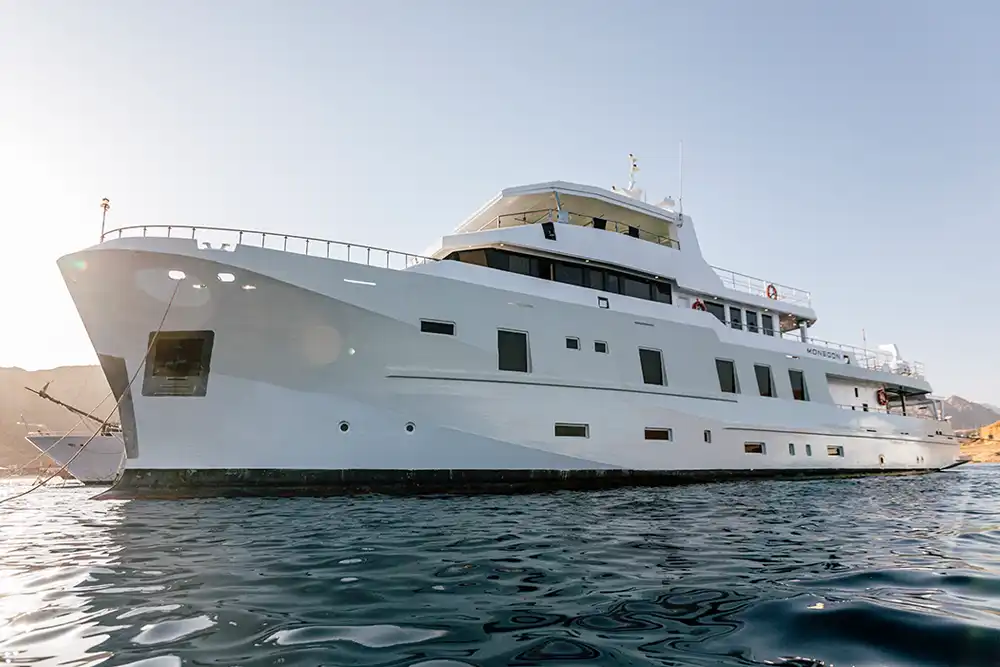
Much has been written in the last few years about the safety of scuba diving liveaboards, in particular the many incidents that have befallen those operating in the Red Sea out of Egypt.
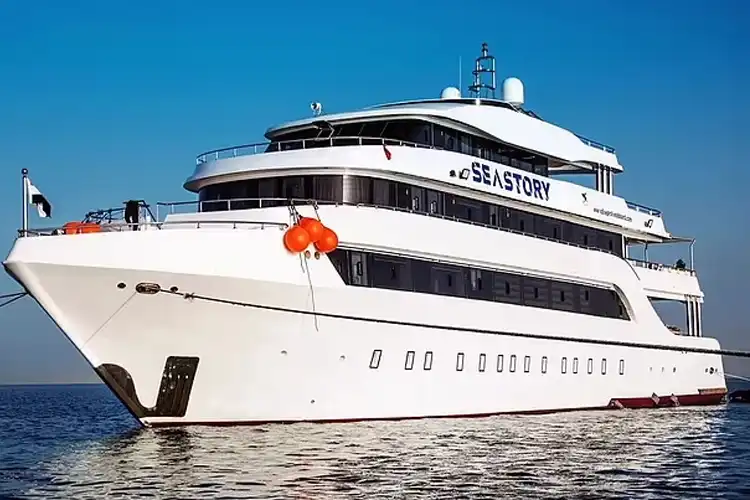
Of those, the one that received the most media attention was undoubtedly Sea Story, which we covered extensively in DIVE after being contacted by some of the survivors.
According to a study by German aviation incident investigator Jan-Phillip Lauer and Justus Schiszler, who wrote a Bachelor’s thesis for his studies at the German Institut für Schiffbau und maritime Technik (Institute for Shipbuilding and Maritime Technology), there have been 56 recorded liveaboard accidents since 2006, 27 of which were in Egypt.
Twelve ran aground, four capsized, ten caught fire and one, Seaduction, suffered a structural failure, causing the vessel to take on water. Most did not involve fatalities but, to date, at least 16 people have lost their lives, and in some cases, it’s a miracle more did not.
The most common excuse given in an attempt to excuse the failures is ‘well, there are a lot of boats in the Red Sea, and accidents are bound to happen.’
The simple answer to that, unfortunately, is that there are many more liveaboards spread across the rest of the world, where the tally is just two more than Egypt alone.
The reasons given for the accidents are often similar – poor crew training, inadequate fire suppression systems, overextended construction, cost-cutting measures and corrupt owners.
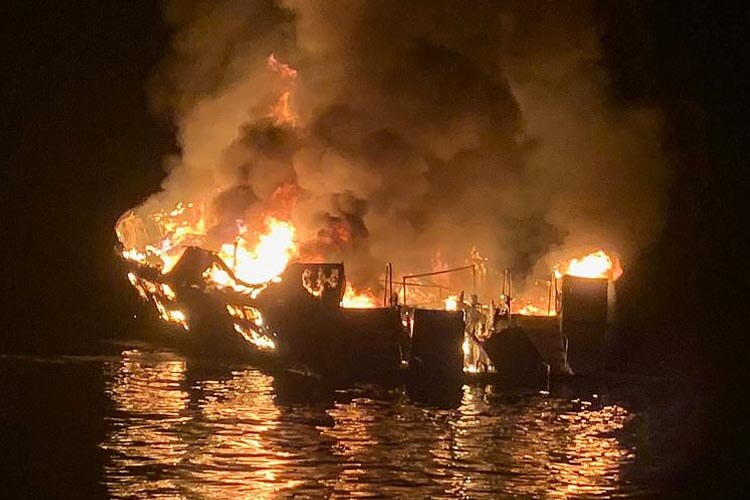
Many point to differences in safety standards between developed and still-developing nations, but it should never be forgotten that the worst liveaboard disaster of all time was the Conception fire, which killed 34 people off the coast of California in 2019.
It is also worth mentioning that some of the boats in question were owned and operated by what many people would consider to be among the most reputable companies.
With very little information available in the aftermath of the accidents, it’s often difficult to point to a precise point of failure, but it is almost certain that top of the overall list comes complacency, and a lackadaisical attitude to safety based on the fact that most voyages take place without incident.
Hurricane
In the aftermath of the Sea Story sinking, the UK’s Marine Accident and Investigation Branch (MAIB) issued a safety bulletin warning divers to exercise ‘extreme caution’ when booking Egyptian liveaboard holidays.
Internet commentators have been less diplomatic, insisting that booking an Egyptian liveaboard is tantamount to a death sentence. This is clearly nonsense, but many divers have become more cautious – a good thing – and liveaboard operators have started to pay heed to their unease.
When I was working as a dive professional in Egypt – and continually defending its reputation against consistent unpleasantness on Internet dive forums – there were two companies that I would name when people asked which liveaboard operator I would recommend: Blue O2 and Tornado Marine.
Although I had not at that point dived on their boats, I knew some of their staff and they came highly recommended by friends that I trust.
It was, therefore, with great personal dismay that I found myself writing in June 2023 about the fire on board Hurricane, in which three British divers died.
The cause of the fire has been given as an electrical failure in the engine room, and the three deceased, who had opted out of the morning dive, were probably trapped in their cabins as the flames took hold.
Survivors interviewed by another magazine have pointed the finger at a failure of the fire alarm and suppression system, and a lack of crew preparedness, leading to the tragedy.

Neither can be excused, but in the aftermath of the disaster, Tornado Marine took a long step back to reassess its commitment to safety at sea, and the company reached out to DIVE to share the work it’s been doing to minimise the possibility of such an incident ever happening again.
In December last year, during a holiday to Sharm El Sheikh, I also took a tour of the newest addition to the Tornado Marine Fleet, a state-of-the-art vessel named Monsoon.
‘The Hurricane incident was a defining moment for the entire Red Sea maritime community, including us at Tornado Marine,’ said Tornado’s marketing manager, Victoria Bell. ‘It reinforced a reality we already believed in: that safety cannot be treated as a checklist or a reaction to regulation.
‘It pushed us to reassess systems, crew preparedness, redundancy, and emergency response across the fleet — not because we were required to, but because as operators carrying people offshore, the margin for error must always be close to zero.’
The Tornado Marine boats
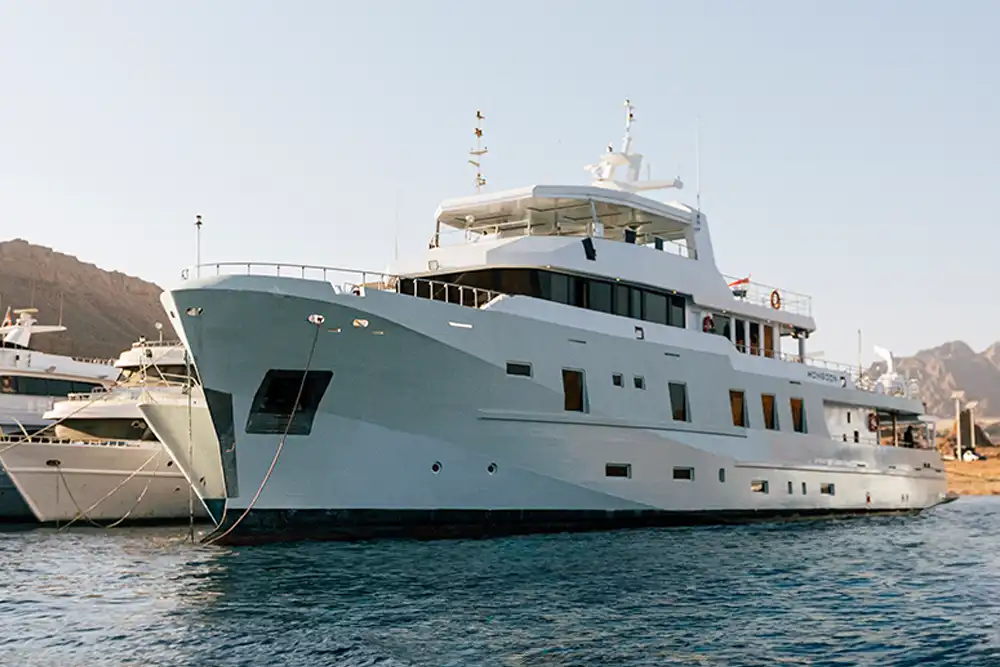
Monsoon, built in 2023, is an impressive 40m-long steel-hulled boat with a beam of 9.15m. We visited her at Watanaya Marina in Sharm el Sheikh, while she was being refitted for the upcoming season, moored up alongside her sister ships Tempest, Mistral, Whirlwind and Cyclone.
She is substantially larger than her sister ships and, where some incidents have been blamed on overextending the height of the vessel, this is clearly not the case. Monsoon is a new vessel, and the depth and breadth of her construction give an excellent impression of stability at first glance.
The attention to detail in terms of on-board safety is substantial. The engine room and galley (which is all-electric, no flammable gas) have in-built, automated fire suppression systems.
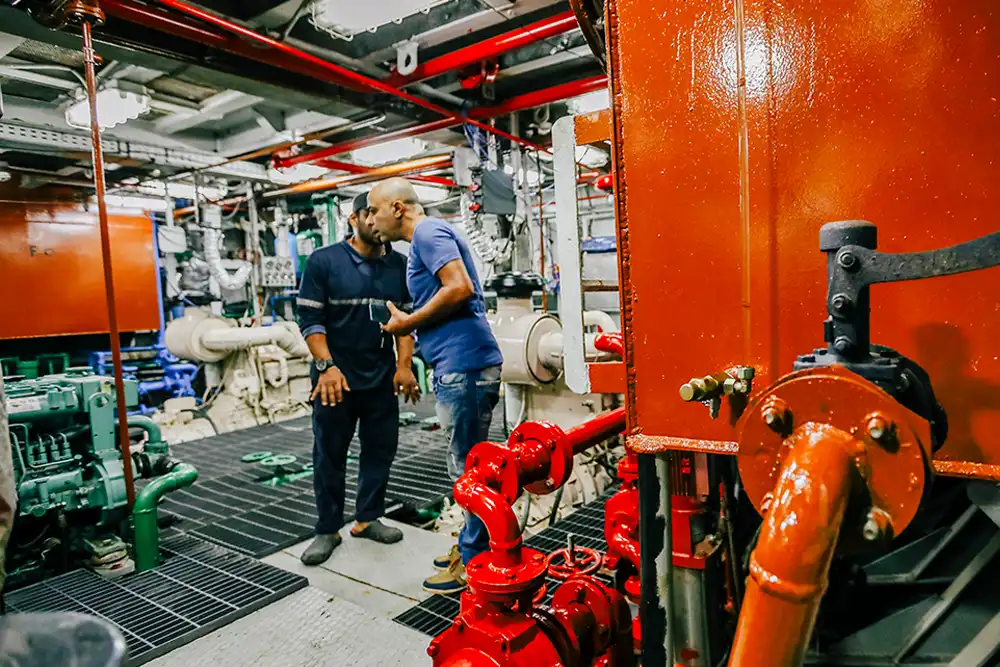
Smoke detectors, fire extinguishers, alarms (both audible and visual) and sprinklers are present in every room and confined space; pressurised fire hoses are spread throughout the decks, and the fuel system can be isolated and disabled from outside the engine room.
Other, less obvious fire-prevention measures have been installed, such as a deliberate lack of high-voltage power sources in the cabins.
There are no individual air conditioning units in the cabins; cool air is supplied from a system based in the engine room and managed through in-room vents.
Only USB power is available in sleeping quarters; devices requiring more power must be charged at an external power station, each outlet of which is independently fused.

In addition to the firefighting systems, all the entrances to Monsoon’s interior can be sealed with watertight doors, and a watertight bulkhead in the middle of the sleeping deck must be sealed at all times the liveaboard is underway. Everything is well signposted; clear instructions for use are present everywhere.
Every safety system that one expects to be on board – and more – is present on Monsoon. Two 25-person life rafts which are properly secured and in date are present at the muster station.
Lifejackets are all SOLAS (international standards for Safety Of Life At Sea) approved flotation aids; an emergency position-indicating radio beacon (EPIRB) and search and rescue transponder (SART) are on board is present; the bridge is fitted out a GPS plotter, radar, satphone, Navtex marine safety system, and – as the crew are keen to point out – windscreen wipers, an often overlooked addition to liveaboards.
International safety standards

To prove that its boats meet the highest safety standards, Tornado Marine brought in Australian maritime consultancy MSI to thoroughly audit its vessels.
‘As our operations expanded, we reached a point where we wanted an independent, external review of our safety culture and onboard systems,’ said Bell, when I asked why the company brought in a consultancy from the other side of the globe.
‘We approached MSI because of their operational, not theoretical, understanding of maritime safety, and the Australian consultancy brought a strong background in commercial vessel risk management and incident prevention.
‘The goal was not certification for its own sake, but stress-testing how we operate in real conditions.’
Monsoon was rated by MSI as being four out of five stars, based on an overall of score of 81.5 per cent from a very expansive list of safety checks.
Other members of the fleet assessed were given three stars – an ‘acceptable’ rating, but Bell is keen to point out that this still represents an average of 72% scored across the three other vessels that were surveyed – and the boats have since been updated.

Some of the points found in the MSI audit were addressed by Tornado Marine while the boats were still in operation, such as upgrading the boats’ navigation lights to meet international collision at sea (COLREG) regulations, and adding fixed on-board firefighting systems throughout the boats.
Other work, such as adding a Plimsoll line to the hull – a measure of the maximum loaded depth of a vessel – or work that required welding, was carried out when each boat was sent to dry dock and drained of fuel.
Marketing director Mohamed Samir points out that SOLAS ratings are loosely classed as ‘mandatory’, ‘recommended’, and ‘voluntary’, and his team have moved well into the addition of ‘voluntary’ features – such as the addition of maritime signalling flags to replace lights in case of an all out power failure, and added redundancy in the naviagation, communication and firefighting features.

The team at Tornado Marine are rightly proud of their achievements and is keen to share them with an increasingly numerous cohort of divers for whom a liveaboard’s safety features have become something of a unique selling point. At the top of that list is a pride in the way they are reworking the entire approach to safety among their crews, from top-to-bottom.
Bell told us that crew members undergo regular safety drills, refreshers and scenario-based exercises, and the company actively reviews incidents from both their own internal perspective and those from the wider industry, to encourage crews to respond to an emergency in a manner that is ‘instinctive, coordinated and calm.’
‘What matters most to us is not a single piece of equipment,’ said Bell, ‘but how systems, crew, and procedures work together.
‘If there is one thing I’m most proud of, it’s the way safety thinking has become embedded in everyday operations — from voyage planning to guest briefings to crew communication.
‘Equipment can be installed quickly; culture takes time, and that’s where we’ve invested the most effort.’
A personal note

As noted above, Tornado Marine was, for some years, a go-to recommendation of mine, and that included Hurricane, one of the boats my friends had worked on.
While that was, at the time, the limit of my association with the company, I nevertheless felt I had some small investment in the operator, and, when three people died on board that boat, I felt that my trust had been irrevocably broken.
I will be honest – I was approached by Tornado Marine some time ago and, until I boarded Monsoon, I hesitated to write this article.
It is no small thing to recommend a company that has received such widespread criticism over alleged safety failings in the past.
Am I going to say this boat will never sink, or that no disastrous incident lies in its future? No, that would be foolish, but Monsoon meets all the criteria I would be looking for in terms of liveaboard safety, and Tornado Marine assures me that these standards are now in place across the fleet.

Before anybody asks: No, DIVE is not being paid for this article, and I haven’t been promised a lifetime of free liveaboard trips for writing it.
Tornado Marine’s owners and marketing team took my photographer friend and me out for dinner, where I told them exactly what I thought about liveaboard safety, and why the trust of many thousands of divers across Europe – and the globe – has been broken by safety failings in Egypt.
I have been outspoken about those failings, and I’m not about to stake my reputation on a free meal. Nevertheless, the Egyptian Red Sea and its diving are very close to my heart, and I firmly believe that, at some point, the tide must turn.
If the efforts of one company can help change the culture of safety in Egyptian liveaboards, then I think it’s fair to say Tornado Marine has taken a giant step forward.
Related articles
- Liveaboard safety – how divers can change it and when to walk away
- Appeals court upholds Conception captain’s manslaughter conviction
- All guests and crew evacuated after Maldives liveaboard fire
- Survivors of Thai liveaboard DiveRACE Class E fire speak out – part 1

- Aggressor Adventures to announce new destination at DEMA Show 2026 - 16 October 2026
- Ancient shipwreck discovered off Turkey could be world’s oldest - 15 October 2026
- Divemaster missing after dive boat sinks in Komodo National Park - 14 October 2026
