


The oldest known member of the critically endangered Iberian orca population has been found with a series of wounds which conservationists believe were caused by shotgun pellets.
The female orca, known as Toñi or ‘La Abuela’ – the grandmother – was photographed with multiple injuries to her dorsal fin and back during field observations off Cádiz, southern Spain, by conservation groups WeWhale Association and Iberian Orca Guardians.
Scientists from the two organisations said they had photographed Toñi a few weeks earlier, when the injuries were not present, and believe the number, size and distribution of the wounds are consistent with a shotgun discharge.
‘We know Toñi. We were with her a few weeks ago and these wounds were not there,’ said Janek Andre, founder and president of WeWhale and the Iberian Orca Guardians Foundation.
‘Now we are seeing multiple impact wounds across her dorsal fin and back which, in our assessment, are consistent with her having been shot with a shotgun.
‘For us, these aren’t anonymous animals. We know them individually; we know their families. Seeing Toñi, “La Abuela”, like this is devastating.
‘If someone has deliberately fired a shotgun at her, this is not only an act of extreme cruelty against an individual animal. It is an attack on one of the last remaining members of a critically endangered population.’
The Iberian orca population

Iberian orcas – also known as the Strait of Gibraltar or Gulf of Cádiz sub-population – came to global attention in 2023, following a series of incidents in which yachts sailing through the area were attacked and damaged by members of the group.
More than 250 boats have been damaged – and at least six sunk – by orcas around the Iberian Peninsula since 2020. Attention at the time was particularly focused on a female named ‘White Gladis’, who was sighted during a number of incidents.
Theories at the time suggested White Gladis might have been exacting revenge for a past injury, however, it was also observed that the animals’ behaviour during the incidents was not particularly aggressive.
The orcas seemed to target the boats’ rudders and left the area after disabling them, suggesting the behaviour might have been a form of play activity.
Experts at the time also noted that if a six-metre-long marine mammal weighing five tonnes really wanted to sink a small boat, it would have little trouble doing so.
One individual matters
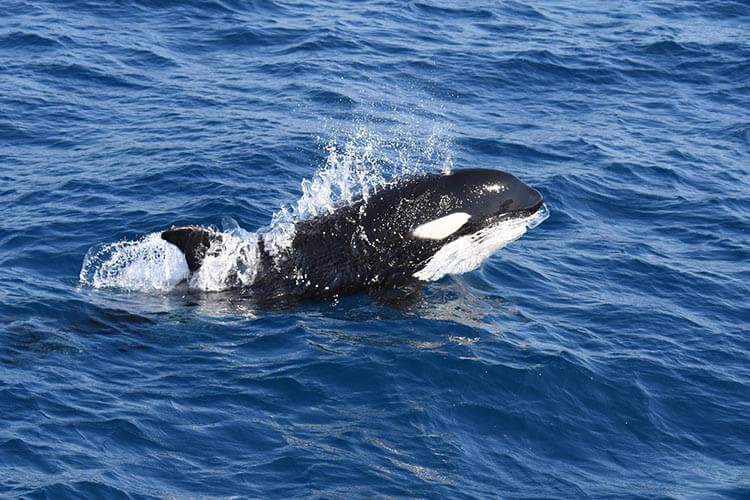
The Iberian orca population is critically endangered and consists of only a very small number of surviving individuals – as few as 35 members were reported in 2023, subdivided into five pods.
The orcas have a long history with humans, as they follow the migration of Atlantic bluefin tuna (Thunnus thynnnus), arriving in the Strait of Gibraltar in spring where they remain throughout the summer before migrating north along the Atlantic coast of Spain and dispersing into deeper waters.
Toñi is the oldest known individual within this population and has been identified and followed for many years.
Conservationists say that losing or seriously harming even one animal could have far-reaching consequences for the whole population, and no matter what the animals are believed to have done, killing them is not the answer.
‘There has been enormous public discussion about Iberian orcas and their interactions with vessels,’ said Andre.
‘Whatever someone’s opinion about those interactions may be, shooting at these animals can never be an acceptable response. These orcas need protection, not retaliation.’
A spokesperson for the conservation groups told DIVE that an investigation into the injury is now underway.
For more information about the Iberian orcas and their protection, visit the WeWhale and Iberian Orca Guardians Foundation websites
Related articles
- Orcas sink one boat, damage another, off coast of Portugal
- The orcas causing boat attacks in the Strait of Gibraltar
- Study explains why Orcas are attacking boats in the Strait of Gibraltar
- Lolita the orca dies after 53 years in captivity
- The orcas hunting whale sharks in the Gulf of California

- Underwater Magic – an extract from Michal Štros’ new book - 19 October 2026
- Aggressor Adventures to announce new destination at DEMA Show 2026 - 16 October 2026
- Ancient shipwreck discovered off Turkey could be world’s oldest - 15 October 2026
