


Why divers need to know that limits shouldn’t be broken, even if we know they can be.
At the time this article was originally written for our Summer print magazine, the tragedy in the Maldives in which five Italian divers and a member of the Maldives armed forces died in a Vaavu Atoll cave was still very much fresh in the memory.
As of the time this article is being republished on our website, now some four months after the tragedy, the results of an investigation into their deaths have not been made public.
With the evidence so far presented, however, it seems likely that the five Italian divers who died – four of them together in a 60-metre-deep dead-end tunnel – died because they thought they could do something they shouldn’t.
Many theories were floated at the time. Much of it was based in poor reporting by journalists who failed to do even basic research about scuba diving.
More egregious, however, was the woefully misinformed commentary in Internet-based dive forums, in which many self-styled ‘experts’ displayed an astonishing lack of knowledge regarding the fundamentals of depth limits, partial pressures and oxygen toxicity.
Many divers were quick to judge the deaths as being the result of breaking recreational limits: ‘These divers were effectively dead the moment they went in the water,’ said one social media poster, a self-described ‘hardcore adrenaline junkie’.
‘At 150 feet [45m], with recreational gear and without a special gas mix, you’re already dead,’ the commentator continued. ‘There was no possible way they were coming back, whether they panicked or not. That dive plan was never going to end with any of them alive.’
Except that’s simply not true. Many divers have reached 45 metres and plenty more on a single tank of air. It’s not an immediate death sentence.
Gas narcosis would almost certainly be an issue, but narcosis affects different people differently. Not everybody starts chasing mythical pink elephants after descending past 30 metres.
EXPERIENCE AND HYPOCRISY
In a post widely circulated on social media, Ramón Verdaguer, a Spanish diving professional and DAN Europe representative, said that many commentators were hypocritical in calling out the Italian divers.
‘Of those of us who have been diving for a considerable time,’ he said, ‘I would dare to bet that we have all exceeded the limits of prudence, diving in dangerous places and conditions, descending to depths currently illegal and with impossible gas volumes.’
He’s right. I am willing to bet that hundreds of thousands of divers have. I am one of them. My deepest dive was to 55m on a single tank of air.
My buddy and I – both experienced instructors with several thousand dives each – reached that depth briefly during a guided dive in Croatia. Conditions were calm, we had plenty of gas, I made a deliberate decision to follow the guide beyond 40m, because I thought it would be fine.
I was annoyed at myself afterwards, as I have always been something of a stickler for the recreational depth limits for which I am trained and have trained many others, but the impression I got from the guide afterwards was that this was a very common occurrence.
(Editor’s note – an update to this story that did not appear in the original print article, a recent presentation by DAN Europe CEO Laura Marroni, summed up by an attendee on the Swiss website Dekoblog, suggested that the Vaavu Atoll cave was regularly visited by recreational divers.)
A similar example cited by Verdaguer at the time was the 115m-deep Blue Hole in Dahab, Egypt, and its notorious archway, which connects the Blue Hole’s interior to the Red Sea via a tunnel at around 56m.
The arch is a good example of a dive in which people get into difficulty because it looks easier than it is. The Red Sea’s clear visibility (and probably the befuddling effects of gas narcosis) makes it appear like an easy swim-through, but it’s 25m long, and even a mild current passing through it means hard work and extra gas consumption, and suddenly there’s no exit, and it’s a long way to the top.
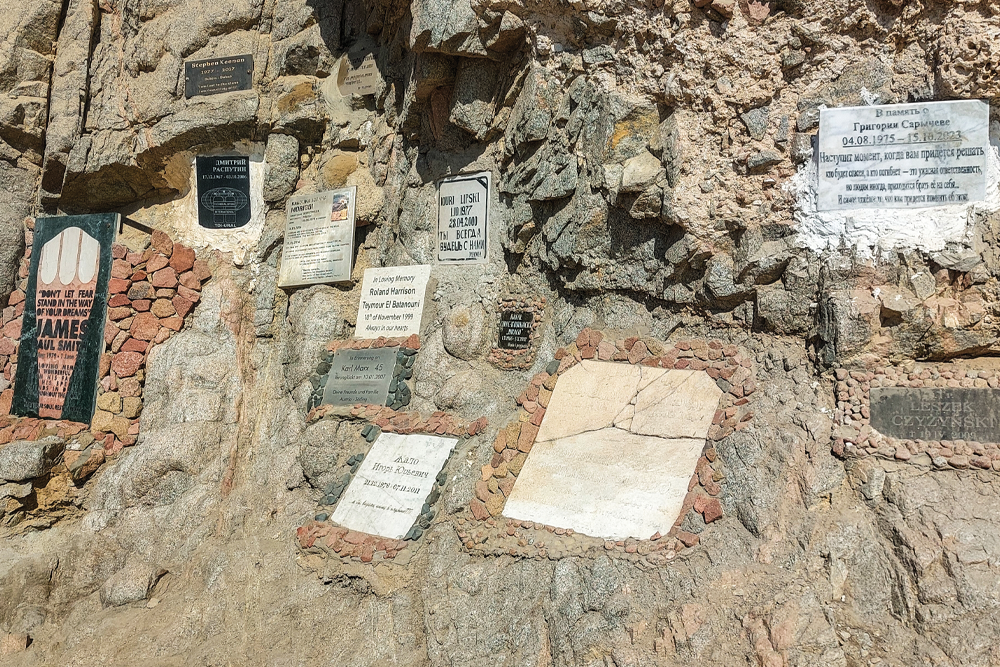
When I was working as a dive instructor in Egypt, a colleague tried to persuade me to accompany him on a dive through it. This was well out of my comfort zone, and I pointed to the plaques on the cliff wall above the dive site, commemorating some of the divers who have died there, as justification for my refusal. It’s a technical dive, for which proper gas mixtures and planning are required.
Popping down to have a look at the arch, however, was a fairly common occurrence. It is certainly ill-advised, but provides a comparable explanation for the Maldives tragedy.
The entrance to the Vaavu Atoll cave is reportedly at about 50 metres. If a hypothetical dive team had descended to the entrance, perhaps did a short tour of the inside – which has been described as a fairly large open space – then there would likely have been no incident. The team could have made a slow ascent and some extra deep stops and nobody would be any the wiser.
If that hypothetical team made a deliberate decision to swim through a 20m-long tunnel into a second, deeper cave, however – or swim through the Dahab arch – then the violation of recreational limits swiftly turns from ‘deeply inadvisable’ to ‘extremely risky’.
The problem is that one leads to the other. In good conditions, it would be perfectly possible for a reasonably experienced diver wearing recreational gear to descend to 50-60m on a single tank with no serious consequences.
At that depth, however, the margins for error are vanishingly small. Thinking you’ve got away with the first bit, so it’s okay to continue on to the second bit, is where it all breaks down.
Any change in circumstance at that point, such as an unexpected current, equipment problem, or moment of brain fog, might cause the Swiss Cheese model of safety to fail catastrophically, and very, very quickly.
KNOW YOUR LIMITS

An easy analogy to draw would be a comparison with motoring speed limits. There is a road near my house with a 40mph limit. It is wide, open, and at certain times of day not overly busy.
As an experienced motorcyclist, I am very certain I could ride down that road at 60mph or more and not come to harm. About a mile down the road, however, there is a slightly blind bend, which conceals a petrol station.
I could probably get away with the first bit, but the consequences of a mistake while breaking the limit in the second bit would almost certainly be fatal.
Do I therefore speed in the bit where I know I can get away with it? No. I stick to the limit. Having said that, when I was younger and considered that I knew everything after just five years of motorcycling, I may well have done.
The analogy is apt because it is sadly the case that most scuba diving incidents, certainly those resulting in fatalities, happen to divers who have a fair amount of experience, but – as clearly demonstrated by Internet analysts commenting on the incident – are not nearly experienced enough. They’ve taken a few courses, made a few dives, and think they know better.
While we don’t have all the answers to the Maldives tragedy, a scenario based around poor decision-making is worth discussing, because the hubris that leads divers into trouble is all too common – a fact to which the plaques above Dahab’s Blue Hole are testament.
As recreational divers, we need to respect the limits of our training, and seek more if we want to go beyond them. They have been accepted and developed based on years of study and practical experience.
That they are also extremely conservative does not give us permission to break them.
More great reads from our magazine
- Eight arms, six lamps, one perfect shot – Nur Tucker’s macro magic
- Bermuda Retriangulation – Jenny Stock dives the shipwreck capital of the Atlantic
- Octopus Boom! Lewis Jefferies dives the UK octopus bloom of 2025
- Hammerhead Heaven – on board the Cocos Island Aggressor
- Grouper Think – why Costa Brava is perfect for the CMAS photo World Cup

Take out a year’s print and digital subscription from £23.99
(UK price, international postage extra)
