


Jenny Stock overcomes her chilly childhood fear to brave some cold-water diving thanks to Venture Heat Europe’s heated drysuit vest
By Jenny Stock
Sharp childhood memories of the biting cold I endured living in a remote moorland terrace in the north of England haunt me to this day. No central heating, snow up to my chin, and an outdoor toilet with an ill-fitting wooden door left me with a residual trepidation that subsequently held back my diving adventures.
For twenty years, hot sand and bath-temperature waters have been the backdrop to my photographs. However, watching fellow photographers deliver stunning images from cooler climes made it clear I was missing out. ‘Be brave, push yourself, embrace the challenge’ a little voice in my head kept nagging me.
Recommendations from underwater photographers in Europe – mainly from Poland and the UK – led me to the Venture Heat, Pro Heated Dive Vest. I contacted manager Harro Cats at Venture Heat Europe to find out more.
Harro explained that when diving in cold water, whether that be recreational, technical, or extended decompression stops, keeping your core body temperature stable is critical. Cold can quickly lead to fatigue, reduced muscle performance, impaired cognition and cause complications in gas exchange during decompression.
When he offered a heated vest for me to try, I readily accepted and booked a trip to God’s Pocket in Canada – one of the world’s top cold water diving destinations – where the water temperature ranges between 7 and 12 °C.
What’s in the box?

The vest itself, a soft-shell undersuit with built-in heating panels on the back and chest and a velcro undercarriage strap. It can be purchased in eight sizes from 2XS – XXXL, and comes with a zippable side panel to make the vest larger if needed.
The vest is powered by two rechargeable 5000 mAh, 7.4 V lithium-ion batteries weighing 444g each, and a dual Y-cable charger with wall adapter and interchangeable mains adaptors for UK/Europe/USA.
Control is via a waterproof, rechargeable, wireless wrist-mounted remote that switches the vest on and off and adjusts between the three heating levels, which comes with a USB-A or USB-C powered charging stand.
A protective zippered washbag, o-ring grease and a safety instruction manual/guarantee card complete the package, which weighs in at just under 2kg (1,979g). The whole ensemble is depth-rated to 100m
Charging my batteries

The vest batteries are charged via two small, round, three-pin plugs on a Y-shaped split cable. As an underwater photographer, power sockets are always in high demand, and I love that the split charger enables both batteries to be charged at once.
A full charge takes around five hours with indicator lights displaying charge levels. The wireless wristband remote is charged on its own stand and takes around three hours to fill on a fast charge. Battery life on the remote is extensive – I recharged it once during my six-day, 18 dive trip.
The wireless remote comes out of the box already paired (instructions for re-pairing are included), so once everything was fully charged I could start my heated adventure. Correctly assembled, the vest is waterproof and saltwater-resistant, but must not be placed directly against your skin, so I donned it over my base layer thermals.
The vest has two zippable battery pockets on either side with cables to plug into the batteries. The batteries are sealed in an epoxy-filled capsule to prevent water ingress, although care must be taken to create a secure connection as oxidation of the connectors and undersuit resulting from exposure to saltwater isn’t covered by the warranty.
Once switched on, the vest enters standby mode while you finish kitting up. When you’re ready, a second two-second push of the on-switch will start the heat. LED lights display the current power setting, and haptic vibrations will also keep you informed in case you can’t see the lights.
I thought this was a fantastic feature, as operating the vest even in a full, bulky drysuit is easy and straightforward.
How does it work?
At the heart of the vest are heating elements placed at two key zones: one on the back, and one on the abdomen and chest area, which helps your body distribute warmth efficiently through your core.
Instead of traditional metallic wiring that is heated directly by its power source, the elements of the Venture Heat vest use carbon-nanofibre cables (similar to fibre-optics) that emit invisible long-wave infrared (FIR) radiation.
This radiation is then absorbed by your body, generating a mild, sun-like warmth – comparable to what you’d feel from an infrared sauna or gentle sunlight.
Keeping the body’s core warm with consistent heat has several advantages for cold-water diving. Comfort in lower temperatures means longer and more enjoyable dives, and will improve gas consumption as staying warm helps you relax and breathe more easily.
A warm core means warmer blood is circulated to the extremities, keeping your hands and fingers nimble, and staving off hypothermia – which can have fatal consequences underwater – will help to keep the mind clear and facilitate proper gas exchange within the body.
There are three heat settings, each with its own indicator lights and haptic vibrations, so you know which one you’re using. Most divers will be comfortable at level 1, which has a predicted battery length of around 6 hours, depending on water temperature and battery condition.
Level 2 is available for use in cooler waters, or as an option for keeping warm during longer dives, and Level 3 is generally reserved either for wetsuits or flooding drysuits. Battery life is shorter at the higher settings.
My experience using the Venture Heat vest
I’m a size 10 and opted for a medium-sized vest. Once I put it on I realised I didn’t need the expansion panel, but it’s good to have the option should I want to wear a bulkier undersuit (or eat all the pies).
Harro warned me to be conscious about battery placement so as not to rub against my hips, but I didn’t find this a problem, in fact everything was a snuggly fit inside my Aqualung Blizzard Pro drysuit.
Fellow vest users had suggested turning the vest on well in advance of the dive, as it’s harder to warm up from the cold than it is to maintain your heat level, so before my first dive, I took this advice and switched the vest on as I left the comfort of my centrally heated room.
The haptic indicator vibrated to let me know it was set to Heat Level 1, and within minutes, my torso was flooded with a warm, toasty sensation that passed over my body and remained there like a heated shield.
The remote is on a velcro elasticated wristband, the size of which can be easily changed, so I attached it to the strobe arm of my camera, rather than on my drysuit.
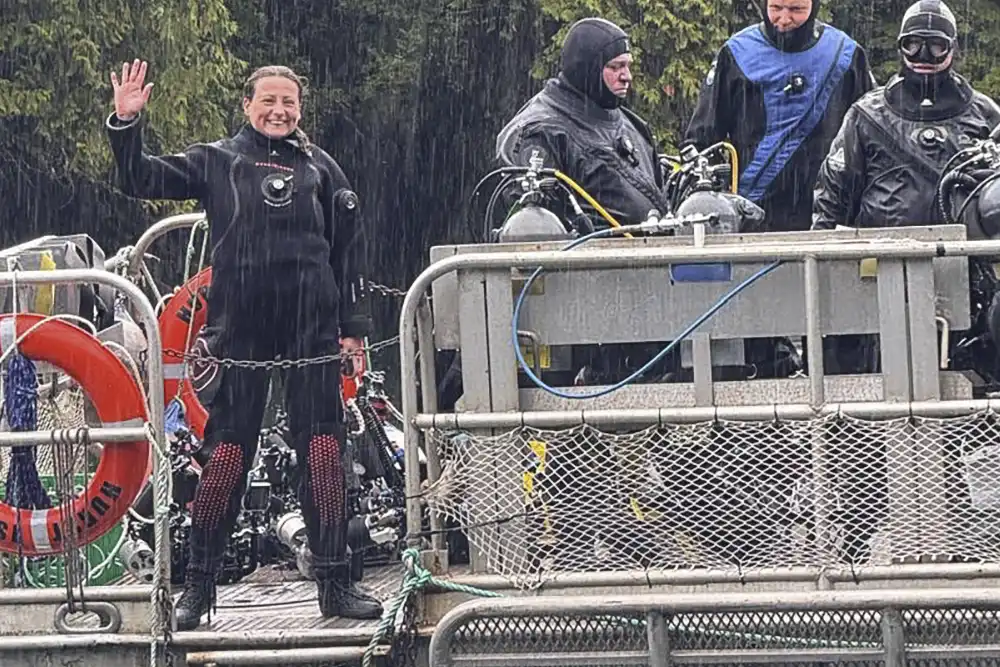
After a boat journey of 20 minutes of wind and rain (and sightings of surfacing humpback whales and scavenging sea otters) I stood on the back of the boat ready to take the plunge.
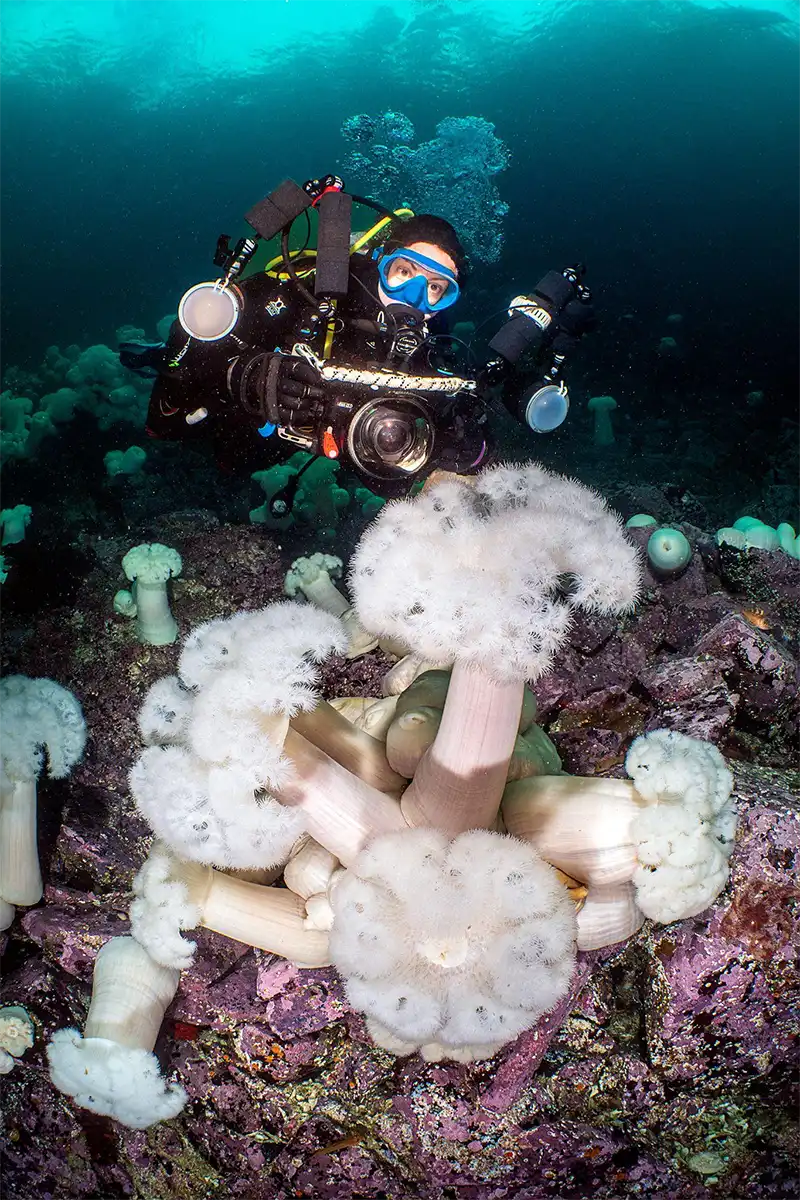
I will admit to some cold-water anxiety but this was alleviated but the warmth of the vest. As I splashed in, a whole new environment greeted me. Emerald green water, huge white plumose anemones and hooded nudibranch made for an overwhelming and delightful experience.
Dive one passed without a thought to the cold. I think novelty and excitement helped carry me through, however, the true test of the Venture Pro Vest was delivered with the shock I received on the second dive.
Still mastering the use of a drysuit, I accidentally dislodged my neck seal and felt an icy cold sensation begin to seep down my neck. Reluctant to get out and waste time fiddling with the seal, I simply ramped the vest up to Heat Level 3 and continued diving with a slow, growing cold patch down my neck for the rest of the dive.
My fingers were cold when I got out, but it was manageable. I’d learnt a couple of lessons, one to take care with my seals, and another that the heated vest can save a dive from a slow flood.
My diving continued without any more floods for the rest of the week. I have to say, I absolutely love the Venture Heat Dive Vest. It became the tech that I rushed to charge first when I got back to my room (my poor camera batteries watched on, waiting their turn).
The only small difficulty I had was that the batteries were sometimes a little hard to unplug from the vest. I continued to apply the o-ring grease supplied, and they have loosened up somewhat, but it took time.
I recharged every two dives, and I didn’t run out of battery on a single dive. Power was occasionally lost during the boat journey back to base but ultimately, the vest gave me the confidence to open the door to an incredible new world of diving.
I developed a Pavlovian smile-response to the haptic vibrations, as jumping from Heat Level 1 to Heat Level 2 on a dive was like receiving a warm hug underwater, enabling me to venture out into a world of wolf eels, mosshead warbonnets, swaying kelp and penpoint gunnels.
I would recommend that anyone citing the cold as an impediment to diving to invest in the vest – it’s the best!
MSRP Venture Heat Dive Vest: £894.99
ventureheat.eu
Related articles

