


The second part of Seattle-based marine biologist Bella Zandoná’s fantastic article ‘My Octopus Mother and the Cephalopods of the Pacific Northwest’, in which she explores some of the charismatic creatures she dives with on a regular basis
Words and pictures by Isabella Zandoná
Giant of the Emerald Sea

The giant Pacific octopus (Enteroctopus dofleini) is the undisputed icon of the Pacific Northwest’s cephalopod world. It is the world’s largest octopus species, with bigger individuals reaching 6m (20ft) and weighing up to 50kg (110lbs), but what makes them extraordinary is not just their size – it is their intelligence.
Seeing a giant Pacific octopus out in the open always feels like a privilege. They spend much of the day tucked away in dens, emerging mostly in low light or at night to hunt crabs, clams and fish.
Encounters are often brief, but unforgettable. I once came face to face with a 2.5-metre (8ft) female as she reached an arm towards me and wrapped her suckers around my gloved hand.

Each sucker contains specialised sensory cells, allowing an octopus to taste and feel by touch, and in that moment she seemed to be studying me as much as I was studying her.
Their lives are short and intense. Giant Pacific octopuses reproduce only once, and after laying eggs, the female guards them constantly without feeding. Over the following weeks, her body slowly fails as she protects the next generation.
When the eggs hatch, thousands of tiny paralarvae drift into the water column, where only a few will survive. The mother’s body becomes part of the same ecosystem she once hunted in, feeding crabs, fish and other scavengers.
It is a harsh ending, but also one of the most powerful reminders of how life beneath the Emerald Sea is always beginning again.
Little Red
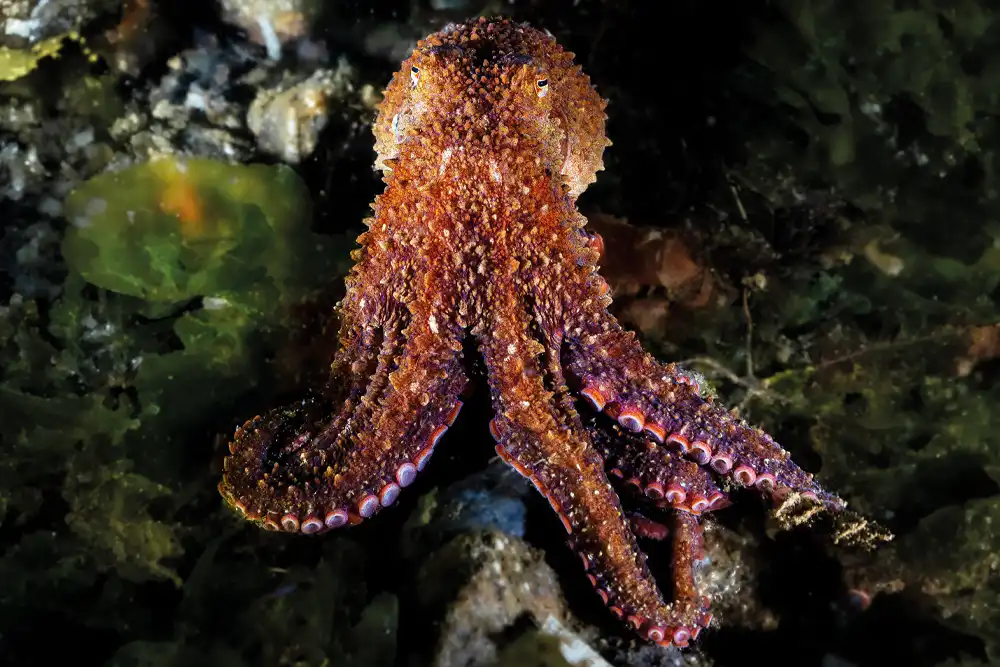
While the giant Pacific octopus commands awe in all divers, the red (or ruby) octopus (Octopus rubescens) entertains us! Smaller in size but overflowing with personality, these fiery little cephalopods are quick, bold and very mischievous.
Rarely exceeding two feet in length, they are endlessly curious, often approaching divers with an audacity that seems almost playful. Some of my favourite underwater laughs have come from the silly nature of these octopuses.
Once, I watched one crawl across the seafloor to investigate my camera housing, wrapping an arm around the strobe as if to claim it, before jetting off and leaving a puff of ink behind.
Another time, I watched one pull a hermit crab out of its shell, inspecting it, then tossing both the crab and the shell aside – as if playing a prank! I’ve watched them sneak under bottles, stalk unsuspecting crabs and vanish in an instant, leaving nothing but their ink behind.

The life cycle of the red octopus is even shorter than their giant cousins. Their lifespan between one and two years means that the population can fluctuate rapidly in response to environmental factors, food availability and predation.
They are preyed upon by larger fish, seabirds, seals, crabs and even other octopuses, making them a crucial part of the food web. Although they are smaller, they demonstrate incredible intelligence.
Seeing them out hunting is always a treat. They are stealth hunters, using their chromatophores to shift colours and perfectly blend into sand, rock and kelp.
Once prey is in range, they pounce, arms first, and trap it beneath them before using their sharp, parrot-like beaks to eat it.
Little Alien

Among the cephalopods of the Pacific Northwest, few are as charming, or as strange, as the stubby squid (Rossia pacifica). At first glance, it looks more like a cute toy than a living creature.
About the size of a golf ball (rarely more than five centimetres long), with a round body, short arms and two enormous eyes, it’s no wonder they are often described as little aliens.
Stubby squids spend their days buried in sand or silt with their big eyes exposed, blending into the seafloor. At night, they come out to hunt, feeding on small crustaceans, worms and shrimp.
Using two long retractable tentacles, they ambush their prey, pulling it into their beak and delivering a paralysing bite.
Stubby squids usually live between 20-300 metres deep, although I have seen them shallower. They live solitary lives, meeting other stubbies only to mate, after which both parents will die, and their life cycle rarely exceeds two years.
Encounters with these tiny purple creatures never lose their charm. Watching them cover themselves in the sand, making use of all their tiny suckers, really is amazing. For a moment, it’s hard to believe that they are real – so small, so perfect and completely at home in this harsh environment.
The ocean here is full of beginnings like that: brief lives that rise, drift and then fade. For every tiny squid that hatches, something else reaches the end of its story.
A rare miracle

Small, silvery and fast, the opalescent squid (Doryteuthis opalescens) is one of the most captivating cephalopods in the Pacific Northwest.
Their skin is also covered in chromatophores, but they additionally have iridophores – cells that reflect and refract light – giving them their opalescent name.
Using these cells, they can camouflage and signal to one another during courtship and hunting. Adults reach about seven inches in length, but their power lies in speed and their hunting precision, using their large eyes and long tentacles to ambush small fish and crustaceans.
Their movements are powered by jet propulsion, drawing water into their mantle cavity and expelling it through their siphon. They are short-lived, with a lifespan of six to nine months.
During mating, the males will use a specialised tentacle to transfer packets of sperm to the females, who will lay thousands of eggs in clusters that can be found anchored to rocks and other underwater structures, where they will incubate.

It was during one of these remarkable spawning events that I finally saw what I had dreamed of for years – the hatching of opalescent squid.
On my birthday in October 2025, we were diving at an underrated dive site named Junkyard in Seattle, when my dive buddy spotted a massive cluster of eggs.
The current was strong, and it took all my power to get close and hold position. We watched as, one by one, the eggs began moving, splitting open to release minuscule baby squid. Each was smaller than a grain of rice, around 2mm and barely noticeable to the naked eye.
Photographing the babies was no easy feat; even locating them in your viewfinder through a macro lens and dioptre is a challenge! It was a fleeting and miraculous scene.
To witness the hatching of opalescent squid is to glimpse an entire life condensed into moments – the beginning of a story that will end in less than a year yet sustains so much life.
More great reads from our magazine
- My Octopus Mother – Bella Zandoná’s unlikely friendship with a female GPO
- Full Circle – Crowley’s return journey through 25 years of Sharm El Sheikh
- Treasure Islands – Turks & Caicos with Aggressor Adventures
- Marine Manoeuvres – Aqaba’s underwater military museum
- On the Record – The extraordinary world of underwater sound

- Neighbours of the North Wall – life among Sund Rock’s wolf eels - 20 July 2026
- Cephalopods of the Pacific Northwest - 10 June 2026
- Diving with Bella – photographing Antarctic whaling ship Guvernøren - 8 May 2026

Click here to take out a regular yearly subscription
