


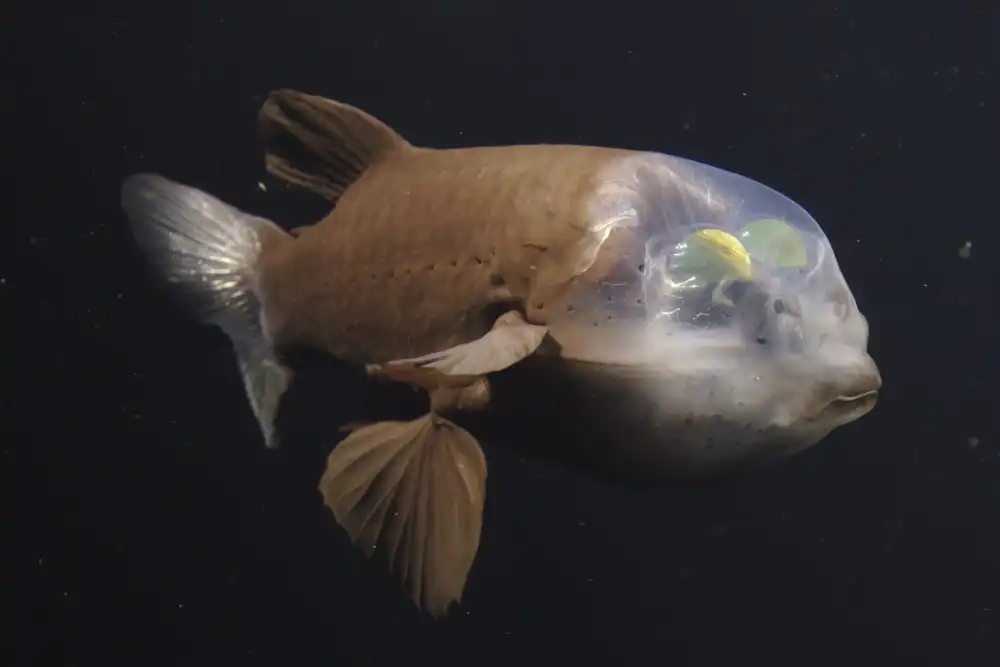
Researchers at the Monterey Bay Aquarium Research Institute (MBARI) have filmed a rarely seen barreleye fish (Macropinna microstoma) in the deep waters of Davidson Seamount, off the coast of California.
The fish was encountered during MBARI’s recent ‘Diving Deep for Delicate Drifters’ expedition on board its flagship vessel, the RV David Packard. It was only the institute’s 11th observation of the species in nearly 40 years of deep-sea exploration.
MBARI’s Biodiversity and Biooptics Team was exploring waters approximately 90km (55 miles) offshore, filming and collecting deep-sea animals using the remotely operated vehicle (ROV) Doc Ricketts.
The barreleye was spotted at a depth of around 600m as MBARI’s pilots were finishing for the day and returning Doc Ricketts to the surface.
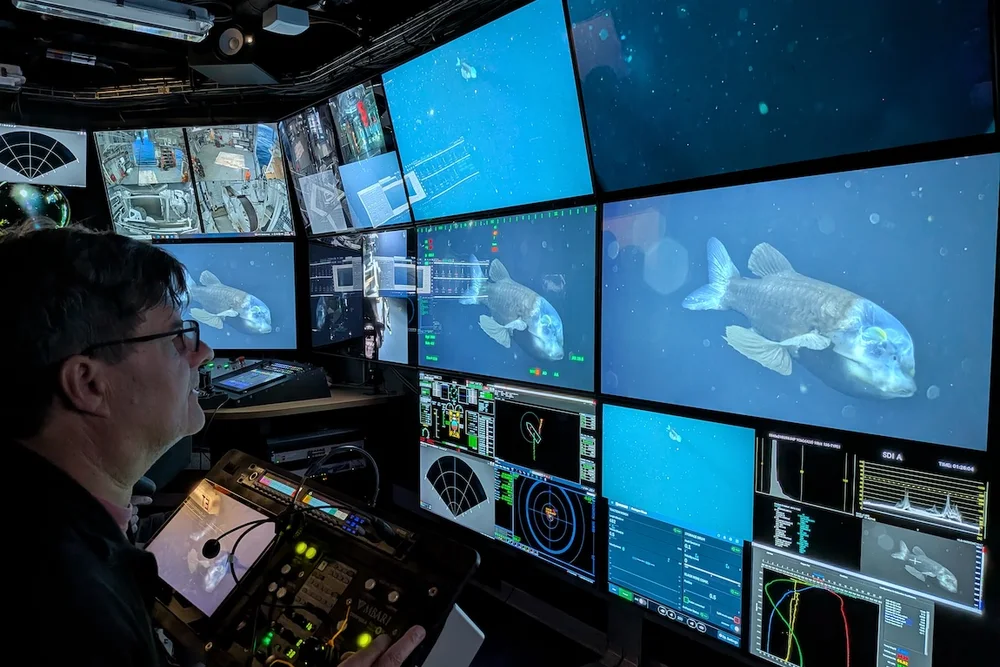
‘Seeing a barreleye fish is a rare treat,’ said MBARI senior scientist Steven Haddock. ‘Crew from across the ship joined the science team in the control room mesmerised by this remarkable animal.
‘Deep-sea animals capture the imagination,’ Haddock added, ‘creating wonder and awe that we hope will inspire stewardship of the largest living space on Earth,’
The eight-day Diving Deep for Delicate Drifters expedition set out to study gelatinous animals including jellyfish, siphonophores and ctenophores (comb jellies).
The research combined blue-water scuba diving near the surface with ROV surveys hundreds of metres underwater to investigate how these animals have adapted to life in deep water.
Barreleye fish – the scientific name Macropinna microstoma means ‘large fins, small mouth’ – live in the ocean’s twilight zone, scanning the water above for the silhouettes of prey.
Its large fins provide stability and manoeuvrability as it remains almost motionless, with its large, tubular eyes directed upwards through the transparent tissue of its head.
When the fish detects a prey animal, the eyes rotate inside the transparent dome to keep it in sight. The dome also protects the fish’s eyes while it picks small crustaceans from among the stinging tentacles of deep-sea siphonophores.
The expedition team observed the barreleye for approximately 20 minutes using a high-resolution 4K camera, testing different lighting conditions to examine its transparent head while manoeuvring Doc Ricketts close enough to record 3D stereo imagery with its virtual-reality camera.
The fish was not collected, but MBARI said the close-up footage would support further research into its vision.
Pigments in its lenses are thought to perform a similar function to the green eye pigments of the strawberry squid, Histioteuthis heteropsis, which act as a spectral filter, reducing downwelling sunlight so the animal can distinguish bioluminescent light from the surrounding background.
This helps to reveal prey which uses bioluminescent counterillumination as camouflage, which Haddock says is one of the unusual ways which fish living in the twilight zone have evolved to detect subtle optical signals in the otherwise virtually lightless water.
MBARI has completed about 7,000 ROV dives and recorded more than 41,000 hours of deep-sea video, but has encountered Macropinna only 11 times. Its previous sighting was in 2021; the latest encounter was the first filmed in 4K and the first recorded from David Packard.
For more from MBARI, visit the website at www.mbari.org, or follow the team on Instagram @mbari_news, Facebook @MBARInews, and YouTube @MBARIvideo
Related articles
