


Richard Condlyffe boards the Bahamas Aggressor II for a classic scuba diving liveaboard trip around the Caribbean archipelago’s best dive spots
Words and pictures by Richard Condlyffe
When we scuba divers think about the Caribbean, the first things that usually come to mind are turquoise waters, coral reefs and tropical sunsets, and nothing is more quintessentially Caribbean than the Bahamas.
With these thoughts filling my mind, I recently flew to Nassau and joined the Bahamas Aggressor II for a week-long itinerary in the central Bahamas, featuring diving in the Exumas and Eleuthera.
The Exumas consist of a series of cays stretching northwest to southeast for more than a hundred miles, much of it protected as the world’s first ‘Land and Sea Park’ which, since 1996, has also been designated a no-take zone. It also contributes to a wonderful feeling of remoteness both in and out of the water.
Eleuthera, situated east of Nassau, is a narrow island that borders the Caribbean Sea and the Atlantic Ocean; a location that defines the diving to be found there.

After boarding the yacht on the Saturday afternoon, guests were shown to their cabins to settle in before setting up their equipment on the dive deck, each at their own designated station.
Crew introductions and thorough safety briefings in the spacious lounge followed, introducing everybody to the ‘Eat, Sleep, Dive’ mantra for the week, followed by dinner and a chance to get to know my fellow guests – some experienced liveaboard divers, others first timers.
We left Nassau early on Sunday morning to first dive the sites south of Nassau en route to the Exumas. The highlight was the Lost Blue Hole, a 30-metre (100ft)-wide blue hole vibrant with life both around its perimeter and inside its depths.
Around the perimeter reef, I came across several southern stingrays, a loggerhead sea turtle, Nassau groupers and spiny lobsters. Descending into the hole, the bottom of which, at around 60m (200ft), is out of reach to recreational divers, I found a spotted moray peering out from its hiding spot in the side wall.
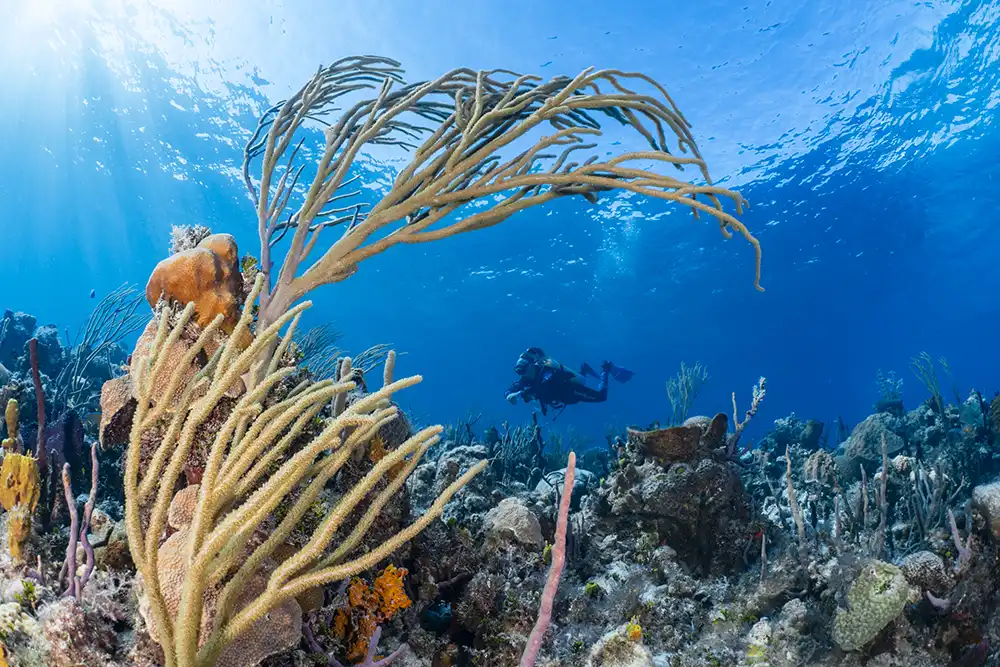
While not present on that dive, I have in the past observed a resident school of blacknose sharks (Carcharhinus acronotus) swimming up and out from the depths. This particular blue hole, in my humble opinion, is most definitely underrated and lives in the shadow of the more famous Belize Blue Hole.
With the first day of diving complete, smiling divers excitedly exchanged stories of the highlights of their diving day, and the Lost Blue Hole was definitely a big hit.
After the debrief, some of the guests relaxed in the outdoor lounge against the backdrop of a golden Caribbean sunset, while others unwound in the hot tub on the sun deck.
Dinner followed – and we quickly realised how well fed we were going to be that week! Each day, the crew laid out a continental breakfast before the first dive, a full breakfast after, lunch after the second dive, snacks after the third and dinner after the fourth.

The quality of the food was outstanding – it never ceases to amaze me how liveaboard chefs can come up with such delightful culinary creations in relatively small kitchens. One particular afternoon snack – the monkey bread – was an absolutely mind-blowing sweet treat.
The short three-hour ride to the Exumas was completed overnight, and by morning, we were ready to dive again. Much of the appeal of this area to me was the variety of dive sites and the diversity of marine life that comes with it; from deep plunging walls to shallow reefs, shipwrecks and plane wrecks, sharks, reef fish, crustaceans and molluscs.
The spectacular diversity of Exuma reefs
Diving off the island of Eleuthera was particularly memorable. Here, the sites are defined by dramatic walls where shallow reef tops give way quickly to deep blue water, creating a strong sense of scale and exposure that is both exhilarating and humbling.
The walls of Eleuthera, situated on the edge of the Great Bahama Bank, are influenced by nutrient-rich currents from the Atlantic Ocean, which bring with them an increase in fish life and the potential for larger encounters.
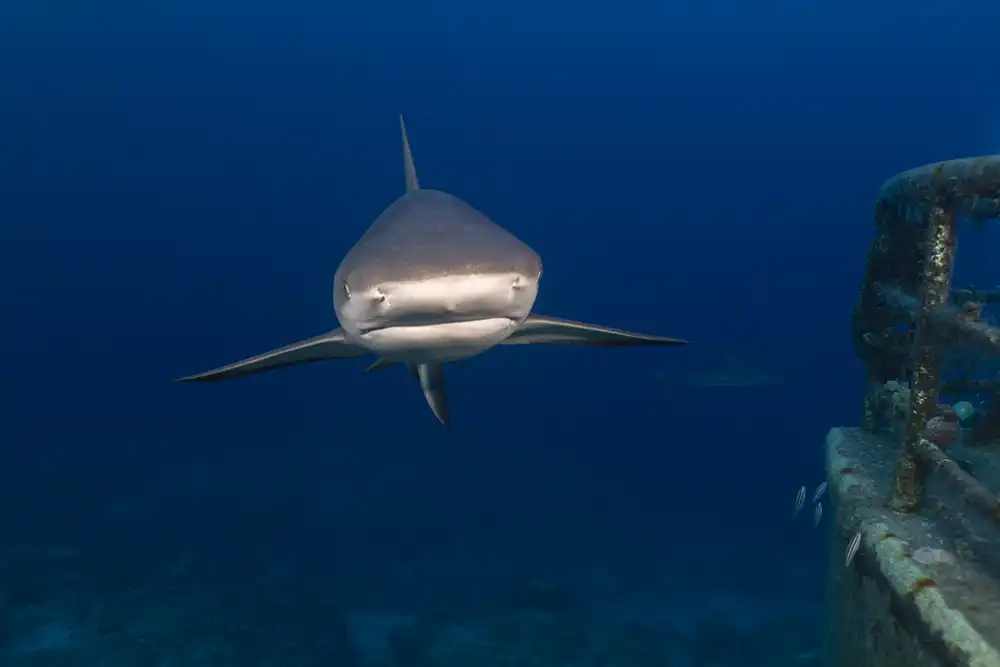
We saw Caribbean reef sharks cruising along the drop-offs, while schools of snapper and grunts gathered along the wall edges, seemingly suspended in the water column.
Eleuthera’s diving was energetic and dynamic. The coral growth is healthy, with large sponges and gorgonians thriving along the wall. The combination of depth, current and marine life made these dives especially rewarding.
Over the course of the week, we explored several dramatic walls. Dog Rocks was a particularly impressive wall site on the northern edge of the Exuma Cays, where the top of the reef sits at about 12m (40ft) and then plunges vertically into the deep blue, making it one of the region’s most thrilling sites.
The terrain features underwater canyons and dramatic swim-throughs – which proved to be very popular with the divers – and the coral life is rich, with black corals, huge tube sponges and elephant ear sponges that have been growing for hundreds, maybe thousands, of years.
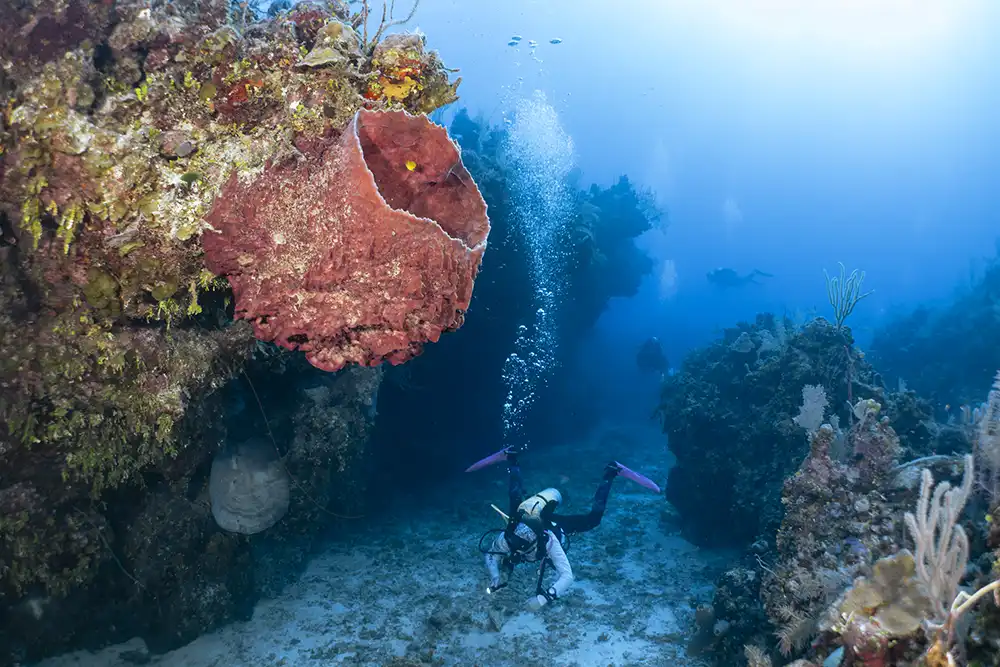
Caribbean reef sharks (Carcharhinus perezi) were spotted patrolling the wall, and a school of Atlantic spadefish (Chaetodipterus faber) hung out just above, not particularly phased by the presence of divers. As with most of the Caribbean nowadays, lionfish are ever-present.
With visibility often reaching 30m (100ft) of brilliant blue water, it was awe-inspiring to swim a short distance away from the wall and look back at the magnificence of its sheer scale.
Sites such as Crab Mountain and Three Peaks provided opportunities to explore shallower patches of reef and sand.
Trumpetfish could be spotted hanging vertically in the water, trying to camouflage themselves among gorgonians; exploring overhangs revealed spiny lobsters and huge channel clinging crabs. Green sea turtles (Chelonia mydas) were spotted at several dive sites, cruising the reef and periodically ascending to breathe.

One of my personal favourites, the flamingo tongue snail (Cyphoma gibbosum), could be found on several dive sites, usually attached to sea fans. While not a difficult subject to photograph, they are so beautifully patterned and fun to experiment with different angles and backgrounds.
The sandy patches that punctuated the expansive reefs provided a different type of scenery to explore. Seemingly barren at first glance, slowing down and getting low to the bottom brings with it the chance to spot yellowhead jawfish (Opistognathus aurifrons) dancing above their sandy holes. No sudden movements though, or they rocket back into the sand quicker than you can blink.
Southern stingrays (Hypanus americanus) nestled in the sand with only their eyes visible can easily be missed, but hermit crabs shuffling across the sand can be spotted by their tell-tale trails.

With such a diversity of dive sites and creatures, photographers need to pack both their wide-angle and macro set-ups and be prepared to make decisions before each dive on which lens to select.
With such good visibility, much fun can be had composing wide-angle images using divers or the yacht as a background.

Exuma wreck dives and sharks
There are several wreck dives that can be visited as part of the Bahamas Aggressor II’s Exuma Cays itinerary, with two in particular standing out.
Austin Smith was a 27-metre (90ft) Bahamian Defence Force cutter, named for a sailor killed in the line of duty in what has become known as the ‘Flamingo Incident’, a day of national reckoning for the Bahamian military.
On 10 May 1980, patrol boat HMBS Flamingo confronted a Cuban vessel fishing illegally in Bahamian waters. Cuban MiG-21 fighter jets attacked Flamingo, killing four Bahamian marines after they abandoned ship, among them Marine Seaman Austin Smith.
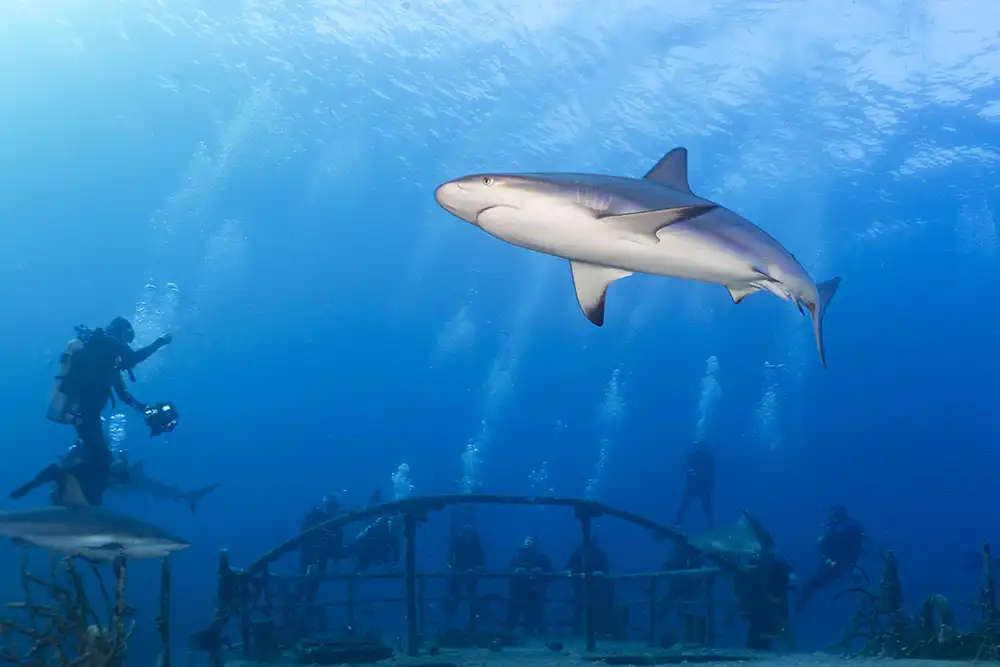
The United States Navy later donated four old cutters to the Bahamian Navy, each of which was named for one of the marines – Edwin Williams, David Tucker, Fenrick Sturrup and Austin Smith.
The cutters were decommissioned during the 1990s to be sunk as artificial reefs. However, Austin Smith sank while being towed to her intended location of San Salvador, blocking a shipping channel on the western side of Highbourn Cay, Exuma.
She was refloated and towed to her current location, where she now rests in 21m (70ft) of water, often frequented by Caribbean reef sharks and one of the ‘sharkiest’ highlights of the trip. HMBS Flamingo has never been found.
Not all wrecks are of ships, such as The Smuggler’s Plane, which sits in only 15 ft of water. We dived it in the late afternoon, when dappled light from the low sun pierces the water creating a beautiful backdrop to the wreck, and a second time as a night dive.
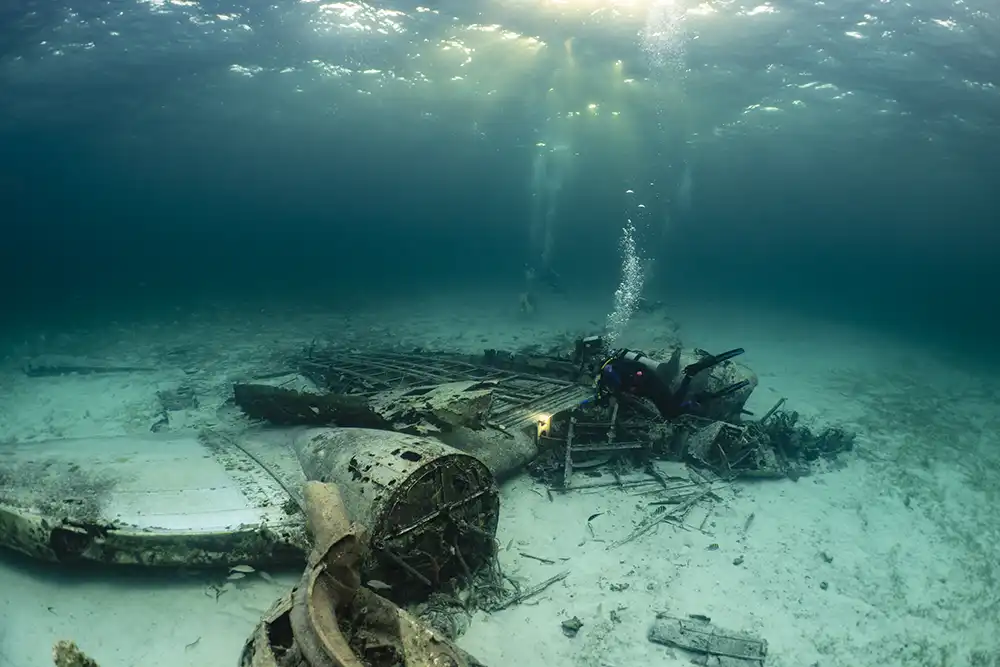
The story goes that this area was often used for drug smuggling in the 1970s and 80s by Pablo Escobar’s cartel. The pilot was an Englishman referred to as ‘British Andy’, who also happened to be quite a drinker. One morning, Andy, a little bit worse for wear, decided to practise his take-offs and landings, in what proved to be something less than a wise choice.
Andy was rescued by a nearby boat and survived without any scratches, but his plane now sits on the seabed where it crashed, a relic of a bygone era which now provides refuge for a variety of sea life.
Several giant anemones, some hosting spotted cleaner shrimps, can be found on the aircraft’s wreckage. Schools of grunts and snappers find refuge in and around the structure, and nurse sharks and stingrays can be found in the sand adjacent to the plane.
Before we knew it, and all too soon, Friday had arrived, and after our morning dives we began the journey back to base in Nassau.
From the moment we first boarded, the crew worked hard to ensure that all of our needs were met – on the dive deck, in the water, in the restaurant, the turn-down service, and the continued education courses taken by several divers.

As we made our way back to port, they continued to provide an excellent service, washing all of our gear and taking it up to the sun deck to dry.
Once docked, Aggressor’s Friday evening tradition is a cocktail party on the sundeck, where the guests and the staff continued to swap stories, looking back on their week, some receiving certificates and applause for completing the next steps in their scuba diving training.
As I journeyed home on Saturday, I reflected on the week on board the Bahamas Aggressor II. It introduced me to new friends from a wide variety of backgrounds and geographical locations; the WhatsApp group we created is still very active weeks after the trip concluded, and I have a feeling it will remain so.
The voyage through Aggressor’s Exuma Cays itinerary had also provided a great selection of dive sites and creature encounters to keep everyone entertained. I have a feeling it won’t be the last time I find myself photographing the underwater world of the Exumas and Eleuthera. Classic Caribbean indeed.

For more from Aggressor Adventures or to make a booking, head to www.aggressor.com
More from Aggressor
- Aggressor Adventures announces Belize Aggressor V and new Belize South itinerary
- Aggressor Adventures announces exclusive Tubbataha expedition with leading marine scientists
- Aggressor Adventures announces upgraded Red Sea Aggressor IV
- Aggressor Adventures CEO Wayne Brown dies aged 65
- New Philippines Aggressor itineraries launched for 2026
