


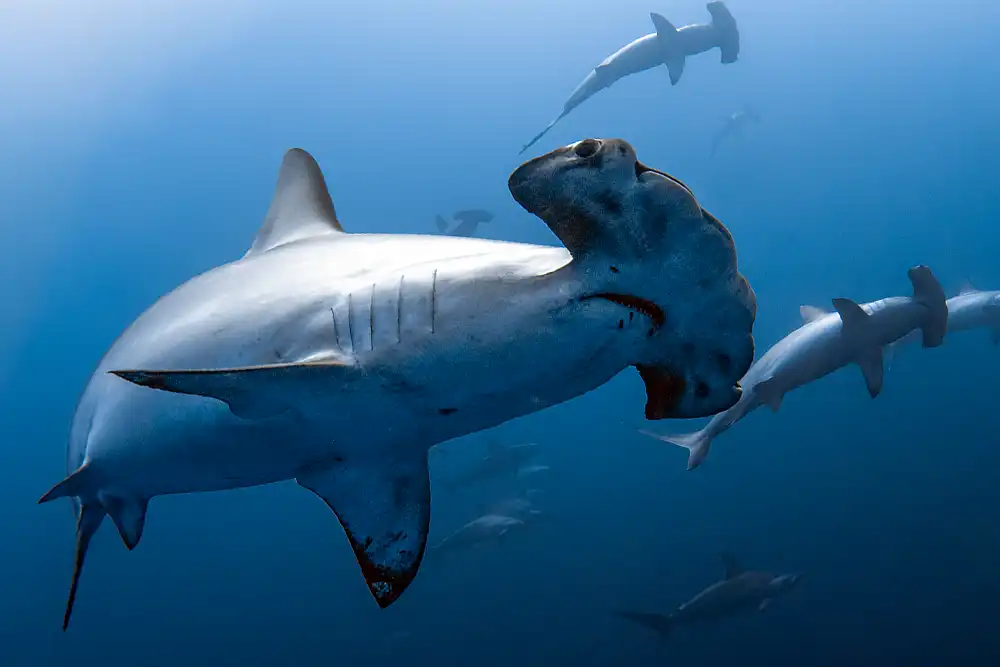
Governments meeting at the Convention on the Conservation of Migratory Species of Wild Animals (CMS) CoP15 in Brazil have agreed new protections for several threatened shark species, including thresher and hammerhead sharks.
The decisions, adopted on 29 March in Campo Grande, include new listings on CMS Appendix I covering all thresher sharks – pelagic, bigeye and common – along with scalloped hammerhead and great hammerhead sharks.
Appendix I listings require governments to implement strict national protection measures, including prohibitions on the catch of listed species, and an overall reduction in human-caused mortality across their range.
Dana Tricarico of the Wildlife Conservation Society’s Global Shark Conservation Team said the listings reflect the conservation status of the species.
‘Iconic ocean wanderers like large hammerheads and thresher sharks, that are already assessed by the IUCN as threatened with extinction, should be fully protected – and these CMS Appendix I listings are an important recognition that this should happen now,’ said Tricarico.
‘These listings recognise that slow-growing endangered shark species should be treated like other marine wildlife such as sea turtles or dolphins, and these listings should drive that action – but success will depend on how quickly and effectively countries implement these new obligations at a national level.’

Pelagic thresher sharks (Alopias pelagicus) are currently listed on the IUCN Red List of Threatened Species as ‘Endangered’, bigeye (Alopias superciliosus) and common threshers (Alopias vulpinus) are both classified as ‘Vulnerable’, while scalloped hammerheads (Sphyrna lewini) and great hammerheads (Sphyrna mokarran) are both classified as ‘Critically Endangered‘.
Each is a highly migratory species often caught both as targeted species and bycatch – hammerheads in particular are a high-value target for the illegal trade in shark fins – but as they move between different international jurisdictions, enforcing protections is conditional on cooperation between countries.
In addition to the new Appendix I listings, governments agreed to list the narrownose smoothhound (Mustelus schmitti) on CMS Appendix II, which is intended to support international cooperation on the management of migratory species.
The narrownose smoothhound is a species of houndshark endemic to the southwest Atlantic across Argentina, Uruguay and Brazil, and is targeted by commercial fisheries – particularly artisanal gillnet fishers – for human consumption.
Populations of the narrownose smoothhound are reported to have declined by more than 80 per cent over the last three generations, resulting in the species being classed as ‘Critically Endangered‘ by the IUCN Red List.
Juan Martin Cuevas, Wildlife Conservation Society’s Shark and Ray coordinator in Argentina, said the species is important for coastal fisheries.
‘This species supports small-scale coastal fisheries, where they are caught both intentionally and as bycatch. But their populations, and the communities that depend on them, are increasingly at risk without coordinated management,’ said Cuevas.
‘Since 2022, WCS teams have been working alongside local partners to monitor these fisheries, helping to identify trends and support science-based management in close collaboration with communities – and we will continue to do so to implement these new listings.’
Related articles
