


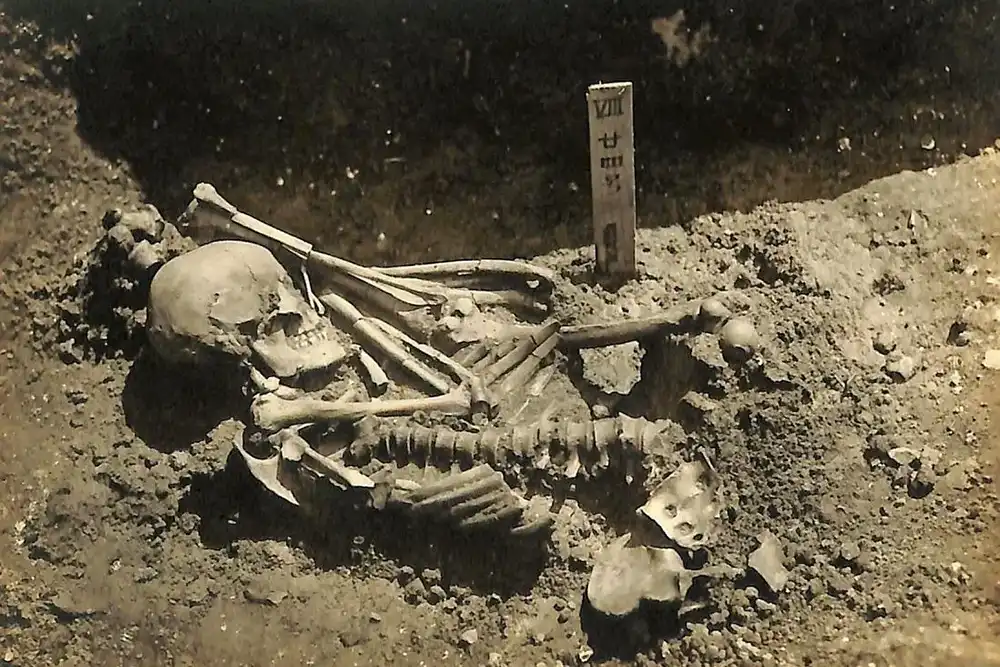
The earliest recorded example of a human shark attack fatality, dating back more than 3,000 years, has been discovered in Japan, according to a study published in the Journal of Archaeological Science: Reports.
The remains of the victim, an adult male, were radiocarbon dated to between 1370-1010 BC – more than 2,000 years older than the previously oldest known case, which was dated somewhere around 1000 AD.
The incomplete skeleton was originally uncovered in 1920, buried in a ‘shell-mound’ in a cemetery in Tsukumo, the 24th of more than 170 skeletons recovered from the archaeological burial site.
‘Tsukumo 24’ had been something of a curiosity since he was first discovered. He had clearly met a violent end: his left hand and right leg were missing; his left leg – missing its foot – appeared to have been severed and buried, inverted, on top of his torso; and at least 790 traumatic lesions characteristic of a shark attack – including ‘deep, incised bone gouges, punctures, cuts with overlapping striations and perimortem blunt force fractures’ – covered the skeleton, according to the study.
The injuries were initially perplexing to archaeologists, as the type, severity and distribution of the wounds made them unlikely to have been caused by another human, and did not appear consistent with the type of cuts that might have been caused by the stone tools in use at the time.
After reading reports describing shark attacks in modern times, the authors of the new study realised that Tsukumo 24’s injuries appeared to be remarkably similar, and set about using 3D imaging techniques and CT scans to map the injuries onto a model of a human skeleton, for further examination.
The location of the Tsukumo cemetery provided further context for the possibility that the skeleton belonged to a shark attack victim. Located close to the Seto Inland Sea, which lies between the western end of Japan’s main island of Honshu and the small island of Shikoku to the south, the area was known to be used for fishing during the Jōmon time period to which Tsukumo 24 belonged, including deep diving for abalone.
Shark attacks are extremely rare, and limited to just a handful of species. Based on the size and type of bites, the shark species thought most likely to be responsible for the Tsukumo attack are the great white and the tiger shark.
Great whites are known to frequent the Seto Inland sea, although there has only been a solitary fatality in which a great white was identified, from a total of four fatal shark attacks recorded since 1959.
Teeth from both species have been recovered in archaeological sites from the same Jōmon time period, although great whites appear to have been more common in the area than tiger sharks, which were more often found around the more tropical island of Okinawa to the south and west of mainland Japan. The study does not conclusively identify which species might ultimately be responsible for the attack, however.
Much of the evidence for what happened to Tsukumo 24 is circumstantial but is certainly compelling.
It is thought that he was alive when the attack began. A concentration of injuries around the victim’s left leg and pelvis suggest that this was where the shark first took hold of him; the loss of the left hand an indication he tried to fend off the animal and was ‘de-gloved’ in the process.
The severity of the wounds inflicted to pelvic bone indicate that Tsukumo 24’s femoral artery was probably severed, and his death would have been swift.
The pattern of injuries suggests that this was not a single ‘hit-and-run’ biting incident, and the shark continued to feed on Tsukumo 24’s corpse for some time – but perhaps not for very long.
There were no signs that the body spent any length of time in the water, and no sign of scavenging by other marine creatures. The report’s authors argue that Tsukumo 24’s companions were probably nearby and able to recover his remains shortly after the attack, whereupon his body – or what was left of it, at least – was accorded an appropriate burial.
The study of the ancient Tsukumo shark attack provides a fascinating – if decidedly grim – insight into the relationship between humans and sharks and, as the authors note, ‘one of the rare instances when humans were on their menu and not the reverse.’
While humans were known to be hunting sharks in the Jōmon period when Tsukumo 24 met his untimely end, the fishers of the time would have taken just a handful each year.
Today as many as 100 million sharks are slaughtered every year, often on the pretence of protecting people from ‘attacks’, while there is a reported average of just six human fatalities caused by sharks each year.
We have always shared this planet’s waters with sharks, which were here some 400 million years before modern humans were born – but Tsukumo 24 lived at a time when humans co-existed with sharks on a much more equitable playing field. One to which we should, perhaps, seek to return.
The complete report, ‘3000-year-old shark attack victim from Tsukumo shell-mound, Okayama, Japan’ by J. Alyssa White et al is published in the Journal of Archaeological Science: Reports
Related articles

- Polish cave diver breaks world scuba depth record with 338m descent - 23 October 2026
- Aggressor Adventures last-minute $1,000 savings on Belize Aggressor III - 23 October 2026
- SS United States to be sunk as world’s largest artificial reef in November - 22 October 2026
