


Scientists have confirmed the discovery of 38 new species and identified a further 28 following a Nippon Foundation–Nekton Ocean Census expedition in June 2025, conducted in partnership with the Japan Agency for Marine-Earth Science and Technology (JAMSTEC).
The discoveries were made in two deep-sea regions off Japan – the Nankai Trough and the Shichiyo Seamount Chain – areas that have received relatively little biological study.
The June 2025 expedition was conducted aboard JAMSTEC’s research vessel Yokosuka and supported by the manned submersible Shinkai 6500. Scientists collected more than 528 specimens, which were catalogued, imaged and preserved for future morphological and molecular analysis.
In October 2025, taxonomists from Japan and other countries met at JAMSTEC headquarters in Yokosuka for a Species Discovery Workshop, where the status of the newly collected specimens was assessed and further scientific papers coordinated.

‘The discoveries made in the Nankai Trough and the Shichiyo Seamount Chain remind us how little of our ocean has truly been explored, ‘said said Mitsuyuki Unno, Executive Director of The Nippon Foundation.
‘By supporting missions like this, The Nippon Foundation is helping to open a new frontier of knowledge for Japan and for humanity. Each new species discovery is a step toward understanding, valuing, and ultimately safeguarding our shared ocean.’
Two landmark papers have been published as a result of the expedition, including a study which revealed a five-fold increase in biodiversity in cold seeps found in the Nankai Trough, and a second covering the evolutionary history of symbiotic sponge-dwelling worms, which have evolved to live in what the scientists have named a ‘glass castle’.
Published in the journal Ecosphere, the study of cold seep habitats in the Nankai Trough, located about 500-600 km southwest of Tokyo, documented 80 animal species, more than five times the 14 previously known to the region.
The study also documented numerous range extensions, new national records, and previously unknown species associations, revealing that the Nankai Trough has an exceptionally rich biodiversity.
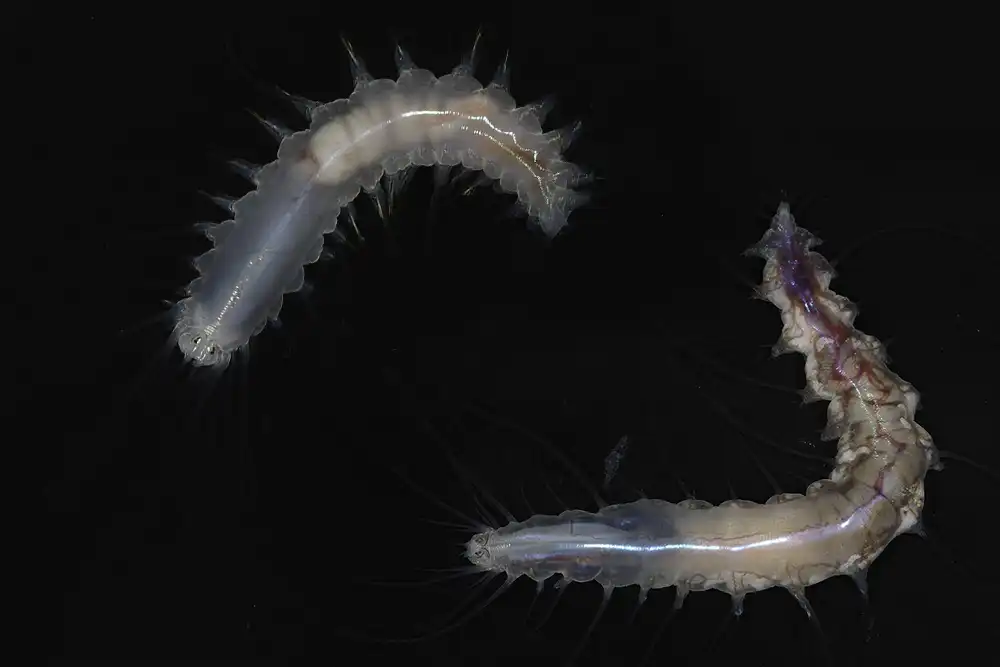
The second study, published in The Zoological Journal of the Linnean Society, covered the Shichiyo Seamount Chain, a series of submerged volcanic peaks located approximately 500-700 km southeast of Tokyo, most of which had not been studied in detail prior to the 2025 expedition.
Researchers on board Shinkai 6500 documented several new coral gardens and areas of seafloor densely covered with sponges, among them a large glass sponge hosting symbiotic polychaete worms inside its skeleton.
Glass sponges construct intricate skeletons from silica – the same material used to make glass – creating rigid structures that can provide cavities for symbiotic animals, sometimes known as ‘glass castles’.
Two new species of worm were formally described as a result of the expedition, together with five new species of squat lobster.
The scientists also found some species of soft corals, amphipods and gastropods previously thought to be rare or absent from Japanese waters.

Launched in 2023, The Nippon Foundation–Nekton Ocean Census is a collaborative initiative dedicated to accelerating the discovery of new ocean species.
Despite covering more than 71 per cent of the planet, only 240,000 marine species have so far been formally identified, with many more – perhaps millions – believed to remain undiscovered.
The project uses mobile laboratories and artificial intelligence to speed up the taxonomical process, and at least 927 new species have been identified since the project’s launch.
All documentation, images and species descriptions are made publicly available through the Ocean Census Biodiversity Data Platform.
More from Ocean Census
- ‘Death ball’ sponge among 30 new Ocean Census species discoveries
- Ocean Census announces discovery of 866 new species
- Ocean Census Arctic Deep documents extraordinary biodiversity
- 100 new ocean species discovered in New Zealand
