


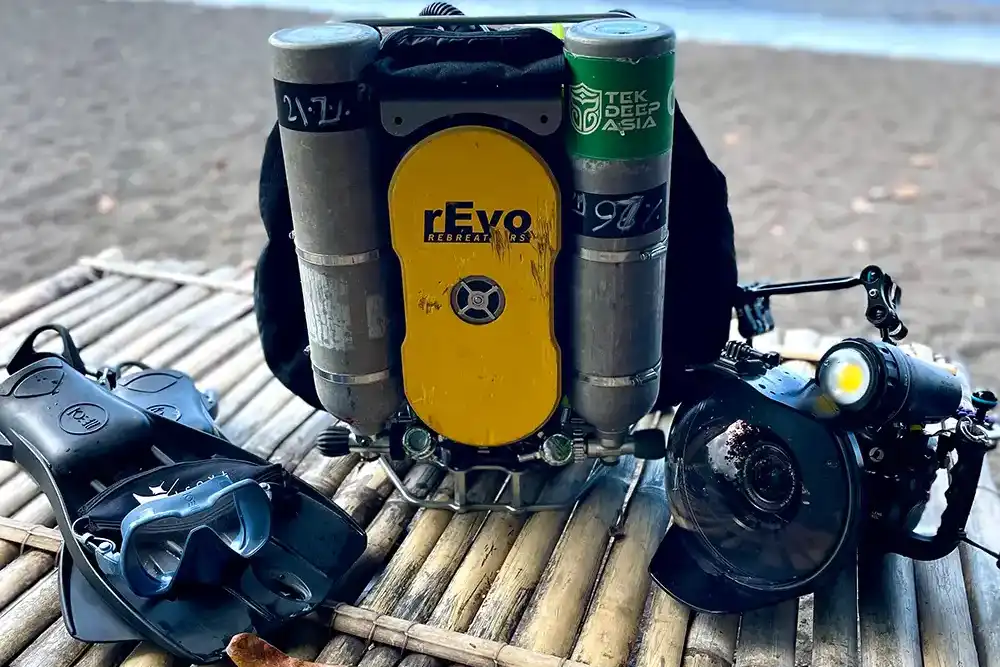
Conservation filmmaker, marine scientist and underwater photographer Jasmine Corbett describes how closed circuit rebreather training transforms not just your underwater photography, but your whole view of the underwater world
By Jasmine Corbett
As a scuba instructor and underwater photographer with thousands of dives under my belt, I assumed the transition to closed-circuit rebreather (CCR) diving would be relatively straightforward. Suffice to say, I was humbled very quickly.
For those unfamiliar, a CCR works in a fundamentally different way to open-circuit scuba. With traditional scuba, every breath you take from your tank is exhaled straight into the water as a stream of bubbles, whereas a rebreather recycles your breathing gas inside a closed loop.
The carbon dioxide you exhale as a waste product is removed by a chemical scrubber (a canister of material that looks a bit like kitty litter), while oxygen from a cylinder is injected back into the loop to replace what your body has metabolised.
You also carry an additional cylinder of breathing gas called the diluent, which is added to the loop to control gas volume, manage buoyancy, and keep oxygen levels within a safe range as your depth changes.
Because very little gas is vented into the water, the result is almost complete silence, dramatically extended dive times, and far greater control over how your body behaves underwater.
For photographers, this changes everything. No more racing against a dwindling air supply or worrying that every exhale will spook your subject.
Instead of sounding like Darth Vader underwater, you can hover quietly next to a turtle or a school of fish without sending them scattering. Patience replaces urgency, and observation becomes your strongest tool.
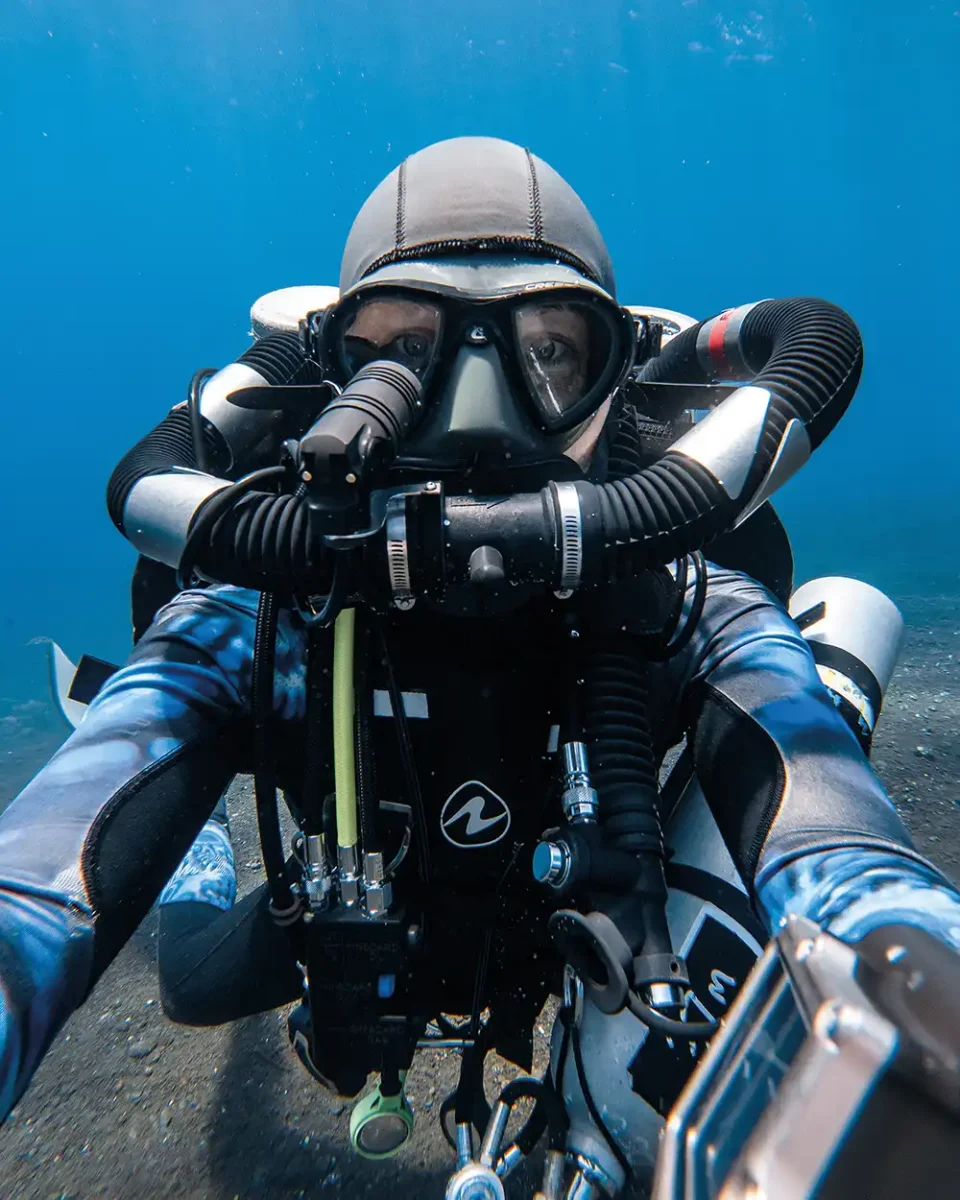
Having dived on open-circuit scuba for the last fifteen years, my curiosity to experience truly silent CCR diving had been growing stronger. Last year, I finally bit the bullet and signed up for the rEvo MOD 1 CCR course with TekDeep Asia in Bali.
Founded by Marc Crane – a legendary figure in the technical diving world who has been diving CCRs for over 20 years – it felt like the perfect place to learn. I was ready to soak up all of Marc’s knowledge like a sponge.
The course begins with an extensive day of theory, followed by repeated sessions of setting up, breaking down, and checking the unit.
Unlike open-circuit scuba, CCR demands an intimate understanding of every component. There are multiple oxygen sensors to calibrate, scrubber material to pack correctly – something of an art in itself – and detailed pre-dive checks that must be followed precisely both in the dive centre and again before jumping in the water.
When we finally jumped in for the first dive, it was equal parts exhilarating and humiliating, as if I were learning to dive all over again.
Suddenly, I wasn’t just thinking about photo composition. I had to constantly monitor the rebreather’s displays, think about gas behaviour, keep multiple bailout plans in the back of my mind, and attempt to master a completely different style of buoyancy.
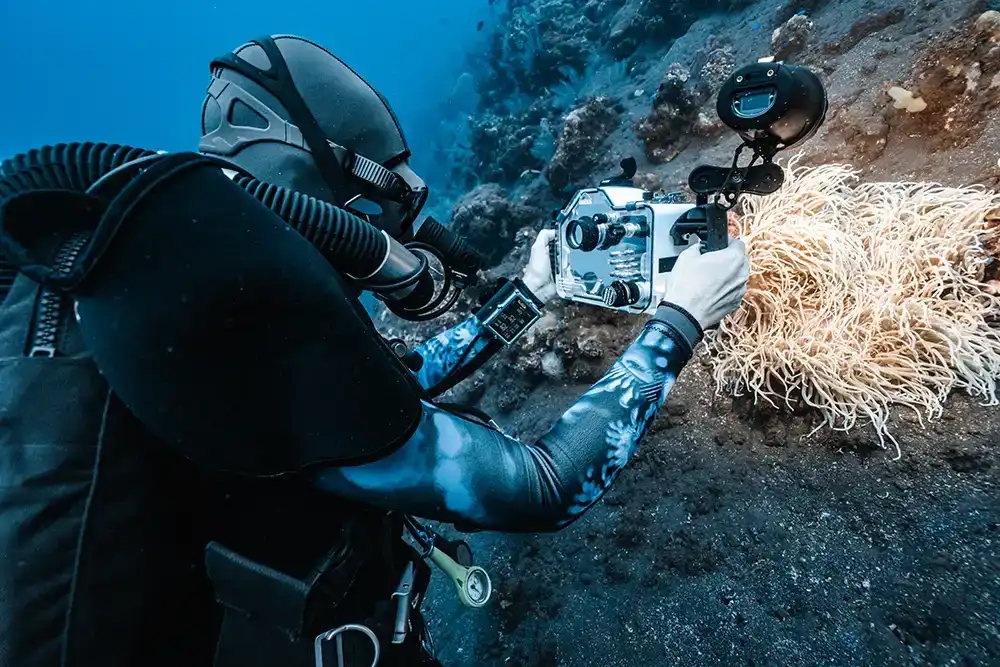
Buoyancy is one of the biggest differences between open-circuit and CCR diving, and one that catches many experienced scuba divers off guard.
On open-circuit, buoyancy is managed using your BCD and by controlling your breathing so that you rise as you inhale and fall as you exhale.
Using a rebreather, you also need to manage the buoyancy of the rebreather’s counterlungs – flexible bags that hold your breathing gas and expand (and therefore become more buoyant) when you exhale and contract when you inhale.
Add to that the volume of the gas inside the loop itself, which changes with depth, and suddenly buoyancy becomes a three- dimensional puzzle.
The first few dives had me flying up and down like a rocket. I had to learn to balance the manual addition of gas into the system with letting the CCR automatically top up the loop, and my first attempts had my cheeks puffed out like a chipmunk – all that extra gas has to go somewhere!
At first, it felt incredibly strange, but when it finally clicked, diving on a rebreather felt magical. Once trimmed correctly, I could hover motionless mid-water, adjust my position by millimetres, and stay stable for minutes at a time, a precision every underwater photographer dreams of.
Gas management using a CCR is far less intuitive than open-circuit scuba. Instead of worrying about how much gas is left in your tank, you need to monitor the partial pressure of oxygen (ppO2) in the breathing mixture to make sure it remains consistent at any given depth.

Too low and you risk hypoxia; too high and it becomes toxic, which can lead to fatal central nervous system (CNS) convulsions.
Modern CCRs monitor the ppO2 for you and automatically top up the oxygen as required, but the diver must always be prepared to make manual adjustments or implement bailout plans if the equipment fails.
Small mistakes can have serious consequences, so CCR training places a heavy emphasis on drills, failure scenarios, and bailout procedures. The learning curve is steep, and it demands respect.
The rewards, however, are worth every moment of frustration. Upon completing the course, I was able to head out for a few fun dives with my camera and truly experienced the silence I’d been yearning for.
Armed with a macro lens and video lights, I was able to film small reef fish completely undisturbed. On open- circuit scuba, the fish would retreat into the coral with every exhale.
On CCR, without a single disruptive bubble, they stayed perfectly still. CCR opens a window into underwater life that open-circuit scuba simply cannot.
Extended bottom times allow you to wait for wildlife behaviours to unfold naturally, rather than capturing a single moment and moving on. Silence keeps marine life calm. Instead of chasing shots, you let them come to you.
But CCR diving isn’t just about hardware – it’s about mindset. You need patience, humility, and the willingness to accept being a beginner again.
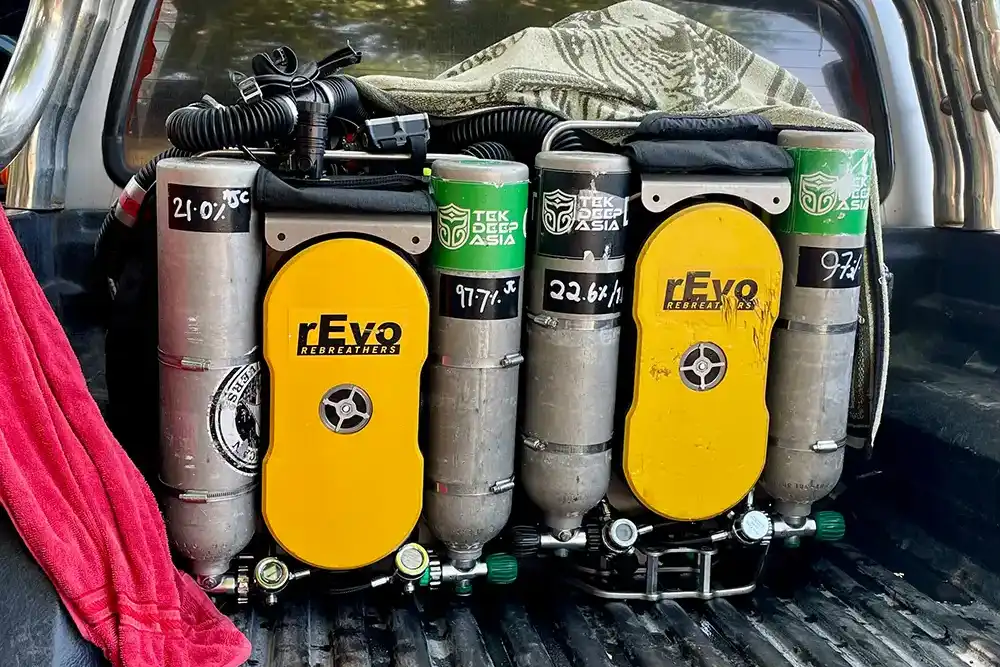
The gear is more complex, maintenance is critical, and mistakes carry consequences. Pre- dive checks are longer, dive planning is more meticulous, and situational awareness must always be sharper.
I faced challenges along the way, but TekDeep Asia’s guidance in Bali made them manageable, and by the end of the course I was hooked. There were laughs, tears (only once, I promise), minor panics, and moments of pure bliss.
I still remember surfacing after my first ‘smooth’ CCR dive, grinning at my buddy and saying, ‘I totally understand why people do this now.’
Learning CCR feels like seeing the ocean with a new set of eyes: slower, quieter, more deliberate. Photography benefits almost immediately, and expanding my dive skills to include CCR has transformed not just how I dive, but how I see the underwater world.
Every CCR dive feels like a chance to learn more about dive safety, to capture moments that were impossible before, and to move through the water with a grace I never imagined.
For any diver serious about underwater photography, embracing CCR isn’t just a skill upgrade – it’s a game-changer.
Jasmine Corbett is a conservation filmmaker, writer, marine scientist and award-winning underwater photographer. With more than a decade of experience in marine conservation across South and Southeast Asia, she has managed conservation projects, taught scuba diving and documented marine life through both technical diving and freediving. Jasmine uses storytelling and visual media to raise awareness of threats facing the world’s oceans, while fostering a deeper connection to their protection.
Jasmine was diving with TekDeep Asia; you can find more of her conservation work underwater photography at www.jasminecorbett.com and Instagram @jasminecorbettphoto
More great reads from our magazine
- Neighbours of the North Wall – life among Sund Rock’s wolf eels
- My Octopus Mother – a life-changing encounter in the Emerald Sea
- Making a splash – a judge’s eye view of the Dive Dauin photo splash-in
- The old man, the sea, and the son – a father and son’s diving journey to Galápagos
- Full Circle – Crowley’s return journey through 25 years of Sharm El Sheikh

Take out a year’s print and digital subscription from £23.99
(UK price, international postage extra)
