


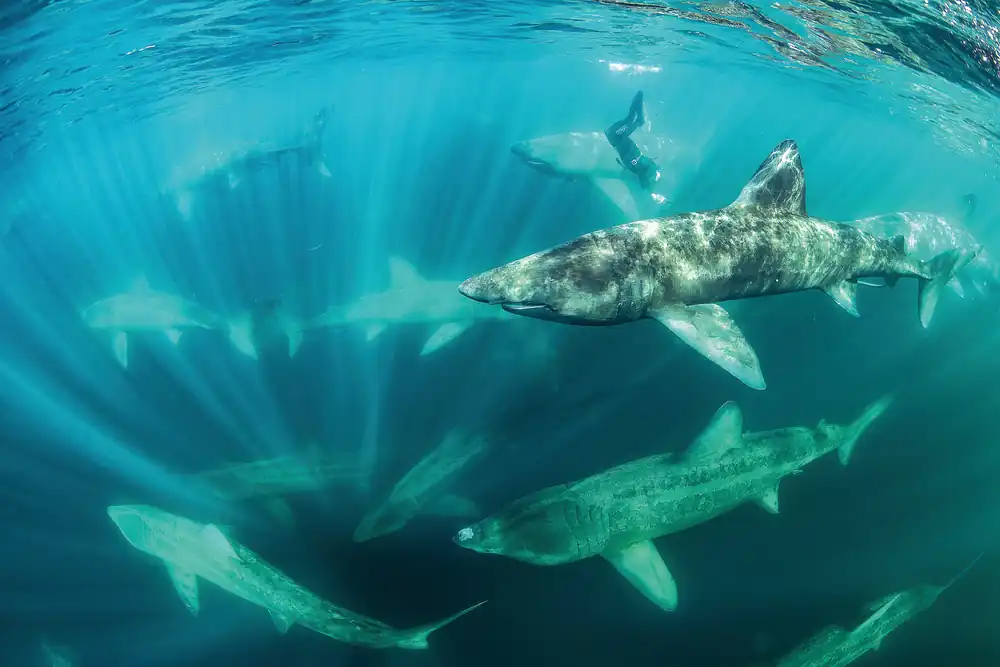
Award-winning photographer Nigel Motyer has been diving and photographing Irish waters since the 1980s. In his new book Beneath Irish Seas, he details the extraordinary depth of life found around the Emerald Isle’s shores, including this extracted chapter on basking shark aggregations off County Clare, featuring some of the most spectacular images of Ainmhí Sheoil – the beast with the sail – ever seen.
Words and pictures by Nigel Motyer
It sometimes seems there aren’t many good-news headlines in marine conservation these days, but one story that lifts the spirit is the resurgence of the basking shark in Irish waters.
When I started diving in the 1980s, a basking shark sighting was a very rare event. Ireland banned the hunting of these animals only in 1984, and the population had been in serious decline for decades.
They were hunted for their oil, which at one point was used to keep the streetlamps of London lit. Since the cessation of hunting, the number of sightings has steadily increased, and it is hoped we are now seeing a real recovery of this extraordinary creature.
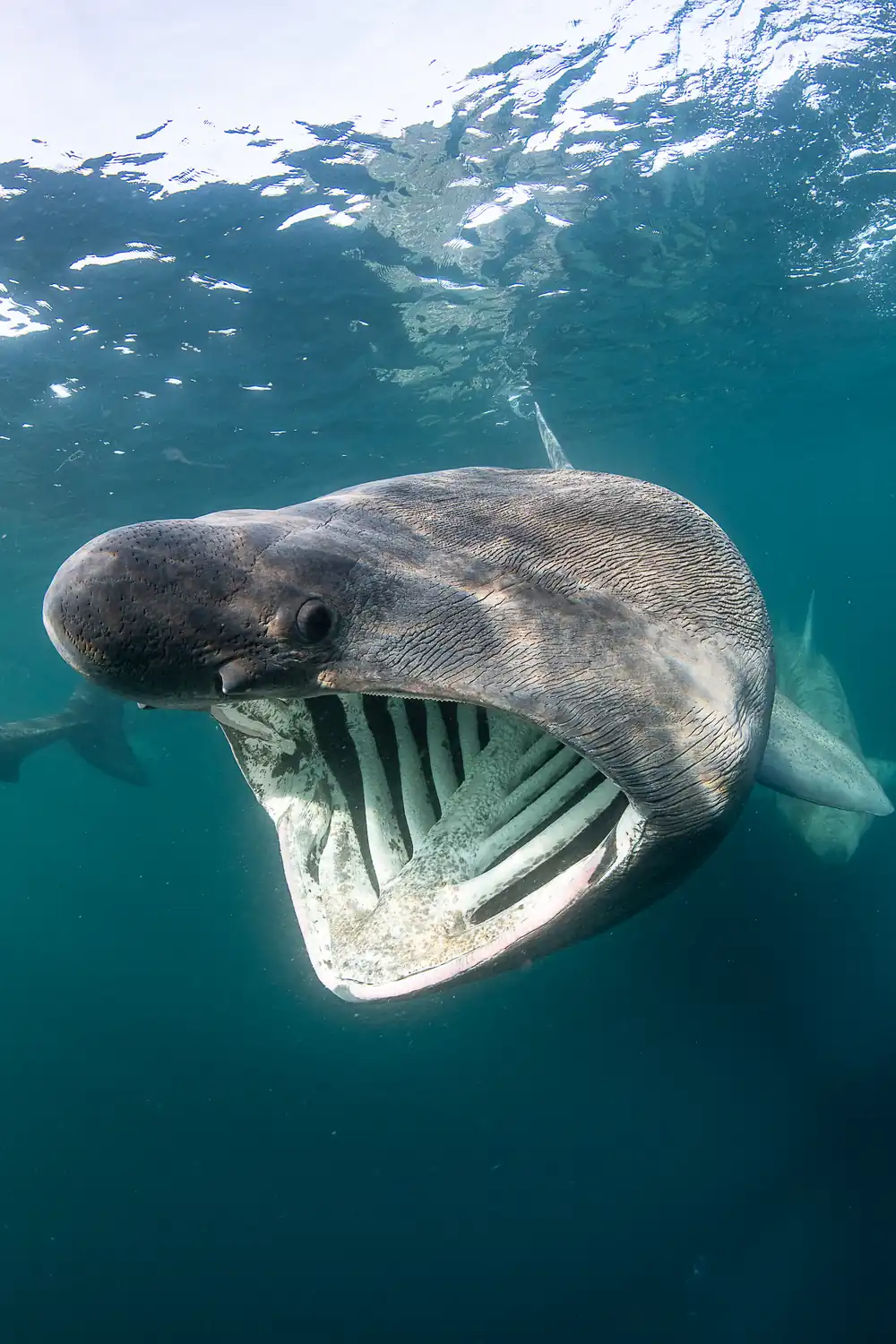
The basking shark is the second biggest fish in the sea, second only to the tropical whale shark, with some of the bigger sharks sighted around Ireland’s coast recorded at more than nine metres in length. They start showing up in Irish coastal waters in early April as the plankton bloom begins.
Groups of feeding sharks can be seen with flared mouths wide open, filtering huge amounts of plankton.
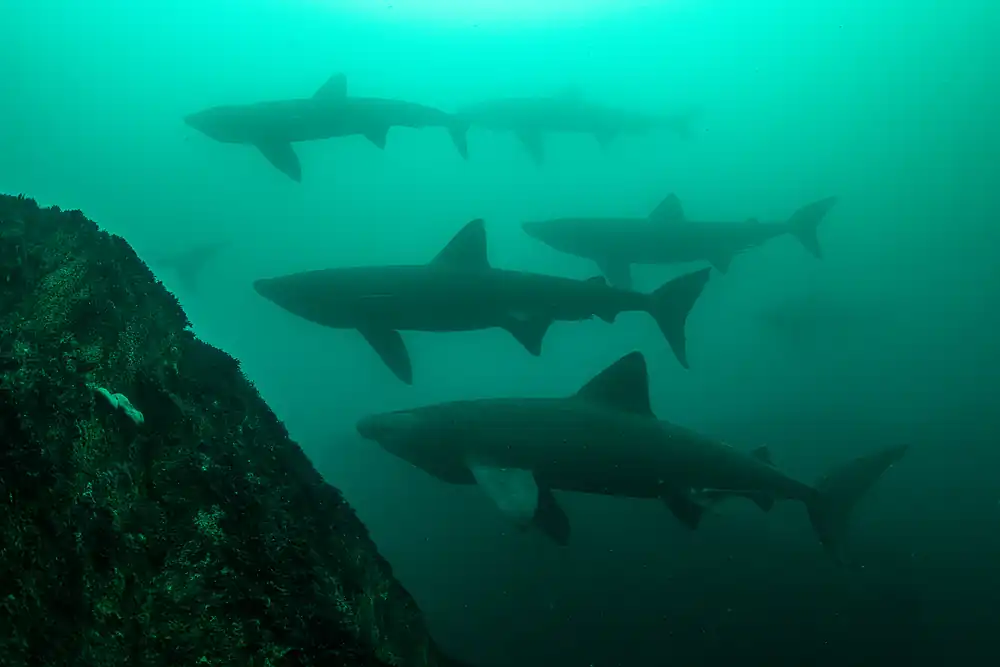
Most early summer observations of basking sharks are of feeding close to the surface. However, in recent years, in late August and early September a different behaviour has been seen.
With fewer sightings in Scotland and Donegal, the sharks seem to move a little farther south, and large numbers have been sighted gathering off the County Clare coast, at Loop Head and as far north as the Aran Islands.
I first photographed these aggregations back in August 2016, just southwest of the Aran Islands, with my dive buddy Nick Pfieffer when we were out looking for blue sharks. Since then, we have seen this behaviour more frequently, with the number of sharks sighted growing every year.
Little is really known about what is going on in these aggregations, but photographic records and observations are adding significantly to the knowledge being built up. The suggestion is that this behaviour may be a mating socialisation.
Once the sharks start gathering, smaller groups of up to thirty line up nose to tail, forming a circular spiral known as a torus. These groups are usually made up of large sharks, so probably sexually mature groups, strengthening the theory that this is mating behaviour.
Female sharks often appear paler in colour and some show signs of abrasion on their pectoral fins, possibly indicators of mating – the males of other shark species bite down on the females’ pectoral fins during mating, although, to the best of my knowledge, actual basking shark mating hasn’t yet been observed.

Perhaps the most spectacular behaviour we see in these aggregations is the sharks jumping out of the water. This is the easiest way to find them, as a 10-metre, 5-metric-tonne animal makes a hell of splash when it lands back in the water.
Again, nobody is really sure why they do this: it could be a show of strength or dominance, but other possible reasons vary from signalling to others, via the sound made when crashing back into the water, that they want to gather, to simply shaking off the parasitic lampreys that attach themselves to these sharks.
Whatever is going on, one thing is certain: despite this being one of the animal kingdom’s biggest species, it is still a very secretive animal, and the ocean gives up its secrets very sparingly.
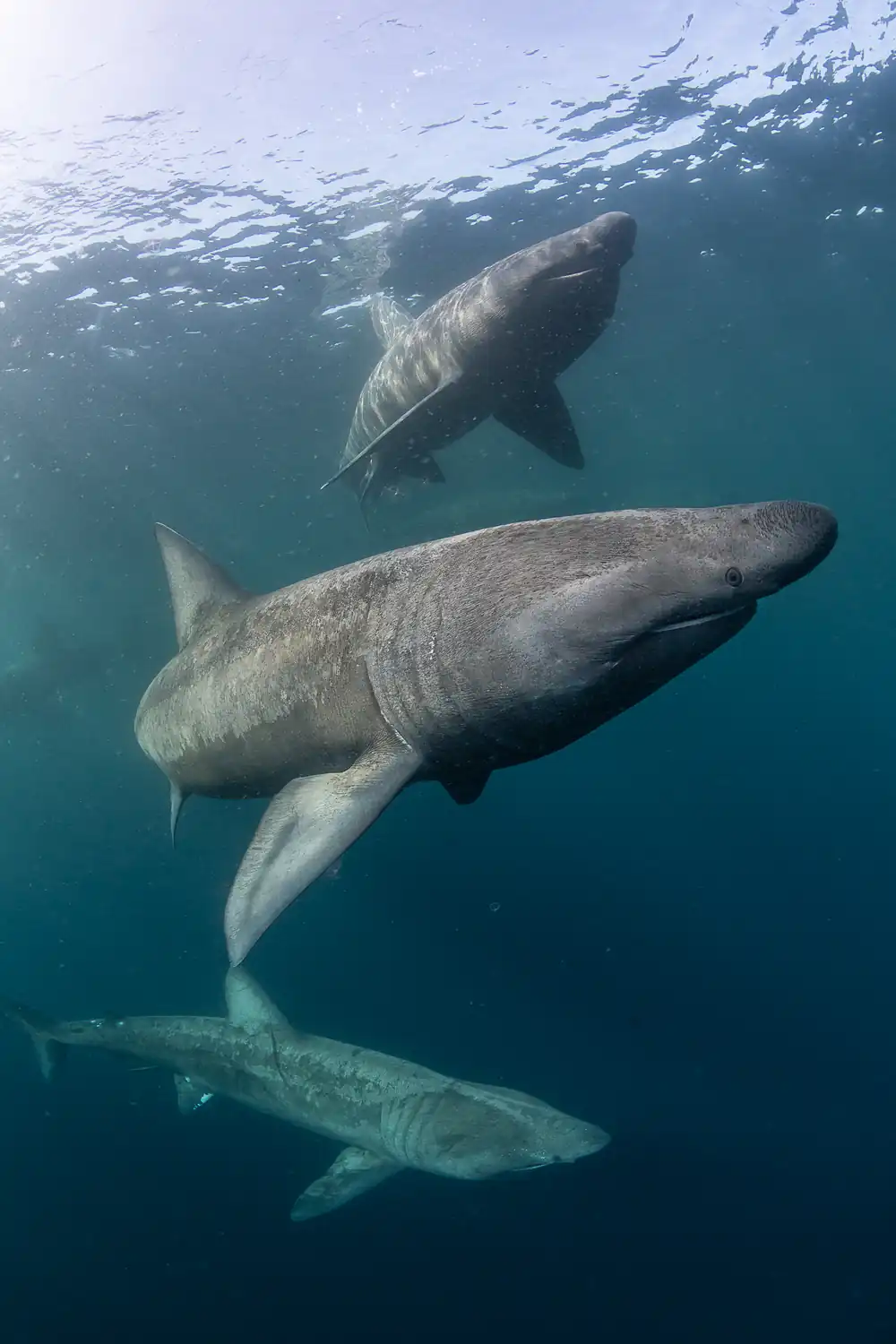
It should be noted that, in October 2022, basking sharks were given protected status under Section 23 of Ireland’s 1976 Wildlife Act, and a new code of conduct was published about how these animals should be approached, which includes the stricture that anyone entering the water should now stay at least four metres away from them.

Beneath Irish Seas is published by Ireland’s Merrion Press; available at all good bookstores priced £24.99
More great reads from our print magazine
- Full Circle – a return journey through 25 years of Sharm El Sheikh
- My Octopus Mother – a life-changing encounter in the Emerald Sea
- ‘Rays of Hope’ – an interview with the founder of the Manta Caribbean Project
- On the Record – The extraordinary world of underwater sound
- Marine Manoeuvres – Aqaba’s underwater military museum

Click here to take out a regular yearly subscription
