


Rescuers are racing to reach seven villagers trapped inside a flooded cave in central Laos, with specialist cave divers from the 2018 Tham Luang rescue now supporting the increasingly difficult operation.
A group of eight people entered the cave – a disused mine – in Long Chaeng district, Xaisomboun province, on 20 May.
The group was reportedly searching for gold and hunting for wildlife, but became trapped when heavy monsoon rain triggered a flash flood that blocked the entrance.
One member of the group escaped before the cave became fully flooded and alerted local authorities.
Rescue teams are believed to have reached around 100 metres (328ft) into the system, but said the trapped group is still about 30m (98ft) beyond the current accessible point.
Officials have expressed ‘cautious optimism’ that survivable air pockets remain inside the cave, and that the villagers may be sheltering in a chamber above the floodwater.

Kengkard Bongkawong, head of operations for Thailand’s Metta Tham Rescue organisation, said that while there is no official map of the cave system, its internal dimensions present the greatest challenge to the rescue teams.
‘The route is not complicated but the problem is the space,’ said Bongkawong. ‘The gap is quite low to crawl through, and we have to tilt at a 45-degree angle.
‘It’s so narrow that we have to crawl and tilt to pass through; also, the rocks are really sharp.’
Rescue footage released by Thai teams showed divers and volunteers moving slowly through muddy, partially flooded tunnels, with pumps deployed in an attempt to combat the persistent rain and lower water levels inside the cave.
Seven divers have so far joined the rescue effort, among them Finnish-born technical diver Mikko Paasi and Thai cave-diving instructor Norrased ‘Ben’ Palasing.
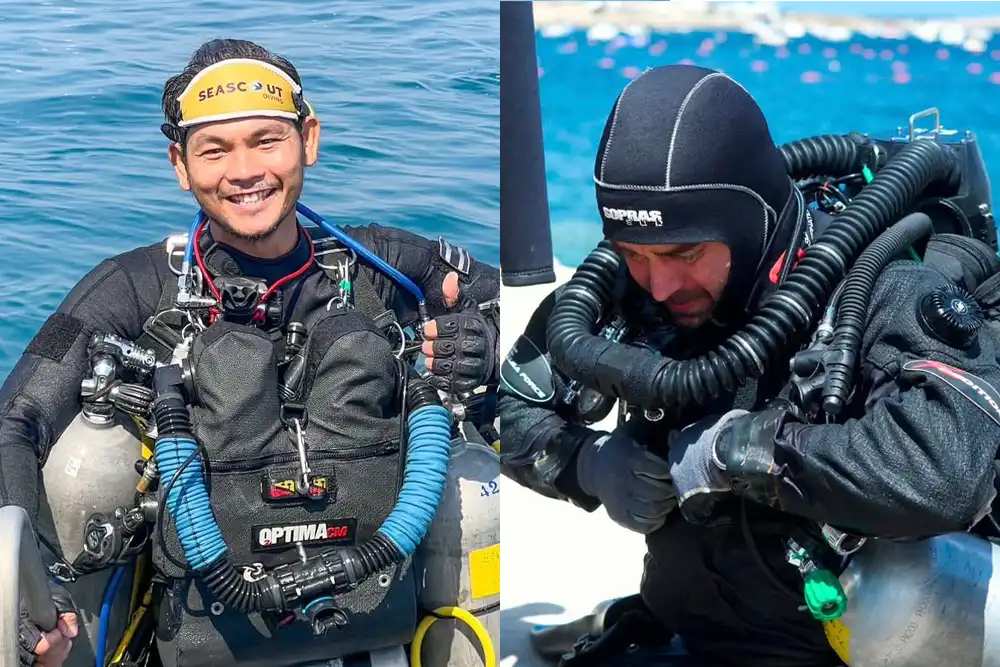
The pair were part of the international cave-diving team deployed to search for 12 boys of the Thai Wild Boars youth football team, who had become trapped together with their coach in the Tham Luang cave system in Chiang Rai, northern Thailand.
The rescue, one of the most complex cave-diving operations ever attempted, resulted in the rescue of all 13 members of the team, who had survived for 19 days trapped in an air pocket.
The Laos incident has drawn comparisons with Tham Luang, although in this case the trapped group consists of adults rather than children, and the logistical considerations are somewhat different.
The cave’s remote mountainous location has created difficulties for rescuers and equipment transport, with some personnel remaining stationed near the cave entrance because travelling to and from the operational area was proving physically exhausting and time-consuming.

In the most recent update on its Facebook page, Thailand Rescue Diver says that Paasi and Palasingh have made an investigative dive and reported that the cave is very narrow, and you must lie flat to crawl through.
‘Both of them have reached the point where they can dive, and they have tried diving,’ reads the report (translated from Thai) ‘They went to a very narrow spot and entered the small hole feet first through sand and stone.
‘The bottom of the mine is 5 meters deep, but inside there is not enough breathing air, so they withdrew. The entrance point is the narrowest point in the mine. If it can be passed, [there] will be a hollow [area beyond], but with [difficult weather conditions] they have come back out to re-plan.’
Related stories
