


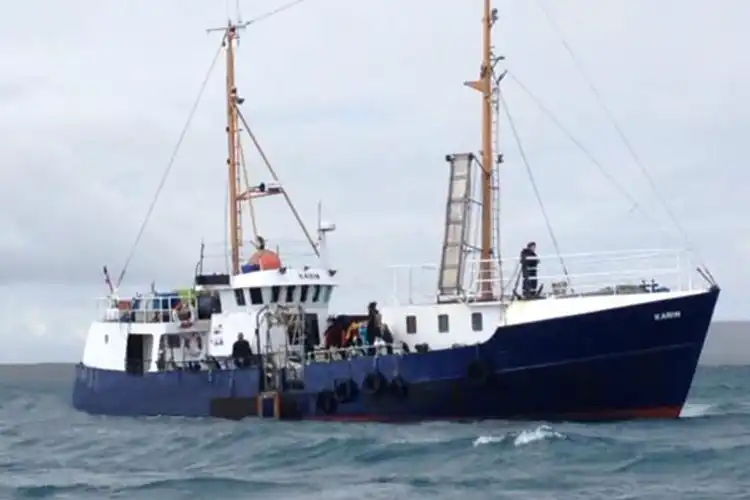
The 2023 death of an experienced diver killed by a boat strike was likely caused by the boat captain’s failure to post a proper lookout, and improper use of a delayed surface marker buoy (DSMB) by the diver himself, according to a report by the UK government’s Marine Accident Investigation Branch (MAIB).

On 28 September 2023, 70-year-old Paul Smith and his dive buddy were carrying out a decompression stop over the wreck of the German battleship SMS Markgraf in Scapa Flow, Scotland, when he was struck by the propeller of the dive boat Karin.
Smith and his buddy were diving from a different dive boat, Jean Elaine, and had deployed a DSMB from a depth of 30m at the start of their ascent, some 15 minutes prior to the incident.
Karin passed directly overhead while the pair were making their final safety stop at a depth of 3m.
Smith’s buddy, who had seen the boat approach, managed to take evasive action and swim down to 9m, but Smith himself never surfaced from the dive.
Despite repeated searches following the incident, Smith’s body was only located three weeks later, and finally recovered on 16 October.
A post-mortem examination concluded that the shape and severity of his injuries were consistent with being struck by a spinning propeller.
The cause of the accident

The investigation found that the most immediate cause of the accident was the failure of Karin‘s skipper to place a lookout on the bow as he went to collect divers.
The report also states there was a failure by the crews of both boats to effectively communicate their actions, and the position of their divers in the water.
Karin was approximately 110m distant from the pair of divers when her captain powered up the engines.
Meanwhile, Jean Elaine‘s deckhand had spotted two SMBs in Karin‘s vicinity, but this information was not relayed to Jean Elaine‘s captain, and other than a brief radio exchange when they arrived at the wreck site, there was no radio communication at all between the two vessels.

The view from Karin‘s wheelhouse was obscured by the height of the vessel’s bow and a raised shelter deck forward of the wheelhouse, which meant the captain could not see the surface for a distance of 100m to the front, with a 20° blind spot to either side.
With visibility blocked to such an extent, the standard practice in such situations would be to post a lookout on the bow, however, in this case, the deckhand who would ordinarily perform that duty on board Karin was busy in the galley.
The crew on board Jean Elaine reported seeing Karin motor right through the two SMBs before seeing a pair of blue fins briefly break the surface, before submerging again.
Smith’s dive buddy swam over to the DSMB, but found the line had broken, and there was no sign of its owner.
DSMB safety warning

According to the report, Smith’s dive computer showed a ‘sharp spike in depth’ from 3m to 1m as Karin passed overhead, followed by a rapid descent to the seabed at a depth of 41m.
The report states that Smith had clipped his DSMB to his BCD, potentially rendering him unable to detach it in time to escape the oncoming boat.
The report also suggests that the sudden spike may have been the result of the line from the DSMB becoming snagged on Karin‘s hull or ladder – which extended 2m underwater – which subsequently drew him towards the propeller.
MAIB suggested that Smith, a diver with more than 30 years of experience, may have clipped his DSMB to his BCD as he was ‘accustomed to doing so, having completed his training long before guidance was introduced advising divers to hold the reels or lines in their hands.
‘The use of DSMBs is an important safeguard for divers conducting drift ascents and decompression stops to indicate their presence to surface vessels,’ say the report’s authors.
‘Until 2006 it was not uncommon for divers to attach a DSMB to their BCD. However, UK guidance had since advised that divers should hold a DSMB in their hand rather than attach it to their person to prevent the risk of entanglement in an emergency situation.’
Summarising its report into the tragedy, MAIB said that ‘there was no structured safety management system in operation on either Jean Elaine or Karin‘, which put divers’ lives at risk both on board and when diving.
MAIB has issued recommendations to the British Diving Safety Group (BDSG) advising that dive boat operators should adhere to the Convention on the International Regulations for Preventing Collisions at Sea (COLREGs) concerning the provision of a lookout, especially when divers are in the water.
MAIB has also advised the BDSG to raise awareness of the hazards to divers that might arise from clipping a DSMB to their person while submerged, and that best practice is to hold the line or reel in their hands, and use a shot line where possible.
The complete report can be downloaded here.
Related articles
- Liveaboard safety – how divers can change it and when to walk away
- UK Government issues safety bulletin for Egyptian liveaboards
- Oil tanker and cargo ship collide off UK coast
- How to deploy a DSMB – essential dive safety kit

- Autopsies confirm Maldives tragedy divers ran out of air - 8 October 2026
- Peter Benchley’s Jaws memorabilia and dive gear to be auctioned for charity - 8 October 2026
- Shifting focus – an interview with Fabi Fregonesi - 7 October 2026
