


‘This will change the way you dive,’ Patrick Danko, Garmin Dive Product Manager, told the assembled scuba diving press, and in just one underwater excursion, Garmin’s Descent S1 buoy did exactly that.
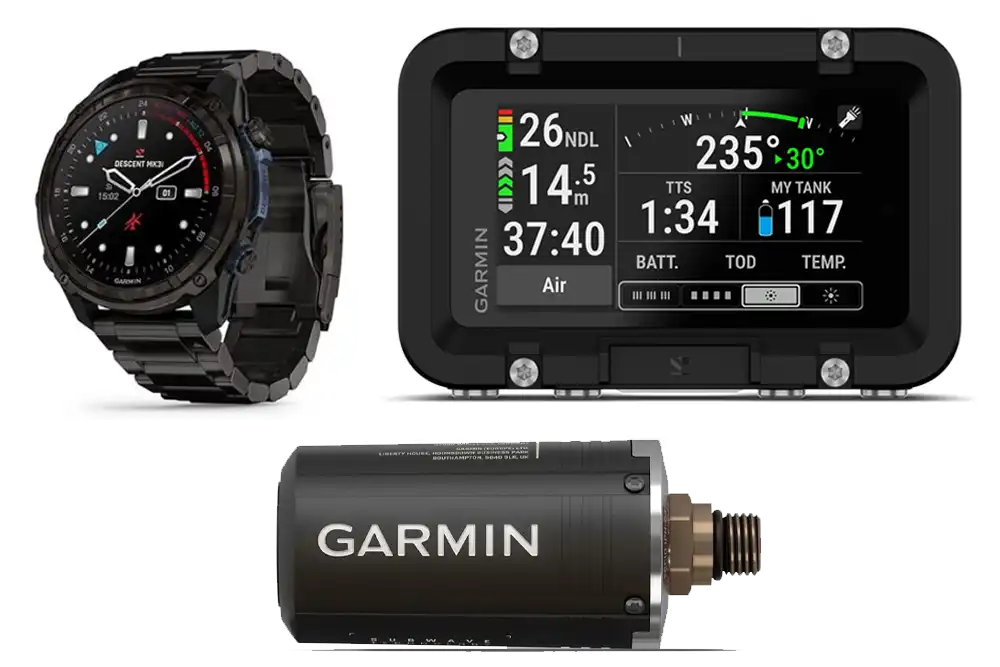
The Descent S1 is the latest addition to Garmin’s underwater communications ecosystem, joining the Descent Mk3i smartwatch-style dive computer and its large-format cousin, the Descent X50i.
When paired with a Descent T2 transceiver, up to eight computers can be networked together using Garmin’s proprietary SubWave sonar communications technology.
Divers within a 30-metre range can monitor each other’s tank pressures, depth and distance, and communicate via a selection of preset messages.
The Descent S1 extends the range to 100 m, but the new buoy can also be linked via Wi-Fi to a smart device at the surface. For the first time in recreational scuba diving history, two-way wireless communication between divers and surface support teams is possible, using a system that is readily available on the open market.
Boat crews can track divers, monitor air supplies and warn of changing surface conditions. Underwater, divers can keep tabs on their position relative to the buoy, and each other, as long as there are no large objects between them.
Should a diver have a problem underwater, they can broadcast a message to both their buddy team and surface support. Should boat crews need to recall their divers, there’s no longer any need to bang a hammer on a ladder – instead you can just send a message into the depths from the captain’s phone.
THE TEST DIVE
The cream of the scuba diving media had been invited to trial the Descent S1 at the fantastic flooded quarry that is Fantasy
Lake Adventure Park near Raleigh, North Carolina, USA. We are split into groups and each loaned an X50i for use in the demonstration, then paddle out to a shot line to which the small and unassuming buoy is tied, and descend to await further instructions.
With an audible ping and haptic buzz notification, the order from the surface, ‘Proceed with dive’, appears on the screen, then ‘Follow me’, from our guide, Jessi. We set off and as I repeatedly glance at the very intuitive X50i’s display, I watch the world of scuba diving change.
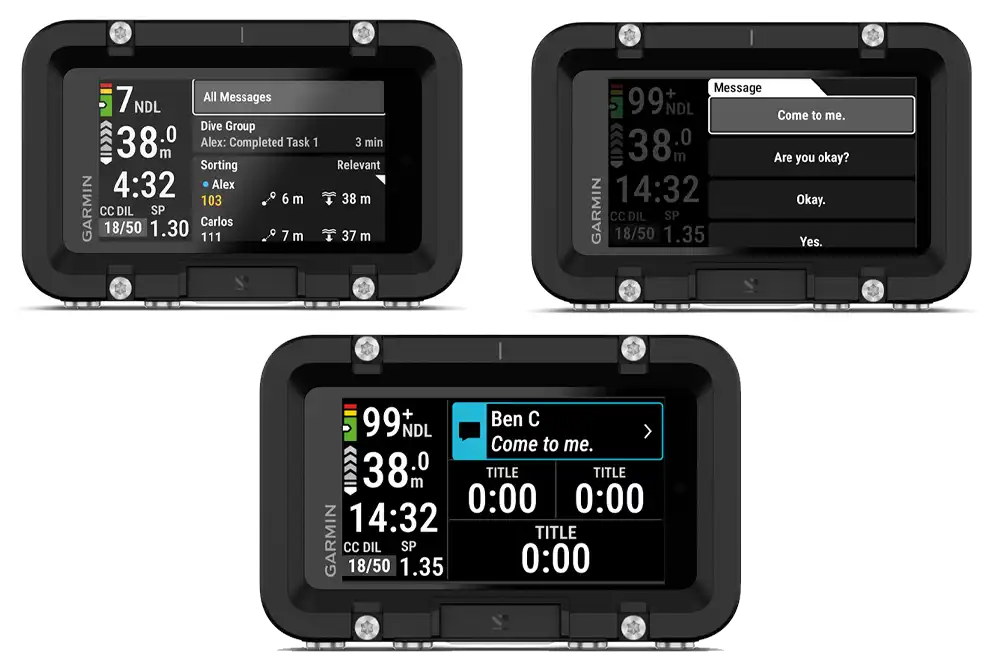
Partitioned neatly on the screen next to the dive data are the tank pressures of the other divers, our current bearing and a prominent blue arrow on a circular dial pointing the way back to the buoy. Messages pop up over the top without compromising important data.
Jessi has been tasked with taking us to three of Fantasy Lake’s attractions – a sunken school bus, an aircraft and a basketball hoop. After each, she broadcasts a ‘Task complete’ message to the divers and the surface team.
Halfway through we receive a message telling us to ‘Turn the dive’, and after shooting some hoops with bowling balls (great fun!) Jessi messages the surface: ‘Task 3 complete’.
‘Proceed to exit point’, comes the message from the surface. By now I’ve figured out the menu system and select an ‘Okay’ in response, as I turn to follow the little blue arrow that points the way home, and leads us right to the shot line, in visibility typical of a flooded quarry (ie not the best).

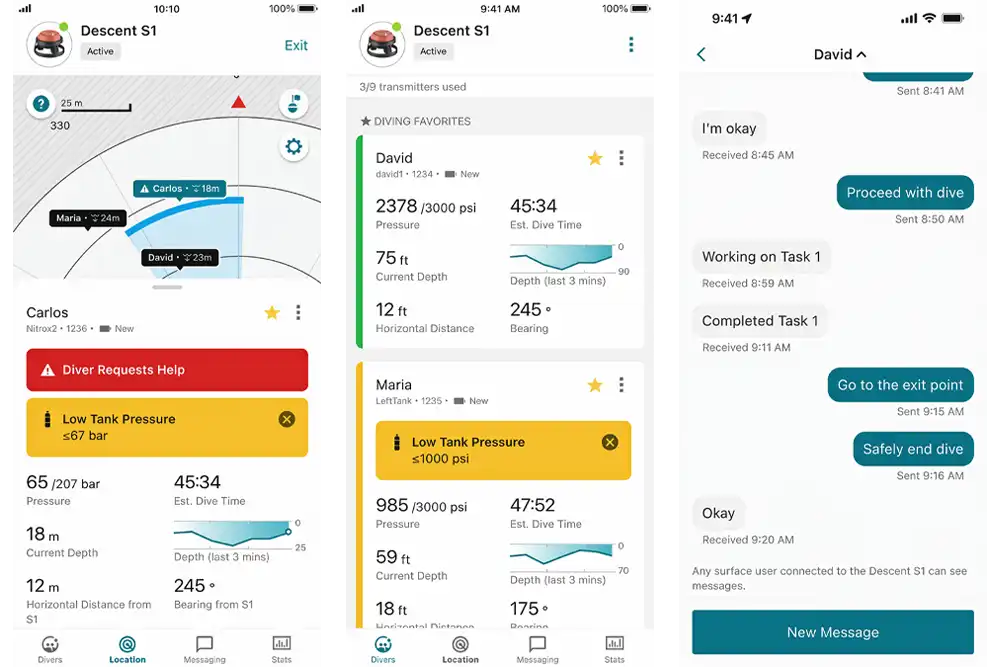
Back on land, we watch as the surface support, in the form of Product Manager Ben Collins, dive product manager, uses his paired smartphone to issue commands and receive responses via the Garmin Dive app. Each diver’s position is marked on a radar-like display; tank pressures clearly displayed with amber warnings appearing as tanks run low.
NEW DIVE POSSIBILITIES
Navigation can be challenging even in good visibility. Featureless sandy bottoms, blue water dives, unfamiliar reefs, night dives – there are plenty of times when, as a guide, I would have liked to have had more directional information than a compass bearing.
In areas prone to strong currents or poor visibility, just a few seconds without visual contact between divers can feel like a very, very long time. Being able to see each other’s depth and distance, send an ‘Are you OK?’ and receive a response in return would go a long way to soothing separation anxiety.
As a guide, being able to check a group’s remaining air without asking would be incredibly beneficial. I could tailor the dive profile on the fly so that divers with poor air consumption don’t end the dive too early for the rest of the group. Such divers often become so embarrassed that they will lie about their remaining air – and I’ve dealt with out-of-air incidents as a result.
There are times when I would have loved to have been able to let my captains know that I needed to finish a dive early, or at a different exit point than planned. I would have equally loved to have received warnings from my captains that sea conditions were turning, and we needed to leave the area.
If a diver hadn’t surfaced on time, being able to locate them would ease a lot of potential panic. All of these things are now possible.
WHAT ISN’T POSSIBLE
There are obvious limitations, mostly due to the difficulties of accurate data transmission underwater. The radio waves as used by devices at the surface can’t penetrate water, and although sound waves travel further underwater, they are much slower, which limits the amount of data that can be transmitted in a given time frame.
To overcome this, the messages that can be sent between devices are selected from a preset menu. The set is, currently, quite small and not customisable, so while all the important bases are covered, the practical use of ‘Task 1 completed’ falls a little short in terms of specificity.
On the plus side (and to address some concerns) no, it will not be possible to post to social media from the depths – and thankfully so, as texting while diving would be as dangerous as texting while driving.
Garmin is already working on options for broader message customisation, and the Mk3i and Mk50i are designed to be updated with new developments, so the suite will undoubtedly be improved in time.
Needless to say, all of the above is only possible if divers are using compatible Garmin products. The company is – unsurprisingly – keeping the technology firmly in-house, but said it would consider marketing a ‘liveaboard kit’ consisting of a buoy, transceivers and a computer, which an operator could use to track and monitor divers regardless of their computer brand preference.
REVOLUTIONARY INNOVATION
Diver tracking and underwater communications are not entirely new concepts, but Garmin has produced the first feature-rich system to tackle both, in a package that is easily accessible to all divers.
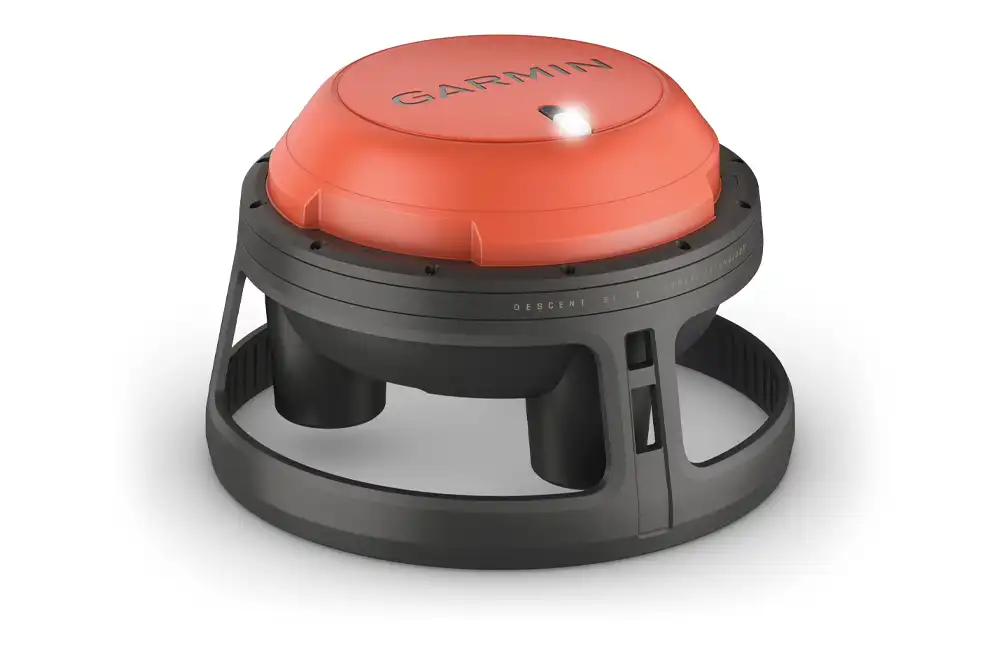
At just 20 cm in diameter by 13.5 cm in height, the Descent S1 is small enough to pack into cabin baggage, making it easily portable for travelling dive groups seeking an extra layer of security.
At £2,200 ($2,500) it doesn’t come cheap, but the innovation behind the system justifies the price tag. Garmin didn’t enter the dive market until 2017, and yet in less than a decade has developed a system that stands to revolutionise the world of scuba diving. The future of diver safety is here.
MSRP Garmin Descent S1 communications buoy: £2,129.99/$2,499.99
www.garmin.com
More from Garmin

- Aggressor Adventures to announce new destination at DEMA Show 2026 - 16 October 2026
- Ancient shipwreck discovered off Turkey could be world’s oldest - 15 October 2026
- Divemaster missing after dive boat sinks in Komodo National Park - 14 October 2026
