


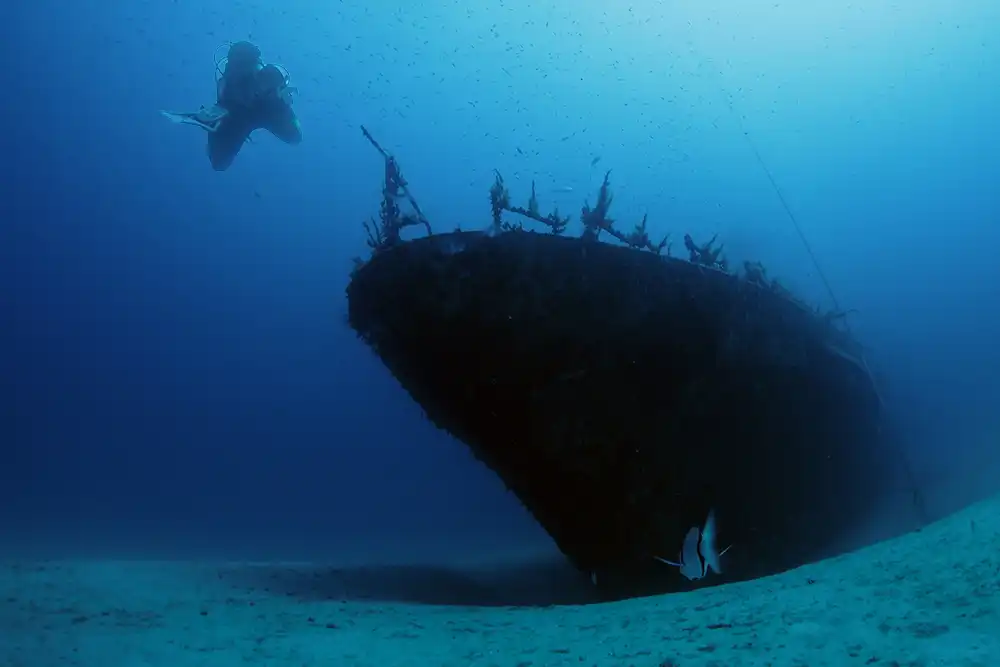
A British scuba diver who died while diving the wreck of the P29 off Ċirkewwa, Malta, in October 2024 died as a result of ‘diving-related pulmonary barotrauma’ after making a rapid ascent, according to the results of an inquest into his death.
The inquest into the death of Darrel Pascoe, 66, a retired carpenter from Newquay who lived in Truro, Cornwall, was held on 5 January at Cornwall Coroner’s Court.
The Court heard that on 12 October 2024, Pascoe was diving with a buddy on the 30-metre-deep wreck of the P29, a former East German minesweeper scuttled off Ċirkewwa when, about three minutes into the dive, he signalled that he wanted to ascend.
Pascoe reportedly made a direct, rapid ascent to the surface, without a safety stop, where he went into cardiac arrest. His dive buddy and another person pulled him to shore, where they called for emergency assistance and began CPR.
Emergency responders transported Mr Pascoe by ambulance to Mater Dei Hospital, where he was pronounced dead shortly after arrival.
Evidence given to the inquest by consultant pathologist Thomas Grigor of the Royal Cornwall Hospital, stated that Mr Pascoe died from pulmonary barotrauma – a lung overexpansion injury caused when a diver does not exhale during ascent, or when air becomes otherwise trapped in the lungs.
The inquest was told that Pascoe had not dived for 18 months prior to the incident, and that autopsy results found that he had an undiagnosed heart condition.
While Malta’s diving regulations require all divers to answer a medical questionnaire prior to diving, a fitness-to-dive medical is not mandatory unless the diver has a known medical condition.
However, Mr Grigor told the inquest that a medical examination may not have found Mr Pascoe’s heart condition, and that it likely only played a minor part in his death, adding that it was ‘impossible to say if Mr Pascoe would have survived the incident if he didn’t have a pre-existing heart issue.’
Assistant Coroner for Cornwall Guy Davis concluded that Mr Pascoe ‘died from diving-related pulmonary barotrauma after making a rapid ascent during a diving expedition,’ adding that the reasons for making the rapid ascent remained unknown.
Related articles
