


A deep-sea research expedition led by Argentine researchers aboard the Schmidt Ocean Institute’s research vessel Falkor (too) has found that the waters off Argentina support far richer and more complex ecosystems than previously thought.
Using the Institute’s remotely operated vehicle, ROV SuBastian, to explore deep-water habitats at depths of almost 4,000 metres, the team’s findings include one of the world’s largest known cold-water coral reefs, one of the world’s largest and rarest jellyfish, and a number of organisms thought to be new to science.
The reef identified by the expedition is the largest known formed by the cold-water coral Bathelia candida. Covering at least 0.4 square kilometres, the reef was found approximately 600 kilometres (370 miles) further south than the species had previously been recorded.
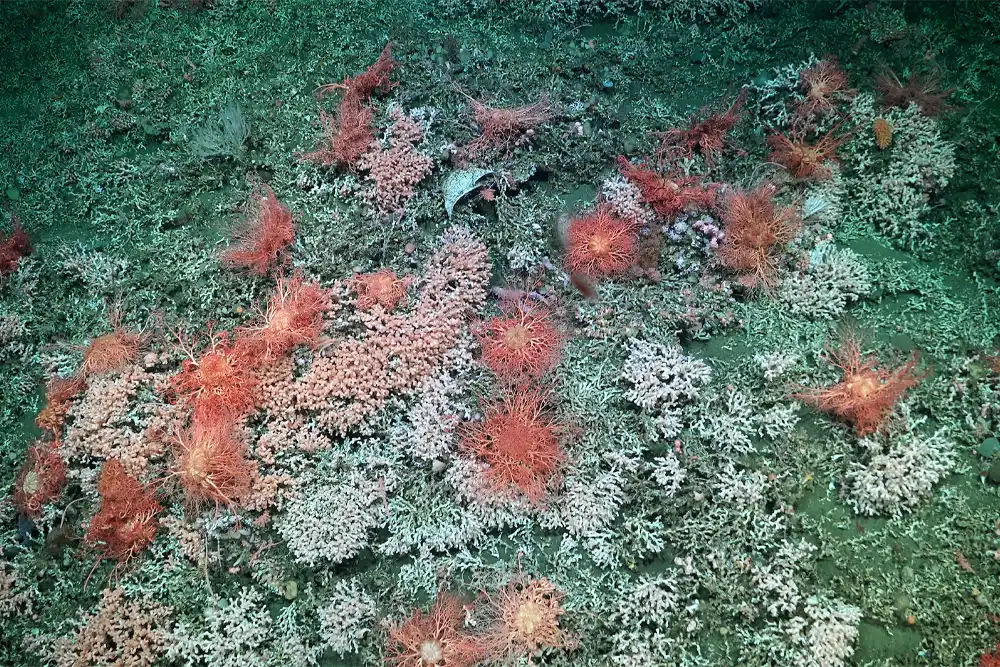
Its size and location suggest that suitable conditions for reef-forming corals in the South Atlantic may be more widespread than modelling had previously indicated.
The expedition also documented Argentina’s first confirmed deep-water whale fall at a depth of 3,890 metres. Whale falls – when the carcass of a dead whale sinks to the seabed – are rarely observed, but shed important light on the deep-sea environment as they create a source of nutrients that can sustain specialised scavengers and microbial communities for decades.
In total, scientists recorded 28 organisms thought to represent previously undescribed species, including worms, corals, sea snails, sea urchins and sea anemones.

‘We were not expecting to see this level of biodiversity in the Argentine deep sea, and are so excited to see it teeming with life,’ said the expedition’s chief scientist, Dr María Emilia Bravo of the University of Buenos Aires and Argentina’s National Scientific and Technical Research Council (CONICET).
‘Seeing all the biodiversity, ecosystem functions, and connectivity unfolding together was incredible. We opened a window into our country’s biodiversity only to find there are so many more windows left to be opened.’
Included among the most notable finds in the footage captured by ROV SuBastian was a rare sighting of a giant phantom jellyfish (Stygiomedusa gigantea), one of the largest of all known jellyfish, which is seldom observed alive.
The phantom jelly’s bell can reach around one metre in diameter, and its four arms can extend up to 10 metres in length. Although it does not possess stinging cells, the length and width of the arms enable it to capture prey in the sparsely populated depths.
One of the main targets of the expedition were ‘cold seeps’, where methane and other chemicals seeping from the sea floor are converted into energy by microbes, which in turn become a source of sustenance for other animals, such as clams, mussels, and tube worms.
The largest cold seep found by the expedition measured one square kilometre, an important find which will enable further studies to be carried out on a poorly understood environment.
Despite the depth and remoteness of the exploration, the scientists inevitably came across a fair amount of observed human debris on the seafloor, including fishing gear and plastic waste, highlighting the extent to which anthropogenic impacts reach even the deepest marine environments.
‘With every expedition to the deep sea, we find the Ocean is full of life – as much as we see on land, and perhaps more because the Ocean contains 98 per cent of the living space on this planet,’ said Schmidt Ocean Institute’s executive director, Dr Jyotika Virmani.
‘We have been privileged to work with outstanding scientists across three expeditions in Argentinian waters, and look forward to seeing their research continue to unfold, unlocking new understanding and inspiration.’
Many of Schmidt Ocean Institute’s dives are streamed live, enabling scientists and citizens around the world to observe the discoveries in real time. To learn more, follow the team on Facebook @SchmidtOcean, X @SchmidtOcean and Instagram @schmidtocean, and on the schmidtocean.org website and YouTube channel.
Related articles
