


Scientists from the California Academy of Sciences have identified 20 new species and recorded evidence of warming trends in deep coral reefs following the retrieval of long-term monitoring devices from waters off Guam.
The findings are the result of two-week expedition in November 2025 to recover 13 autonomous reef monitoring structures (ARMS), which had been passively collecting biodiversity and temperature data at depths of up to 100 metres (330ft) since their deployment in 2018.
The project was carried out in collaboration with the Smithsonian Institution’s Global ARMS Program. Scientists from the University of Guam, the University of São Paulo and the Bishop Museum also took part.
ARMS are stacks of one-foot-square PVC plates designed to function as artificial reef habitat, allowing marine organisms to settle and grow over long periods.
Once retrieved, the structures were transported to the University of Guam Marine Lab, where specialists identified, photographed and collected each specimen found on the plates. The remaining encrusted material was scraped off and sent for DNA analysis.
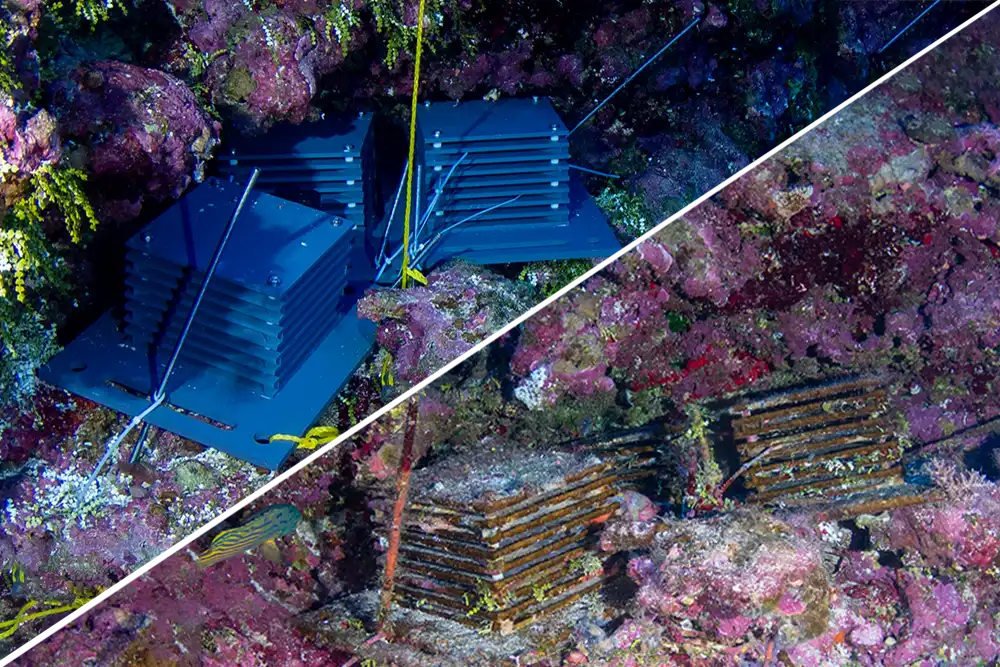
Scientists collected around 2,000 specimens during the Guam expedition. Initial analysis recorded 100 species previously undocumented in the region, 20 of which may be completely new to science.
The team also recovered three years of temperature data from the upper twilight zone, between 55 and 100 metres below the surface.
Luiz Rocha, curator of ichthyology at the California Academy of Sciences, said the ARMS provided a rare long-term view of deep reef ecosystems.
‘The autonomous reef monitoring structures, or ARMS, that we recently retrieved in Guam are essentially small underwater hotels that coral reef organisms colonise over time,’ Rocha said.
‘As deep-reef scientists, our biggest limitation in studying the mesophotic zone is time, due to the long decompression needed to ascend. While we humans can only spend 15-25 minutes surveying at these depths, ARMS have been collecting data 24/7 for eight years.
‘This long-term snapshot of deep reef biodiversity is unparalleled, revealing everything from never-before-seen species to evidence of a clear and steady warming trend at depth,’ said Rocha. ‘Understanding twilight zone ecology, connectivity, and vulnerability is essential for effective conservation planning in a rapidly changing ocean.’

The Guam expedition marks the first stage of a two-year retrieval programme to collect 76 ARMS deployed across deep reefs in the Pacific. Further retrievals are planned at sites including Palau, French Polynesia and the Marshall Islands.
The resulting data will contribute to the most comprehensive baseline of upper twilight zone biodiversity assembled to date, and will also improve understanding of thermal conditions at depth, where temperature records are limited.
The work is linked to global species discovery initiatives, including the Nippon Foundation–Nekton Ocean Census partnership, which will host a workshop to classify the new species once DNA results are available.
Robert Lasley Jr, curator of crustacea at the University of Guam, said the volume of data recovered exceeded previous records for the region.

‘This approach captures a remarkable diversity of marine life that cannot be obtained any other way,’ said Lasley. ‘Two weeks of processing the ARMS plates yielded more data and species records than we’ve ever seen before in Guam at these depths, including cryptic invertebrates and previously undocumented communities.
‘Our findings highlight the complexity and richness of mesophotic ecosystems and underscore their need for protection.’
For Rocha, the findings underline the importance of documenting deep reef ecosystems.
‘More than half of the species that live in deep reefs are unknown, yet these reefs are already being affected by fishing, pollution, and climate change,’ he said.
‘Most marine protected areas only cover shallow reefs, pushing human-driven pressures towards deeper waters. Our goal is to show just how beautiful, unique, and valuable these ecosystems are so we can safeguard them before it’s too late.’
Related articles
