


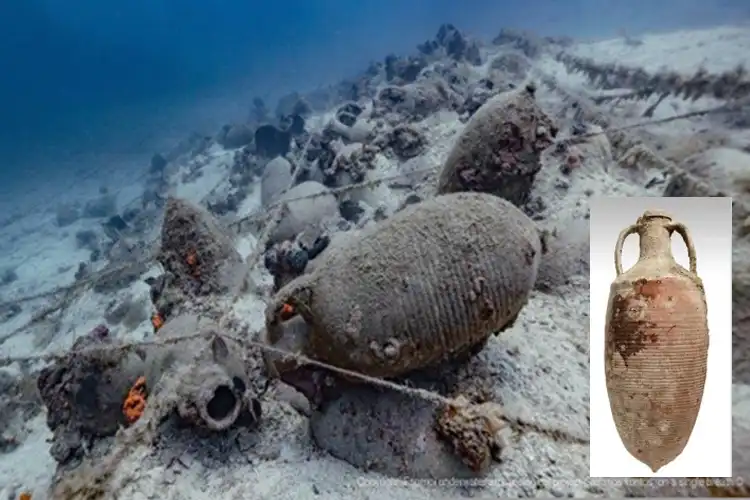
Greece’s Ministry of Culture has announced the creation of two new underwater archaeological sites that will be opened to divers in the North Aegean.
The sites, located at Akra Fygou (Aspros Kavos) on Fourni and Vathylakas Bay on the neighbouring island of Thymaina, form part of the Fourni Korseon archipelago near Ikaria.
Both will operate under formal regulations governing the protection of antiquities and the conditions for recreational diving.
‘The Ministry of Culture has set as its priorities the protection, promotion and exploitation of the underwater cultural heritage of our homeland, which is particularly rich in the number of archaeological sites and shipwrecks and is particularly diverse,’ said the Greek Minister of Culture Lina Mendoni.
‘The delimitation and establishment of two visitable underwater archaeological sites in the marine area of Fourni Korseon, near Ikari constitutes an important step in the protection and organised access of the public to the underwater cultural heritage of the North Aegean.’

Mendoni added that the initiative forms part of a broader strategy combining research, conservation and tourism.
‘This initiative is part of the broader development model of sustainable exploitation of the marine cultural reserve of our homeland, which combines scientific research, the protection of antiquities and the qualitative development of diving tourism,’ she said.
Systematic underwater research in the Fourni archipelago began in 2014, led by the Ephorate (Directorate) of Underwater Antiquities with support from the RPM Nautical Foundation, a non-profit organisation specialising in archaeological research in the Mediterranean.
Surveys conducted between 2015 and 2025 documented 62 shipwrecks across Fourni, Thymaina and nearby islets, dating from the 6th century BC to the early 20th century.
‘Fourni is today one of the most important underwater archaeological sites in the Mediterranean,’ Mendoni said. ‘The systematic research of the Ephorate of Underwater Antiquities has brought to light dozens of shipwrecks, dating from the 6th century BC to modern times, documenting the timeless maritime and commercial importance of the region in the Aegean.’

The first of the new dive sites at Akra Fygou includes seven documented shipwrecks arranged across four marked diving routes, with maximum depths ranging from 23m to 41m.
The wrecks span multiple historical periods, from the Archaic era to late antiquity, and include cargoes of amphorae originating from across the Aegean and Black Sea.
Among them is a wreck from the 6th century BC carrying Samian amphorae, the earliest identified in the area, and a vessel from the 5th–6th century AD that was transporting amphorae from Crimea, Sinope and Heraclea Pontica.
Among the finds is a cargo of carrot-shaped amphorae from the Black Sea city of Sinope, the only such cargo so far discovered in the Mediterranean.
The second site at Vathylakas Bay features three documented wrecks and a wider area of scattered archaeological material, including anchors and ceramic deposits, indicating sustained maritime activity from the Hellenistic through to the Roman period. Four planned diving routes will extend to depths of between 32 and 70m.

One of the deeper wrecks, dating to the 4th century AD and lying between 54m and 67m, is described as being in near-pristine condition.
Its cargo includes amphorae from North Africa, southern Spain and Portugal, reflecting extensive trade networks of the late Roman period.
The Ministry said the creation of the two sites will allow ‘safe and organised access for divers to a unique underwater archaeological landscape, while ensuring the protection of the monuments.’
The Fourni archipelago has been designated as a protected underwater archaeological zone, with 24 individual sites formally demarcated in 2025.
Related articles
