


A student participating in the scuba diving training session during which 12-year-old Dylan Harrison drowned on 16 August has come forward to describe how the events leading up to her death unfolded.
The Fox4 interview with Ted Sickels raises serious questions about instructor William ‘Bill’ Armstrong’s fitness to conduct a course that day, and the subsequent handling of critical evidence.
Sickels is described as a diver with ‘decades of Caribbean diving behind him’, who joined the training session ‘to obtain his US certification’. It is unclear as to which certification level he was trying to obtain that day, although it is known that Armstrong is a NAUI-certified instructor and was conducting a NAUI-sanctioned course.
Sickels gave an initial account to police officers and later filed a detailed written statement, but has chosen to speak out publicly following the international furore over Dylan’s death and details surrounding Armstrong’s conduct that day.
‘[Armstrong] arrived after all the other students had arrived’, said Sickels. ‘When he got there it was kind of hurried at that time. He arrived with his wife [but] his demeanour wasn’t as jolly as it usually was. He wasn’t joking around as much as he was in the class.’
What none of the students could be aware of was that Armstrong — an assistant chief deputy with the Texas-based Collin County Sheriff’s Office — had worked a full day shift in his role as a police officer before starting on overnight shift at his second job as a security guard for an investment firm from 9pm to 6am.
The scuba course he was conducting that day was scheduled to run from 8am to 5pm.
A student in difficulty
The class initially descended to a 5m-deep platform at the Scuba Ranch – an inland dive site in Terrel, Texas – using a buoy line, but Sickels said he immediately noticed the 12-year-old struggling.
‘She was not neutrally buoyant,’ he said. ‘She was having to hold onto the rail of the platform. She was not floating like the rest of us.’
Later in the dive, Sickels says he misunderstood a hand signal and ascended to the surface, leading Armstrong to bring the rest of the group to the surface as a result.
A photograph taken when the group surfaced would, tragically, become the last image ever captured of Dylan alive.
Armstrong then instructed the class to descend again to 5m (15ft) to make a simulated safety stop, but this time without using the buoy line.
‘He resubmerged the whole entire class as a group,’ said Sickels. ‘They got a head count. The head count was off by one. Bill went back down to see if maybe she was on the platform.
‘And I’m sitting there, I’m wondering, “Okay, why are you going down there to see if she’s on the platform? We’re not over there on the platform.”’
Armstrong’s divemaster, Jonathan Roussel, searched for bubbles at the surface while Armstrong searched underwater. Armstrong surfaced once to report he was unable to find Dylan, before descending again and returning a second time, without success.
At this point Sickels says Armstrong asked one of his students to call for an ambulance and exited the water.
Why are you not doing anything?

‘This keeps playing over and over in my head, every night,’ said Sickels. ‘I’ve probably woke up at least 50 times since that night.
‘It was Bill standing on the dock and Dylan’s mother screaming, “Why are you not doing anything? Dylan is afraid when she is alone in the house in a thunderstorm!”
‘And Bill turned around and looked at her and said, “We are doing everything we can. She’s got plenty of air in her tank. As long as she keeps her regulator in her mouth, we will find her, and she will be okay.”’
Sickels said Armstrong then left the water and got into a car to look for help around the lake — a decision he continues to question.
‘Where in the hell is he going? He is a certified rescue diver. Why is he not here leading?’
Unanswered questions
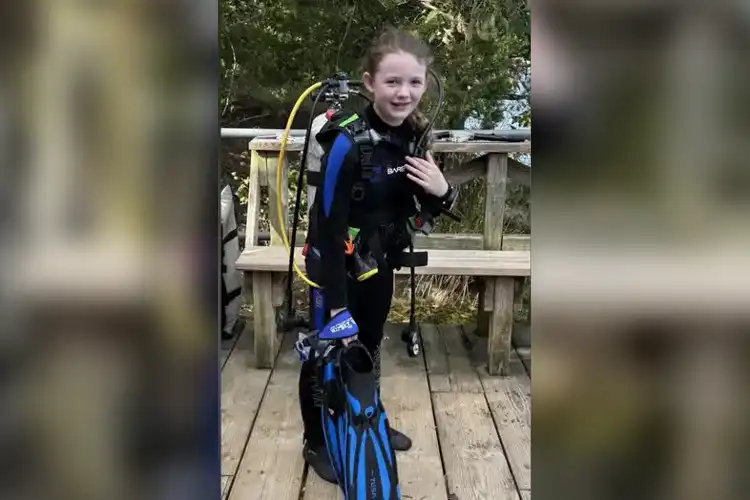
In his initial statement to the police, Armstrong said that the group had descended one by one using the buoy line. News reports at the time suggested that this was contradicted by a statement from one of the other students, which Sickel’s public statement has now confirmed.
Dylan’s body was found after just 7 minutes at a depth of around 12m (45ft) by a diver from another group that was participating in an instructor course at the Scuba Ranch on the same day.
In the aftermath of the tragedy, it has become apparent that data from dive computers used by the students – which would provide clarification as to the manner of the group’s descent, and what happened to Dylan as she drowned – was never recovered by the local police department.
A computer belonging to divemaster Roussel – which also may have aided the investigation – was susequently lost.
William Armstrong has since resigned from the Collin County Sheriff’s Office, but questions over Armstrong’s conduct both before and during the course remain unanswered – including whether or not he was fit to supervise the course after having barely slept for 24 hours.
The Kaufman County Sheriff’s Office, which is investigating the circumstances of Dylan’s death, has confirmed that the case remains an open criminal investigation.
Related articles
