


Archaeologists have uncovered a remarkably well-preserved 2,000-year-old shipwreck off the coast of Alexandria — believed to be one of Egypt’s ancient ‘pleasure barges’, or thalamagoi, used for ceremonial and leisurely voyages in the great harbour of the Ptolemies.
Discovered in the submerged Port of the Royal Island of Antirhodos — once part of Alexandria’s vast Portus Magnus — the wreck was found during excavations led by the Institut Européen d’Archéologie Sous-Marine (IEASM) under the direction of Franck Goddio.
According to IEASM, the preserved timbers measure around 28 metres, corresponding to an original vessel approximately 35m long and 7m wide. The flat-bottomed hull, with a hard chine at the bow and a rounded stern, appears to have been designed to maximise breadth for a central pavilion — a signature feature of these luxurious ceremonial craft.
Graffiti in Greek discovered on the vessel’s central carling dates the wreck to the first half of the 1st century AD. The inscriptions support the hypothesis that the boat was built in Alexandria and would have featured a lavishly decorated cabin. Evidence suggests she was propelled solely by oars.
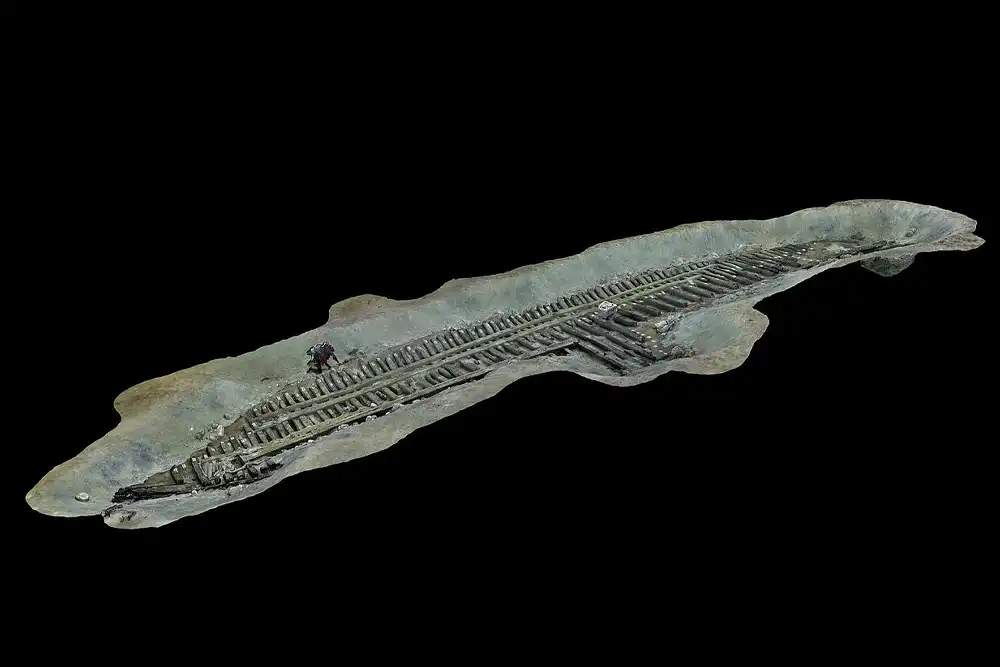
Franck Goddio said: ‘This is extremely exciting, because it’s the first time ever that such a boat has been discovered in Egypt.’ He noted that the vessel’s configuration ‘corresponds closely to the ancient descriptions of thalamagoi, barges designed for leisure or ritual use along Alexandria’s waterways.’
The ancient geographer Strabo, who visited Alexandria around 29–25 BC, offers one such description in contemporary work Geography, writing: ‘…they hold feasts in cabin-boats (thalamagoi), in which they enter the thick of the cyami and the shade of the leaves.’
Goddio has proposed an additional interpretation of the wreck’s final moments. ‘This intriguing shipwreck could have been used along the canals in Alexandria as Strabo described, but as it was also found very close to our excavations on the temple of Isis on Antirhodos Island, it could well have sunk during the catastrophic destruction of this temple around AD 50,’ he said.
‘We might thus also suggest a ritual use for this barge – it could have belonged to the sanctuary and been part of the naval ceremony of the navigatio Iside. In this yearly procession celebrating Isis, a richly decorated vessel represented the solar barque of the goddess, mistress of the sea.’
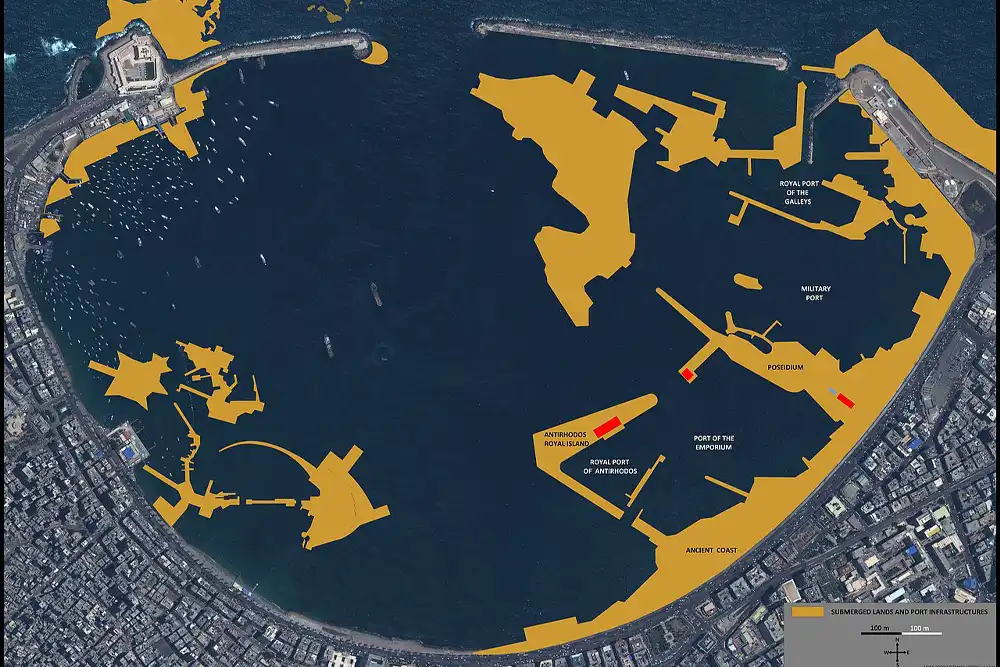
The festival vessel — known as the Navigium — would have travelled from Alexandria’s Portus Magnus to the sanctuary of Osiris at Canopus along the Canopic Channel. The position of the wreck, combined with its design and dating, strengthens this ritual interpretation.
Although research on the wreck is in its early stages, Goddio said the vessel offers ‘a fascinating glimpse into life, religion, luxury and pleasure on the waterways of early Roman Egypt’. He added that iconography of thalamagoi survives in several artworks, including a depiction in the Nile mosaic of Palestrina, showing noblemen hunting hippopotamus from similar cabin-boats.
Some of the most famous thalamagoi were the floating palaces of the Ptolemies, including Cleopatra VII’s barge, which she used to tour Julius Caesar through the sights of Egypt in 47 BC.
For more than three decades, Goddio’s team has mapped the drowned royal quarter of Alexandria, uncovering palaces, temples and harbour structures lost to earthquakes and subsidence. This latest find adds an unprecedented new dimension: the first archaeological example of a pleasure barge once described in historical texts but never before identified.
Related articles
