


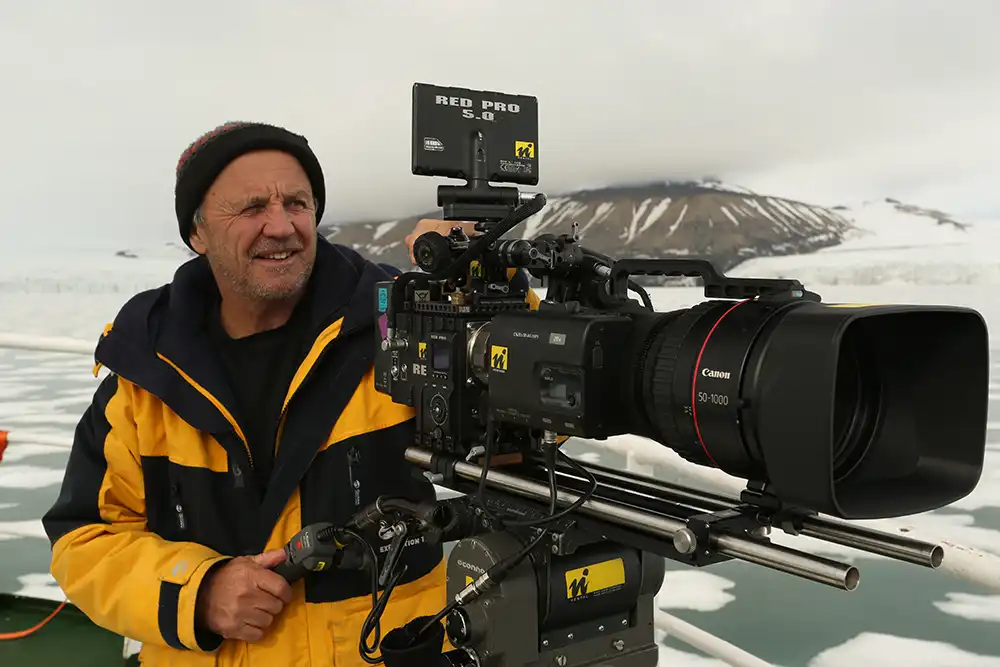
World-renowned underwater cameraman Doug Allan fell in love with the ocean at an early age, and has since gone on to create some of the most iconic underwater footage ever filmed
‘I first stuck a mask on my face when I was about ten years old,’ says Douglas Allan, describing in his broad Scottish accent the moment his love for the underwater world began.
‘I remember a man going in the water with a mask, and when he came out, he saw me watching and asked if I would like a wee look – and that was it – I was hooked.’
Today, 68-year-old Allan is one of the world’s most highly regarded wildlife cameramen, particularly for his work under the ice.
With a long list of awards to his name, Allan has captured some of the most iconic footage of marine wildlife ever broadcast – such as hunting orcas washing seals off ice floes by generating waves with their tails – and it all began with snorkelling and scuba diving.
Allan learned to dive in his home town of Dunfermline, Scotland, before enrolling at Stirling University to study marine biology.
Deciding early on that life in a laboratory was not for him, Allan sought opportunities that involved both science and diving, eventually landing a job working for the British Antarctic Survey (BAS), where he began to document his life through writing and photography.

Allan had some knowledge of cameras through his father’s career as a photojournalist, but it was the lifestyle rather than the craft that he found appealing. ‘It wasn’t so much that [my father] inspired the photography,’ he says, ‘It was more that he passed on something of the excitement of having a job where you never really knew what you would be doing that week.’
In between Antarctic expeditions, work as a commercial diver in Germany allowed Allan to save enough money to buy a pair of Nikon S2 cameras and underwater housings, and return to Antarctica ‘better prepared.’
It was there, as he neared the end of his second contract with BAS as a diver at Signy base, that a chance meeting with David Attenborough opened the doors for Allan’s career as a wildlife cameraman.
In January 1981, Attenborough, his cameraman, sound recordist and producer were aboard the BAS support vessel HMS Endurance, filming in Antarctica for what would become 1984’s The Living Planet TV series. With his intimate familiarity with the location, scientific knowledge and boat handling experience, it fell to Allan to guide the small crew as they filmed.
‘It gave me a very brief, but the best possible experience, of watching a film crew at work,’ says Allan. ‘And I thought what this cameraperson was doing was a solution to all the things that I liked: travelling, photography, working with people such as David. It was clear that they were having a fantastic time and really enjoying themselves.’
Attenborough’s visit sparked Allan’s interest in moving from still photography to movies. ‘They gave me some very sensible advice,’ he says, ‘but they also implied that what I knew about the Antarctic and cold-water diving was fairly unusual and that they had never met anybody quite like this.’

Offered a position by BAS at Halley Base, where he knew a colony of emperor penguins would be in residence over the winter, Allan bought a 16mm camera and pitched the resulting footage to a BBC producer, where it eventually formed half of the first episode of the BBC’s Birds for all Seasons.
Since then, Allan’s work has featured in the BBC’s Blue Planet, Planet Earth, Frozen Planet and Ocean Giants – to name just a few.
‘I was lucky that my first interest, diving, was something that I could attach all these other interests on to,’ says Allan. ‘You can’t be a good underwater photographer without being a good diver,’ he adds. ‘So, I became a good diver, and then I picked up photography, then I moved from stills into movie.’
Allan also presents lectures about his career, experiences and some of the issues facing the planet today. There are, after all, few people better to detail the changes within the natural environment than those who have spent their lives filming it.
‘You cannot visit anywhere consistently or live somewhere where you’re so connected to nature without noticing the changes,’ he says.
Allan’s latest lecture Wild Images, Wild Life will be touring UK theatres between 16 September and 1 December. Allan will talk about his filming expeditions, from the tropics to the poles, with behind-the-scenes accounts of how the footage was obtained.
‘There’s going to be some funny bits in it, there’s going to be some dramatic bits in it,’ says Allan. ‘If you like those ten minutes at the end of some of the big series that tell you how we do things, then you certainly won’t be disappointed coming to my show.’

