


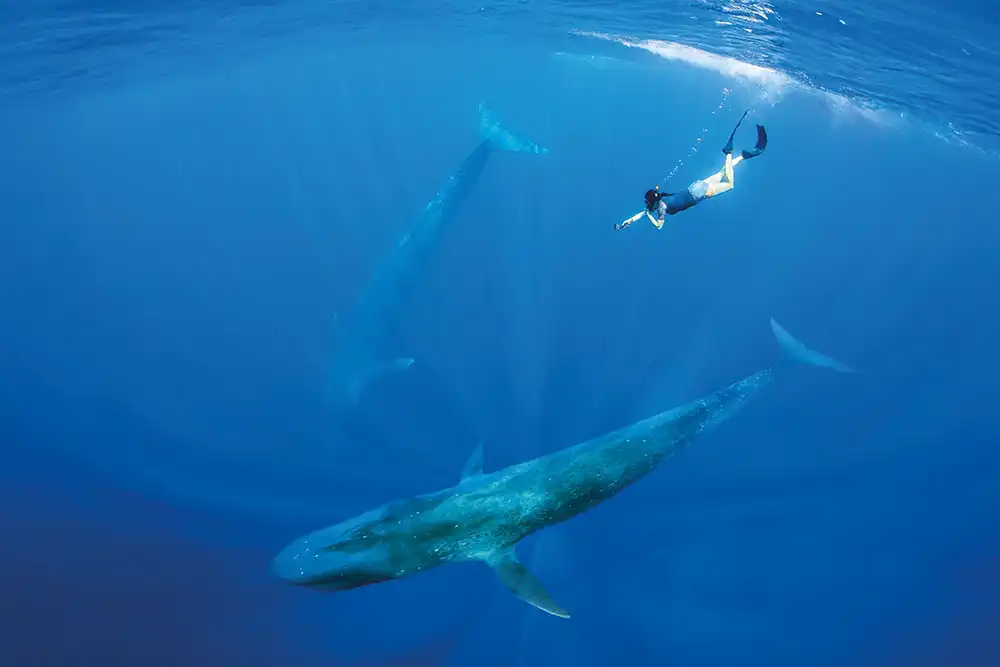
Each year, hundreds of pygmy blue whales pass Timor-Leste on their migration route to Australia – a privileged few get the chance to swim with them
Words and photographs by Josef and Lenka Litt
We had been searching for days. Each morning, eager with anticipation, we set out early into the channel between the northern coast of Timor-Leste and tiny Atauro Island. Each day we returned with sunburned faces and no sign of blue whales willing to swim with us.
By the fourth day our excitement had faded into quiet frustration. Then, just as we were beginning to accept yet another empty morning, our luck suddenly shifted: a pod of pygmy blue whales appeared on the horizon.
Moving slowly, as if sizing us up, these enormous animals made their way towards us. We slipped into the water and were instantly immersed in an alien world.
The water was so clear it felt like air, and the sound of their clicks and calls resonated all around. The four adult whales allowed us to swim alongside them for more than four hours as they moved through the channel.
At one point one of them veered away from the group, came within just a couple of metres, turned to her side and looked at us with her beautiful eye. It was a rare moment of profound connection with the most enormous creature in the world.
Timor-Leste is one of the few places on Earth where this unique experience is possible, as pygmy blue whales make their annual migration south towards Australia. One of the four subspecies of blue whales, pygmy blue whales are pygmy in relative terms only, growing up to 24 metres long compared to the 30 metres of their larger cousins.
The animals are following a so-called ‘blue corridor’, a migratory superhighway for marine megafauna that runs alongside Timor-Leste.
Around 600 to 800 pygmy blue whales – the total population of the subspecies is thought to number between 2,000 and 5,000 individuals – breed and raise their calves in the warm waters of Indonesia’s Banda Sea then migrate, along with sperm whales and other species, towards the colder waters of Western Australia to feed. They pass Timor-Leste between October and December each year.

Timor-Leste’s blue corridor
Whales are frequently observed along three main ‘whale swimways’ following Timor-Leste’s northern coast. One runs close to the shoreline, another is about a kilometre out, and the third traverses the middle of the channel between the coast and Atauro Island.
Atauro lies just 25 kilometres north of Dili, the capital of Timor-Leste, but it feels worlds apart – renowned for its peaceful villages, rugged volcanic landscape and exceptionally rich coral reefs, it is often described as one of Timor-Leste’s ecological treasures. Occasionally, you can even see whales passing by from Atauro’s shoreline.
If you wish to swim with them, you will need a bit of luck – not only to be in the right place at the right time, but also to find whales that are not too preoccupied with their migration and willing to share their presence with you.
Luck can be helped, though. Citizen scientists and students map cetacean migration at an observatory near the village of Subaun, about 50 kilometres east of Dili.
They are often the first to spot animals entering the channel and share this information in a WhatsApp group with guides working for whale tourism operators. The guides also share their findings, although they usually wait until their clients have had contact with the whales before informing others.
Timor-Leste does not have a formal legislative framework to regulate whale-watching and whale-swimming tourism. However, local operators have reached an informal agreement that governs the behaviour of boats, guides and tourists during encounters with these creatures.
Skippers’ experience, trained eyes and knowledge of cetacean behaviour determine the success of encounters. They can accurately predict whether a whale will surface or dive and can estimate the direction in which an individual or group will move.
An experienced skipper will steer the boat a safe distance from the whales, ensuring they are not threatened or frightened, giving swimmers enough time to enter the water unnoticed and wait calmly for the animals to approach.
Swimming with and photographing pygmy blue whales
A single group of up to five people can be in the water with the cetaceans. When the group is too large or if people are splashing about too much, you can immediately sense a shift in energy. The whales change course and vanish into the depths without a trace.
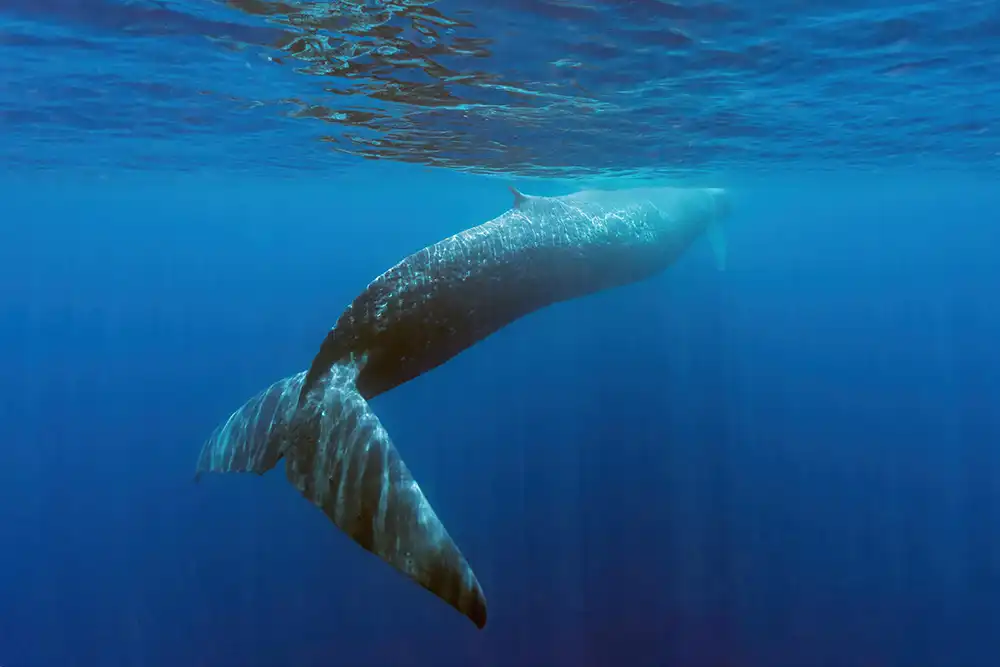
It is humbling how easily they can dismiss us. But during the best drops, when everything aligns – the silence, the spacing, the current – we sometimes caught a glimpse of a swiftly approaching shape in the blue.
One of us would gasp into a snorkel, point, and for a few seconds, we were privileged witnesses to this wonder of nature. People often ask whether such a close encounter is frightening – the answer is no. These creatures are enormous, yes, but their presence feels calm and almost otherworldly. It’s not fear you experience – it’s awe.
When it comes to photographing blue whales, the main challenges are their size, skittishness and constant movement. The visibility in the channel between Dili and Atauro Island is 20–30 metres, but the water contains many particles that reflect sunlight, causing backscatter.
After giving us plenty of time with the pod, our guide changed approach and allowed only two of us in the water at a time. This proved a game-changer for photographers and videographers because the whales came much closer.
They are surprisingly swift, given their size. They undertake their migration with real purpose, so there is about a ten-second window between first spotting an approaching whale and encountering its massive tail as it swims past.

It is therefore critical to move quickly into a good filming spot, usually by diving to a depth of five to ten metres. By the time you reach the surface your lungs are fit to burst.
With larger groups of swimmers, the whales often greet the first couple of snorkellers before diving to avoid the rest. When we swam in pairs, however, they approached as close as one or two metres, continuing their journey close to the surface rather than diving.
We captured the whales with a GoPro Hero11 Black and a 15mm fisheye lens on a full-frame camera to photograph the enormous whale from close range.
In hindsight, a 1.4x teleconverter would have helped enlarge the whale optically when it approached at an angle. We stayed agile by avoiding external strobes and using a small dome port.
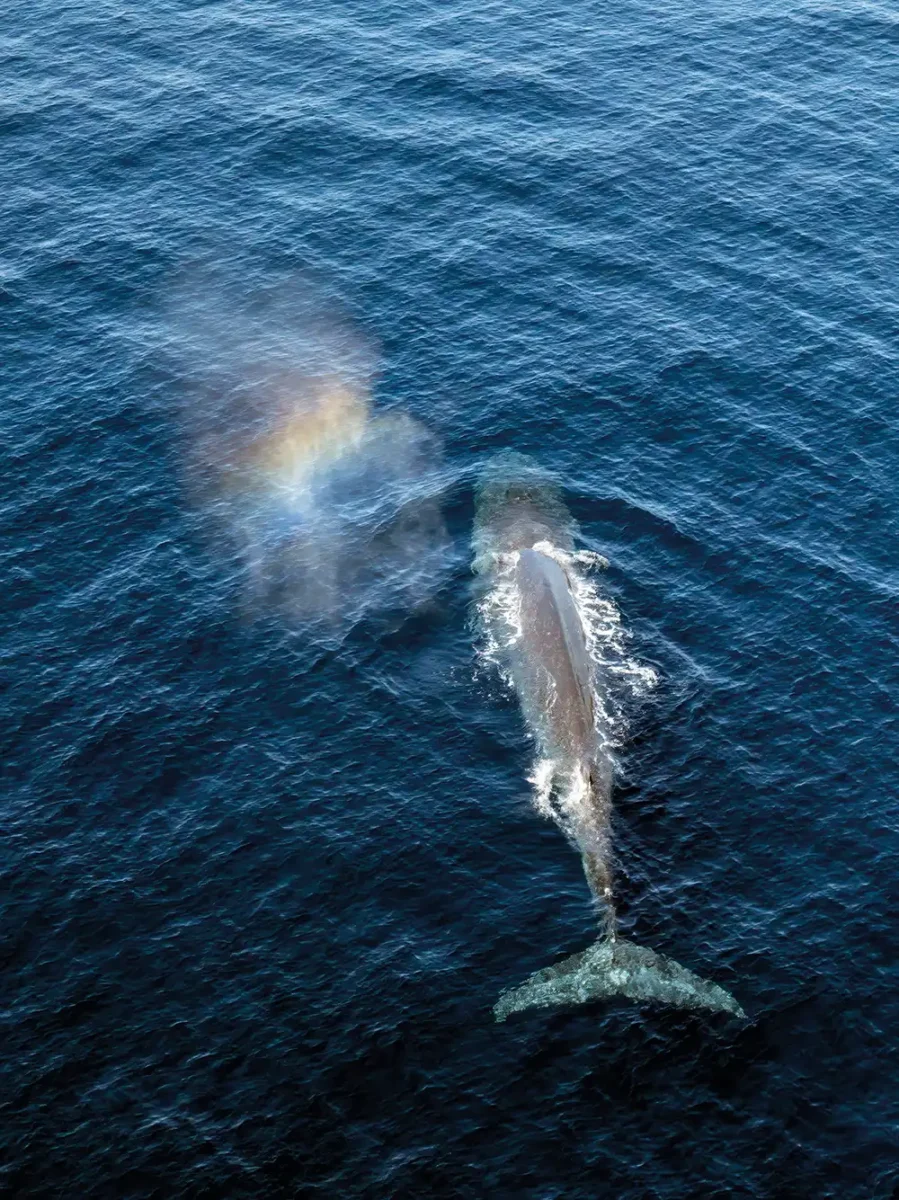
We also filmed from the boat. Drone use is currently unregulated in Timor-Leste, with no restrictions on capturing footage of whales. Because they are constantly in motion, the boat must cover large distances, fast, to keep up.
This was one of the most exhilarating drone shoots we have experienced, as we attempted to locate and lock onto a whale from the air while standing on a swiftly moving boat.
We have not found any official statistics on the frequency and quality of encounters, but when we visited in late November, during the peak whale-swimming season, fellow travellers confirmed two high-quality encounters in the ten days before and during our visit.
To increase the likelihood of meeting cetacean friends, you should book four or five half-day trips and bring freediving fins so you can move fast in the water.
Whales under threat
Recent scientific evidence underscores whales’ vital role in sustaining ocean health and, consequently, the health of the entire planet.
Whales help control the climate by absorbing carbon throughout their lives – a single individual can sequester as much carbon as thousands of trees. Their excrement fertilises the oceans, encouraging the growth of phytoplankton, which produces more than half of the world’s oxygen.
Economists estimate the value of a single whale to be more than US$2 million, with the total value of the global population of large whales exceeding US$1 trillion.
Whales face many threats. They are hit by ships, mistake plastics for food, and ingest microplastics through their prey. Noise from shipping, oil and gas extraction and industrial activity can mask their communication and interfere with their ability to find food or mates.
High-intensity noise, such as military sonar, can disrupt their inner ear, leading to temporary or permanent hearing loss. The loud sounds can cause whales to panic and surface too quickly, leading to decompression sickness or even death.

Iceland, Japan and Norway still engage in commercial whaling. Meanwhile, Denmark’s dependencies, the Faroe Islands and Greenland, along with Native Americans, continue to hunt whales for cultural reasons, with 1,213 whales killed for commercial or scientific reasons and 369 killed for tradition, in 2023.
Approximately 300,000 cetaceans, large and small, die each year due to entanglement in fishing nets alone.
The fight back has begun. Protecting migration routes like the one we visited is key to cetacean conservation. In 2022, the WWF and partners published the first comprehensive report on whale migrations and the threats they face.
Since then, efforts have been made through regional cooperation, including the creation of Protecting Blue Corridors – a project mapping whale and dolphin movement globally and identifying emerging threats.
Without such action it will become increasingly difficult to swim with these gentle giants in their habitat.
We managed to capture some stunning footage during our time with the blue whales but were left hungry for more.
We would love to see a mother and calf – you’re not allowed to be in the water with them, but because they tend to move more slowly than groups of adults, such a pairing could yield some magical drone footage. Perhaps next time.
GETTING THERE
Timor-Leste’s international airport in the capital, Dili, provides connections to Denpasar, Singapore, Melbourne and Darwin. There are one or two flights a day linking Denpasar and Dili.
If you are accustomed to being picked up at the airport by a representative of the diving centre you’ve chosen for your holiday, Timor-Leste will adjust your expectations. Atauro is connected to the mainland by a ferry once per day. If you require transport outside the schedule, you will be instructed to meet a boat on the beach.
This is where we learnt that seaworthiness is a relative term. Anything that floats and doesn’t leak – at least not much – is considered seaworthy in Timor-Leste. Our boat was a low, painfully slow fishing barge. We sat on hundreds of gallons of fuel destined for Atauro Island and ended up drenched to the bone with sea spray, but we made it to our camp safe and sound.
This was not the case on the return journey, where our ride was a battered wooden boat with an engine that was too heavy for the vessel, causing its bow to point skywards. The engine broke down in the middle of the channel between Atauro and the mainland, where we had not choice but to wait two hours for a rescue.
That said, the boats used for whale watching were relatively new, well-maintained and equipped with two engines. We always felt safe. Expect to pay US$250 per person per half-day whale-swimming experience (with no guarantee of sightings).
TOPSIDE
For those seeking entertainment, staying in the capital city, Dili, which is lively with Malaysian culture and bustling urban life, is a good choice. For a quieter experience, you can move to Atauro Island, where the pace of life slows down and the coastline offers peaceful evenings surrounded by nature.
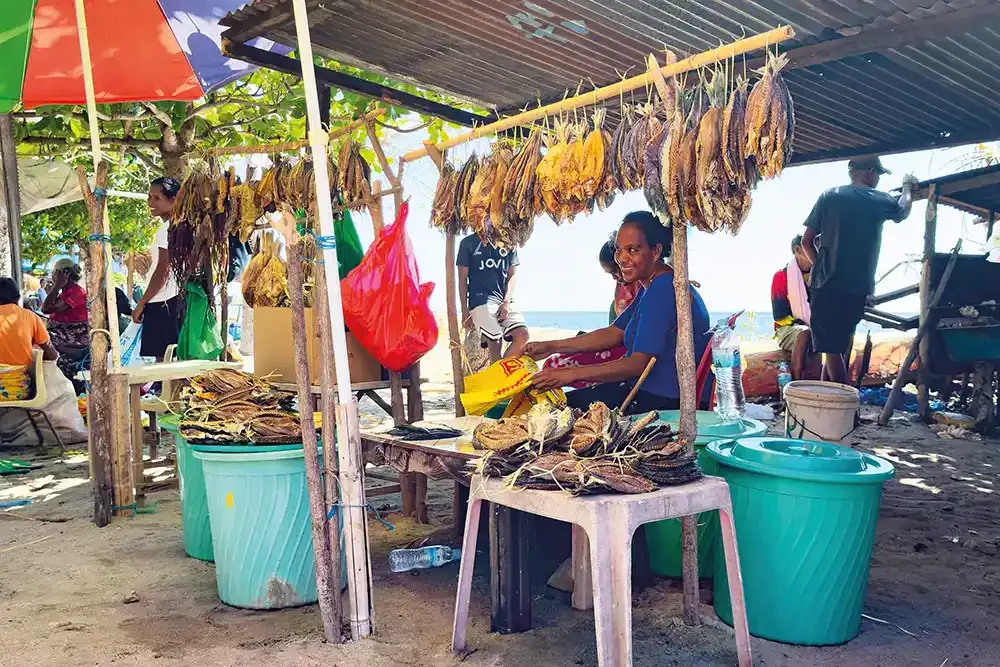
The local market by the pier on Atauro Island, which opens every Wednesday and Saturday at 9.30am, is the main source of supplies for locals and visitors alike. The more adventurous can sample local delicacies such as dried fish and grilled seafood.
More great reads from our magazine
- ‘Rays of Hope’ – an Interview with Karen Fuentes, founder of the Manta Caribbean Project
- ‘Taking Stock’ – expert tips on becoming a stock photographer
- ‘Voyage of Discovery’ – finding new dive sites in Raja Ampat
- ‘Machine learning’ – an interview with Blue Machine author Helen Czerski
- ‘Pierless’ – the myriad photographic opportunities of Barbados’ Cement Pier

Click here to take out a regular yearly subscription
